
Jack Russell Terrier Training Guide: A Realistic 8-Week Plan
A realistic 8-week jack russell terrier training plan built for their big personality — short daily sessions, breed-specific tips, and week-by-week progress to expect.

Written by Bradley Brown
Founder & editor · Reviewed 2026-07-16
If You Only Do Five Things, Do These
Before diving into the week-by-week plan, here's the short list that underpins everything else. Nail these and the rest falls into place:
- Keep sessions to 5 minutes, twice a day. Jack Russells switch off fast when bored — short bursts beat long slogs every time.
- Use high-value food rewards. Kibble won't cut it for a breed this independently minded. Tiny pieces of cooked chicken, cheese, or Fritz work far better.
- End every session on a win. Ask for something your dog already knows, reward it, then stop. They finish confident; you finish sane.
- Manage the environment before the behaviour becomes a habit. A Jack Russell left to practise zoomies, digging, or barking for six months is much harder to redirect than one who never got the run of the place unsupervised.
- Stay consistent, not perfect. One family member letting the dog jump up while another doesn't will stall progress faster than anything else. Agree on the rules first.
Why Jack Russells Need a Slightly Different Approach
Jack Russell Terriers were purpose-bred to bolt foxes from their dens — they needed to work independently, make fast decisions, and persist under pressure. That history lives on in every dog of this type today. It means you're training a dog that is genuinely intelligent, but one whose default setting is self-directed problem-solver, not please-the-handler.
That's not a character flaw. It's not because you've done something wrong. It simply means the standard retriever-focused advice — long sessions, lots of repetition, steady patience — will have your Jack Russell staring at the ceiling within three minutes.
The good news: this breed is extremely food-motivated when the reward is good enough, learns quickly when the training is varied and punchy, and tends to generalise new skills reasonably well once they're solid. Eight weeks of focused, realistic work will get you a long way.
Weeks 1–2: Foundations (And Getting Your Dog's Attention)
The single biggest mistake owners make in the first fortnight is trying to teach too much. Your only real job in weeks one and two is this: make yourself more interesting than the environment.
Name recognition is the non-negotiable starting point. Say your dog's name once, and the moment they flick their eyes to you, mark it with a cheerful "yes!" and deliver a treat. Do this ten times in a row, twice a day. Within a few days, that head-snap response to their name becomes automatic.
Hand-targeting (touching their nose to your open palm) is the underrated foundation skill for this breed. It gives you a way to move your dog, interrupt unwanted behaviour, and build focus — all without physical pressure. Hold your palm flat in front of their nose, wait, and the moment they sniff or nudge it, mark and reward.
What to avoid: Repeating commands. If you say "sit" four times before your dog sits, you've accidentally taught them that "sit" means nothing yet — wait for the fourth one. One cue, then wait. If nothing happens, help them into position (gently) or simply reset and try again.
Weeks 3–4: The Core Four Commands
With attention sorted, move into the four cues that will genuinely improve daily life: sit, drop, stay, and come.
Teach them in that order — each one builds on the previous. Sit is usually quick with a food lure moved slowly back over the nose. Drop takes longer; lure from a sit position, moving the treat straight down to the floor between their front paws. Don't push on their back — Jack Russells tend to resist physical pressure and it breaks trust fast.
Stay is where most owners rush. Build duration before distance. Ask for a sit-stay, wait two seconds, reward. Then three seconds. Then five. Only once you have ten seconds of reliable stay do you take even one step back. Distance is the last thing you add, not the first.
Come should always be practised in a low-distraction environment first. Never call your dog to you and then do something they dislike (nail trim, bath, end of a play session). If recall is poisoned early, rebuilding it is genuinely hard work.
Common mistake: Repeating "stay" like a mantra while backing away. Say it once, then let your body language do the work.
Weeks 5–6: Loose-Leash Walking and Impulse Control
Loose-leash walking is the skill owners most often describe as the hill they'll die on with a Jack Russell. It's not hopeless — it just takes longer than with softer breeds and requires you to be more consistent, not more forceful.
The method that works best: stop the moment the lead tightens. Become a tree. When your dog releases the tension — even slightly — mark it and keep walking. Every single pull that gets rewarded with forward movement teaches them that pulling works. Harnesses with a front clip (like a Ruffwear Front Range or similar, widely available in Australian pet stores for $50–$90 AUD) significantly reduce pulling mechanics without causing pain.
Impulse control is worth dedicating real time to in these two weeks. The "it's your choice" game is simple: close your fist around a treat, hold it out, and wait. The moment your dog stops mugging your hand and backs off even slightly, open your fist and let them eat. This one game builds the mental off-switch that Jack Russells lack by default. Three minutes of this a day is worth more than twenty minutes of repetitive heel-work.
Weeks 7–8: Proofing in the Real World
Proofing means your dog can perform a behaviour even when things are happening around them. A Jack Russell that sits perfectly in your kitchen but explodes at the sight of a bird on your morning walk has a kitchen-trained sit, not a trained sit.
Start adding one distraction at a time: train in the backyard instead of inside, then on a quiet footpath, then near a park. Don't jump to the busiest oval in the suburb and wonder why it fell apart.
Off-lead recall in a safe, enclosed space should be the focus of week eight if your dog is ready. A long line (5–10 metres) gives them some freedom while keeping you in control. Call once, party like they've just won the Melbourne Cup when they arrive, and never chase — chasing teaches them that running away starts a brilliant game.
This is also a good fortnight to introduce a basic "leave it" cue, particularly useful for a breed that will eat a dead bird without a second thought. Treat it like the impulse-control game — reward the moment they disengage from the object, before they've even been tempted to grab it.
What to Expect, Week by Week
Progress with Jack Russell terrier training is rarely linear, and knowing that in advance saves a lot of frustration.
- Week 1–2: Your dog may seem uninterested or easily distracted. This is normal. You're building a habit of attention, not seeing finished behaviours.
- Week 3–4: Most dogs show a noticeable shift. Sits become fast, drop is emerging, and name response is reliable indoors. Stay and come are still fragile — that's fine.
- Week 5–6: The leash-walking plateau is real. Expect two steps forward, one step back. Impulse control games tend to show faster results than expected.
- Week 7–8: You'll see the biggest leap in real-world reliability, provided you've been consistent. The behaviours that felt shaky in week four will feel solid in a familiar environment.
A rough rule: behaviours learned in weeks one and two will be the most reliable; anything added later needs more repetition in varied environments before it sticks under pressure.
If by week eight your dog has solid name response, a reliable sit and drop, a reasonable stay, a recall that works in a quiet park, and isn't dragging you down the footpath, you've done a genuinely excellent job. That's a well-trained dog by any practical measure — and a Jack Russell you can actually live with.
As an Amazon Associate we earn from qualifying purchases.
Frequently asked questions
How long does it take to train a Jack Russell Terrier?
Basic obedience — sit, drop, stay, come, and loose-leash walking — is achievable in 6–8 weeks with consistent daily sessions of around 5–10 minutes. That said, proofing those behaviours in distracting environments takes longer, often another few months of regular practice. Jack Russells learn quickly but need variety to stay engaged.
Are Jack Russell Terriers hard to train?
They're not hard to train — they're independent thinkers, which requires a slightly different approach. High-value food rewards, very short sessions, and one cue per behaviour (no repeating) make a significant difference. Owners who struggle most are usually those using low-value treats or sessions that go on too long.
What age should I start training my Jack Russell?
As early as possible — puppies can begin learning simple cues like sit and name recognition from 8 weeks of age. The good news for owners of older dogs is that Jack Russells remain very trainable as adults. The idea that you can't teach an old dog new tricks doesn't hold up; it just takes a little more patience with ingrained habits.
How do I stop my Jack Russell from barking?
First, identify what's triggering the barking — alert barking, demand barking, and anxiety-driven barking all need different approaches. For most Jack Russells, management (limiting access to windows, reducing boredom through enrichment) is the fastest short-term fix. Teaching a solid 'quiet' cue and rewarding calm behaviour builds the long-term solution. If barking is severe or constant, a consultation with a certified dog behaviourist is worthwhile.
Can Jack Russells be trained to walk off-lead?
Yes, but reliable off-lead recall with a Jack Russell requires consistent training over several months and should only be used in safe, enclosed areas until it's extremely solid. Their prey drive means a squirrel or rabbit can override even a well-trained recall in an unfenced space. A reliable long-line (5–10 metres) is a practical middle ground for open areas.
Why does my Jack Russell ignore me when I call them?
This usually comes down to one of three things: recall hasn't been sufficiently rewarded in the past, the dog has accidentally been called to something unpleasant (ending playtime, going inside), or the distraction level is simply too high for where the training currently is. Go back to practising recall in a low-distraction environment with extremely high-value rewards, and rebuild from there.
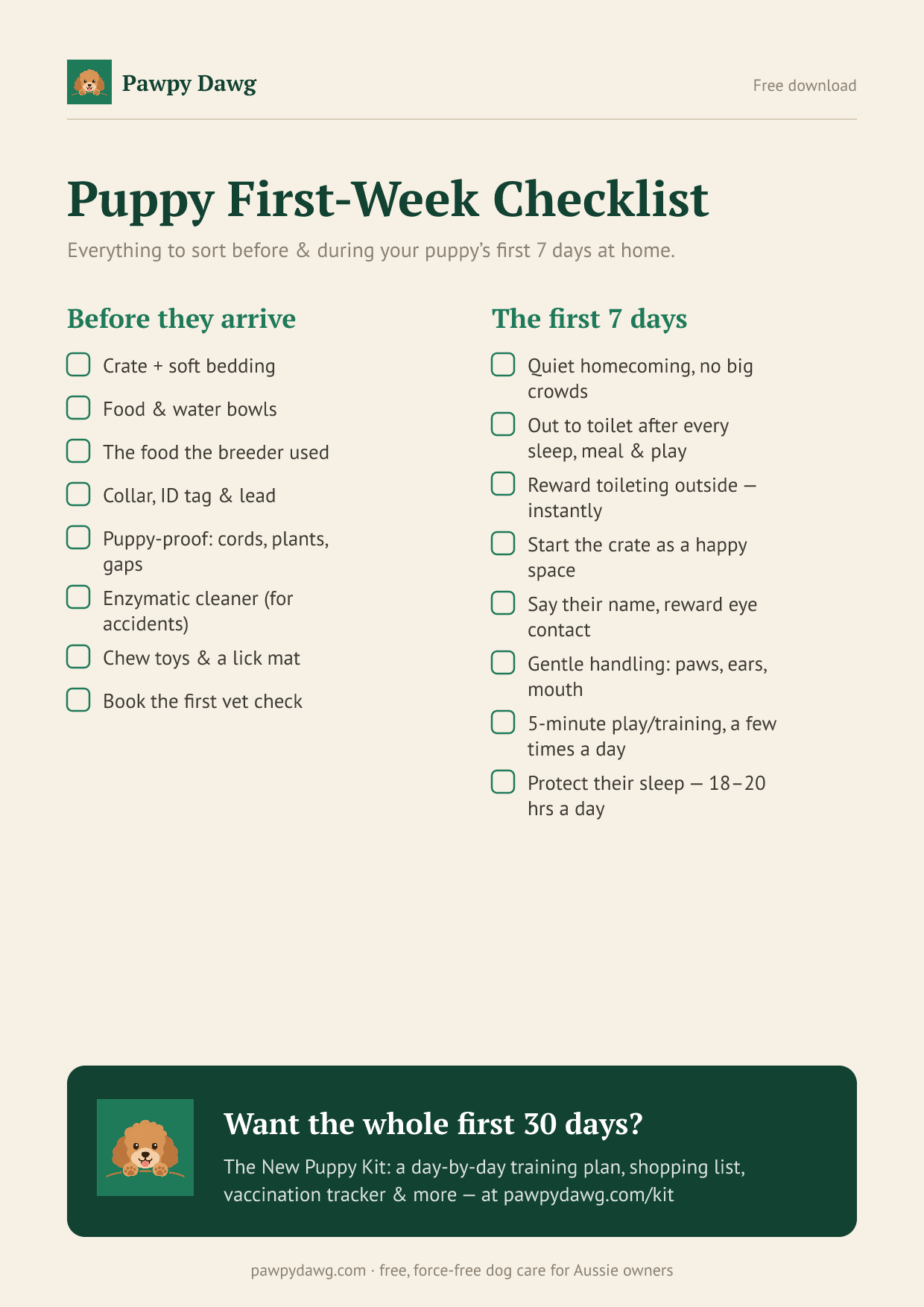
Free printable
Free: the Puppy First-Week Checklist
Everything to sort before and during your puppy's first 7 days home — a printable one-pager. Plus the occasional genuinely useful dog tip. No spam, unsubscribe anytime.
Related guides
How to Stop a Jack Russell Terrier Pulling on the Lead (Step-by-Step)
Tired of your Jack Russell terrier pulling on the lead? This step-by-step positive-reinforcement plan gets results in 5–10 min/day. Start today.
Read the guide →
How to Stop a Jack Russell Terrier Barking at Strangers (Step-by-Step)
Tired of your Jack Russell terrier barking at strangers? This step-by-step positive-reinforcement plan gets real results in 5–10 min daily sessions.
Read the guide →
Jack Russell Terrier Separation Anxiety: A Step-by-Step Fix
Struggling with Jack Russell terrier separation anxiety? Get a realistic, step-by-step positive-reinforcement plan — with a quick win you can try tonight.
Read the guide →