
How to Stop a Jack Russell Terrier Barking at Strangers (Step-by-Step)
Tired of your Jack Russell terrier barking at strangers? This step-by-step positive-reinforcement plan gets real results in 5–10 min daily sessions.

Written by Bradley Brown
Founder & editor · Reviewed 2026-07-13

Your Jack Russell just lost the plot at the postman — again. You're embarrassed, your neighbours are giving you looks, and you're starting to wonder if this dog is just broken. He's not. And you haven't ruined him.
Jack Russells were bred to hunt, bark, and make decisions independently. Reacting loudly to strangers isn't defiance — it's the breed doing exactly what centuries of selective breeding wired it to do. The good news: that same sharp, driven brain responds extremely well to training, once you understand what's actually going on.
Here's what to try today, and a full plan to follow from there.
Quick Win You Can Try Right Now
Before your next walk, load your pocket with something irresistible — small pieces of cheese, chicken, or a high-value commercial treat. The moment your dog notices a stranger but hasn't started barking yet (that split second of alertness), say "yes!" cheerfully and pop a treat in his mouth. That's it. You've just introduced the core mechanic of the whole plan: rewarding the calm noticing before the bark. Even one or two successful repetitions today starts building a new association.
Why Jack Russells Bark at Strangers
Jack Russells are terriers first. They're alert, territorial, and have a low threshold for alarm. Barking at strangers usually comes from one of three places:
- Fear — the stranger is unpredictable and potentially threatening
- Territorial behaviour — "this is my space, back off"
- Frustrated excitement — "I want to interact but I can't!"
Most Jack Russells are a mix of all three, and the intensity varies with distance, the stranger's body language, and how the dog has been inadvertently rewarded for barking in the past (think: stranger walks away = bark worked).
The Step-by-Step Training Plan
This plan uses desensitisation and counter-conditioning — the evidence-based approach recommended by veterinary behaviourists. Sessions should be 5–10 minutes maximum. Short and positive beats long and stressful every single time.
Step 1: Find Your Dog's Threshold
The "threshold" is the distance at which your dog first notices a stranger without reacting. For some dogs it's 20 metres; for others it's 5. You need to start every session below threshold — where your dog can see the stranger but remains calm.
- Spend 2–3 days just identifying this distance on your street or at a local park
- If your dog is already barking when you notice the stranger, you're too close — move further away
Step 2: Build the "Stranger = Treat" Association
Once you know your dog's threshold distance:
- Position yourself at that distance from pedestrian traffic
- The instant your dog orients toward a stranger (ears up, body stiffens slightly), mark with "yes!" and deliver a treat
- Repeat every time a stranger appears within your dog's view
- Keep sessions to 5–10 minutes, then end on a good note and go home
After 3–5 sessions at this distance with consistent calm behaviour, halve the distance by one or two metres and repeat. This is a slow process — expect 2–6 weeks before you're comfortably walking past strangers.
Step 3: Add a Cue
Once your dog is reliably looking at you after noticing a stranger (because good things keep appearing from your pocket), introduce a verbal cue like "watch me." Say it right as the stranger appears, reward the eye contact. Over time this gives you a tool to redirect attention before barking starts.
Step 4: Practice "Look at That" (LAT)
LAT, developed by trainer Leslie McDevitt, is particularly effective for reactive dogs:
- Point toward a stranger and say "look at that" in a calm tone
- When your dog glances at the stranger and then looks back at you, reward the look-back
- You're teaching your dog that strangers are a cue to check in with you, not a reason to bark
Step 5: Controlled Meet-and-Greets
Once your dog is reliably calm at close range on walks, arrange low-pressure introductions:
- Ask a calm, dog-savvy friend to help (someone who won't crowd or reach over your dog)
- Have the stranger stand sideways (less confrontational) and let your dog approach in his own time
- Stranger drops a treat on the ground without making direct eye contact
- Never force the interaction — if your dog retreats, that's fine
Common Mistakes That Make It Worse
| Mistake | Why It Backfires |
|---|---|
| Telling your dog off for barking | Adds your stress to his, and attention (even negative) can reward the behaviour |
| Picking him up when he barks | Confirms there's something to be scared of — and rewards the bark |
| Flooding (forcing close contact) | Overwhelms the dog and breaks trust; can escalate to biting |
| Inconsistent rules | If barking at the window is sometimes okay, it's harder to teach it's never okay on walks |
| Waiting for the bark before treating | You've missed the window — always reward the noticing, not the reacting |
Managing the Environment While You Train
Training takes time. In the meantime:
- On walks: cross the street proactively before your dog fixates. This isn't failure — it's smart management that prevents rehearsal of the barking behaviour
- At home: use frosted window film or a cardboard barrier on lower windows to reduce the parade of "intruders" that your dog barks at all day. Every bark rehearsal makes the habit stronger
- At the front door: put a mat 2 metres back from the door and practice "go to your mat" with treats before visitors arrive. A dog on his mat can't be in someone's face
Realistic Timeline
| Where You Are Now | Realistic Expectation |
|---|---|
| Barking at every stranger, full meltdown | 6–12 weeks to reliable management |
| Barking at strangers within 5 metres | 3–6 weeks to significant improvement |
| Occasional barking, generally manageable | 2–4 weeks to mostly resolved |
These are training timelines with daily 5–10 minute sessions. Miss a week, and progress slows — but it doesn't disappear. You can always pick back up.
When to Get Professional Help
Consider consulting a qualified dog trainer (look for a member of the Delta Society Australia or a certified applied animal behaviourist) if:
- Your dog has snapped or bitten a stranger, even once
- The barking is getting worse despite consistent training
- You're avoiding walks entirely because of the anxiety it causes you both
- Your dog shows signs of fear or aggression in multiple contexts (this may need a veterinary behavioural assessment)
A good trainer charges roughly $100–$250 AUD for an initial consultation and can shortcut weeks of trial and error. It's worth it.
The Bottom Line
A Jack Russell barking at strangers isn't a character flaw — it's a normal terrier behaviour that's well within your ability to reshape. Start below threshold, reward the calm noticing, keep sessions short, and manage the environment while you train. Consistency over a few weeks beats intensity over a few days. You've got this.
Frequently asked questions
Why does my Jack Russell only bark at strangers on walks, not at home?
On walks, your dog has no escape route and feels more vulnerable, which lowers his threshold for reacting. At home he may feel more secure in his territory, or the distance from strangers through a window is enough to keep him under threshold. Some dogs do bark intensely at home too — if that's the case, window management (frosted film, blocked sightlines) can help reduce rehearsal of the behaviour.
How long does it take to stop a Jack Russell barking at strangers?
With consistent daily sessions of 5–10 minutes, most owners see significant improvement in 3–8 weeks, depending on how reactive the dog is and how long the behaviour has been practised. Dogs with a long history of barking or those who are genuinely fearful may take 2–3 months to reach reliable management. There's no instant fix, but progress is usually noticeable within the first two weeks.
Should I use a bark collar to stop my Jack Russell barking at strangers?
Bark collars — including citronella, vibration, and shock types — are not recommended by veterinary behaviourists for fear- or anxiety-based barking. They suppress the outward behaviour without addressing the underlying emotion, which can increase anxiety and in some cases lead to biting without warning (the dog can no longer signal distress). Positive-reinforcement desensitisation is safer and produces more lasting results.
My Jack Russell barks at strangers inside the house too. What should I do?
Start by managing the environment — use frosted window film on lower windows and baby-gate your dog away from the front door. Teach a solid 'go to your mat' cue and practise it daily with treats so your dog has somewhere calm to be when visitors arrive. Apply the same desensitisation steps indoors by having a trusted friend knock and enter slowly while you reward calm behaviour at a distance.
Is barking at strangers a sign my Jack Russell is aggressive?
Not necessarily. Most barking at strangers is driven by fear, alarm, or territorial instinct — not predatory aggression. However, if your dog lunges, snaps, or makes contact, that's a more serious concern that warrants a consultation with a veterinary behaviourist or accredited trainer. In the meantime, keep your dog safely on lead and at a comfortable distance from strangers.
Can an older Jack Russell be trained to stop barking at strangers?
Yes. The idea that older dogs can't learn is a myth — adult and senior dogs respond well to positive-reinforcement training, sometimes better than puppies because they have longer attention spans. Progress may be slightly slower if the behaviour is deeply ingrained, but the same desensitisation and counter-conditioning steps apply. Patience and consistency matter far more than age.
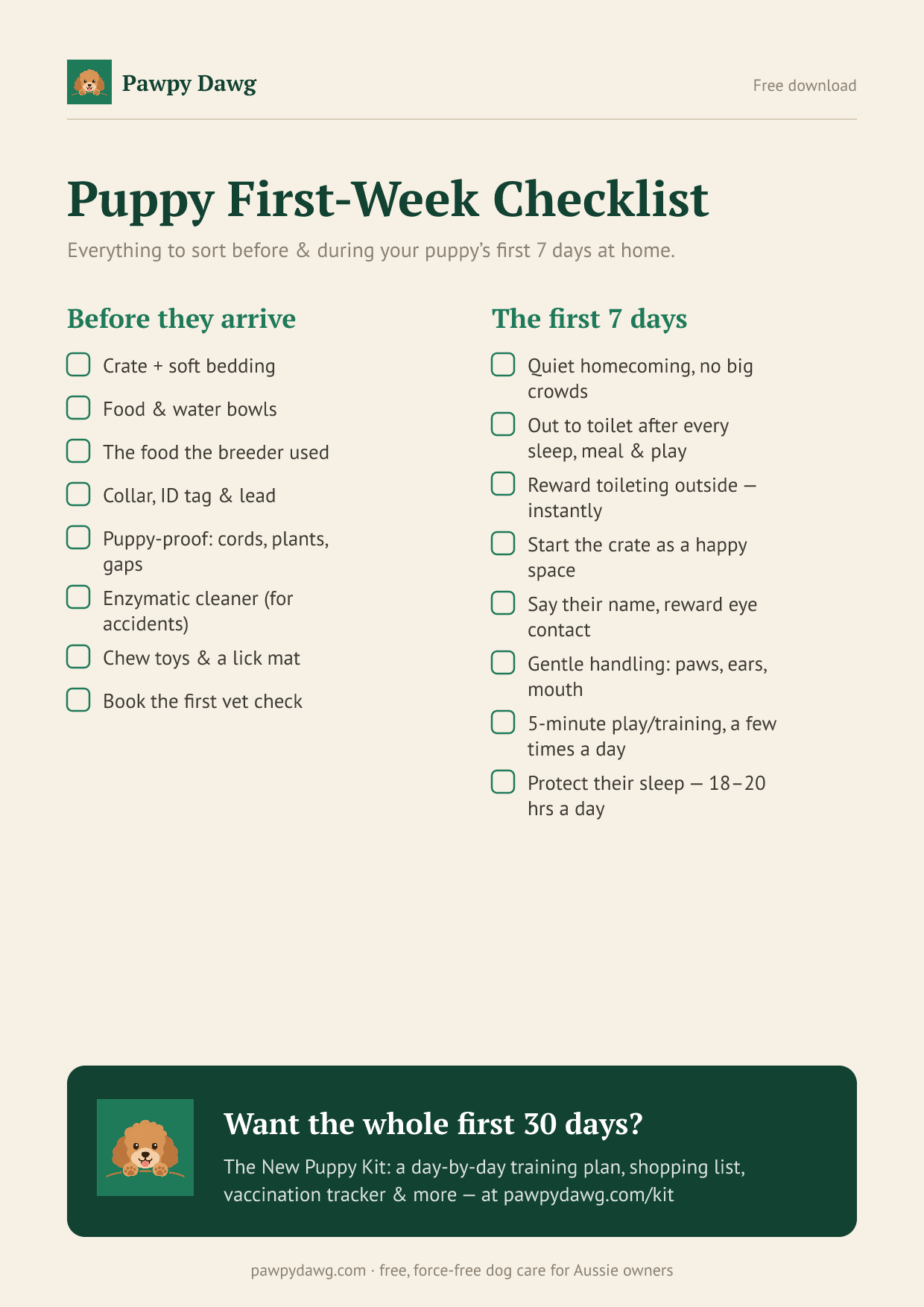
Free printable
Free: the Puppy First-Week Checklist
Everything to sort before and during your puppy's first 7 days home — a printable one-pager. Plus the occasional genuinely useful dog tip. No spam, unsubscribe anytime.
Related guides
How to Stop a Jack Russell Terrier Pulling on the Lead (Step-by-Step)
Tired of your Jack Russell terrier pulling on the lead? This step-by-step positive-reinforcement plan gets results in 5–10 min/day. Start today.
Read the guide →
Jack Russell Terrier Separation Anxiety: A Step-by-Step Fix
Struggling with Jack Russell terrier separation anxiety? Get a realistic, step-by-step positive-reinforcement plan — with a quick win you can try tonight.
Read the guide →
How to Stop a Jack Russell Terrier Jumping Up on People (Step-by-Step)
Tired of your Jack Russell terrier jumping up on people? This step-by-step positive-reinforcement plan gets real results in minutes a day — starting tonight.
Read the guide →