
How to Fix Resource Guarding in Your Labrador Retriever
Labrador retriever resource guarding explained — practical, positive-reinforcement steps to stop growling over food, toys & spaces. Realistic timelines included.

Written by Bradley Brown
Founder & editor · Reviewed 2026-06-30

Labradors have a reputation for being laid-back, food-obsessed goofballs — which is exactly why resource guarding can catch owners off guard. A dog that wolfs down everything in sight is also a dog that can become fiercely protective of whatever it values. Growling over the food bowl, snapping when you reach for a toy, or stiffening on the couch when someone approaches are all forms of resource guarding, and they're more common in Labs than most people expect.
The good news: resource guarding is a normal canine behaviour, not a sign your dog is "dominant" or broken. It's driven by anxiety — will I lose this thing I value? — and that anxiety responds well to systematic, positive-reinforcement training. Here's how to do it properly.
Understand What You're Actually Dealing With
Resource guarding exists on a spectrum. Before you start any training, honestly assess where your Lab sits:
| Severity | Signs | Urgency |
|---|---|---|
| Mild | Stiffening, eating faster, side-eye ("whale eye") | Address now — easy to resolve |
| Moderate | Low growl, lip lift, moving body over resource | Address now — still very manageable |
| Severe | Snapping, biting, redirecting aggression | See a qualified behaviourist first |
If your Lab has already made contact with skin — even a "soft" bite — skip straight to the professional help section below. No shame in it; a behaviourist will simply help you do this more safely.
Step 1 — Stop Doing the Things That Make It Worse
Before adding any new training, remove the fuel from the fire.
- Don't repeatedly take things away to "show him who's boss." Every removal that ends in the dog losing the item confirms his fear and makes guarding stronger over time.
- Don't punish growling. A growl is communication. Suppress it and you get a dog that skips the warning and goes straight to a bite.
- Don't let children approach the dog during meals or when he has a high-value chew. Manage the environment while you train.
- Don't free-feed. Scheduled meals give you more control and make food-based training more effective.
Step 2 — Build a "Good Things Happen When You Approach" History
This is the foundation of every resource-guarding fix, and it comes from the work of behaviourist Jean Donaldson (Mine! is the go-to book on this topic).
The basic drill (food bowl):
- Fill your Lab's bowl with his regular meal — but only put half in the bowl to start.
- Stand about 2 metres away and let him begin eating.
- Walk calmly toward him, drop a small, high-value treat (cooked chicken, cheese) into the bowl, then walk away.
- Repeat this 5–10 times per meal, every meal, for at least two weeks.
What you're teaching: Your approach predicts better food arriving, not food disappearing. Over time, your Lab will start looking up at you hopefully rather than stiffening.
Progression: Gradually decrease the approach distance over sessions until you can stand right next to the bowl and he's relaxed. Only move closer when he's completely comfortable at the current distance.
Step 3 — Teach a Solid "Drop It" and "Leave It"
These cues give you a safe, co-operative way to get things back — no confrontation required.
Teaching "Drop It"
- Offer your Lab a low-value toy to hold.
- Bring a high-value treat to his nose — don't say anything yet.
- The moment he opens his mouth to sniff the treat, say "drop it" and deliver the treat.
- Give the toy back immediately after. This is critical — you're not ending the game, you're interrupting it.
- Repeat 10–15 times in short sessions before adding distance or difficulty.
Teaching "Leave It"
- Place a treat on the floor and cover it with your foot.
- Wait. The moment your dog backs away or looks at you, mark with "yes!" and reward with a different, better treat from your hand.
- Gradually move to an open hand, then items on the ground uncovered.
Common mistake: Owners teach "leave it" but never follow through with "drop it." You need both.
Step 4 — Practise Trading
Trading is the real-world application of everything above. You're teaching your Lab that handing something over is always worth it.
- Pick up a toy and play with your dog.
- Pause, show him a treat, and say "drop it."
- The instant he releases the toy, deliver the treat AND immediately resume play or hand the toy straight back.
- Over hundreds of repetitions, giving things up becomes a habit rather than a crisis.
Start with low-value items and work up to the things he guards most heavily. Don't rush this — spending two extra weeks on low-value items costs you nothing and builds a far more reliable behaviour.
Step 5 — Address Space Guarding (Couch, Bed, Doorways)
If your Lab guards a particular spot:
- Temporarily remove access (close the door, use a baby gate) while you train — not as punishment, but to prevent rehearsal of the guarding behaviour.
- Teach a confident "off" cue using luring and reward, never physical removal while the dog is tense.
- Once "off" is reliable in low-stakes situations, practise it in the previously guarded location, heavily rewarding every successful response.
- Decide whether the dog is allowed back on the couch once training is solid. There's no rule saying he can't be — he just needs to move cheerfully when asked.
Realistic Timelines
| Situation | Realistic timeframe |
|---|---|
| Mild food bowl guarding, young Lab | 3–6 weeks of consistent practice |
| Moderate toy/chew guarding | 6–12 weeks |
| Multiple guarded resources | 3–6 months |
| Severe or long-established guarding | Ongoing management + professional support |
Consistency matters far more than intensity. Five minutes of well-executed training daily beats a single hour-long session on the weekend.
Common Mistakes That Slow Progress
- Moving too fast. If your dog is stiffening at any stage, you've progressed too quickly. Go back a step.
- Inconsistent rules across the household. Every person needs to follow the same protocol. One family member doing the old "alpha" approach undoes everyone else's work.
- Only training when guarding happens. Guarding incidents are not training opportunities — they're management failures. Do your proactive sessions when the dog is relaxed.
- Stopping too soon. Behaviours that were reinforced for months or years need months of consistent counter-conditioning to shift reliably.
When to Get Professional Help
Call a qualified professional if:
- Your Lab has snapped or bitten anyone
- Guarding is escalating despite consistent training
- You feel unsafe or anxious around your own dog
- A child or vulnerable person lives in the home
Look for a trainer or veterinary behaviourist who uses force-free, positive-reinforcement methods — credentials to look for in Australia include PPGA (Pet Professional Guild Australia) membership or a vet with a postgraduate qualification in animal behaviour. A consultation typically costs $150–$400 AUD depending on format and location, and it's money well spent compared to a bite incident.
Your vet is also worth a call — sometimes guarding that appears suddenly or escalates quickly has a pain component, and ruling that out is a sensible first step.
Frequently asked questions
Is resource guarding normal in Labradors?
Yes, resource guarding is a normal canine behaviour seen across all breeds, including Labradors. It's driven by anxiety about losing something valuable, not aggression or dominance. Labs can be particularly prone to it because of their strong food motivation. The key is to address it early with positive-reinforcement training before it escalates.
Should I punish my Lab for growling over food or toys?
No — punishing a growl is one of the most counter-productive things you can do. A growl is your dog's way of communicating discomfort; suppressing it doesn't remove the underlying anxiety, it just removes the warning signal. Dogs that are punished for growling often skip the warning and go straight to snapping or biting.
How long does it take to stop resource guarding in a Labrador?
Mild cases with consistent daily training can show real improvement in three to six weeks. Moderate guarding across multiple resources typically takes three to six months. The biggest factor is consistency — brief daily sessions practiced by every member of the household produce far better results than occasional intensive sessions.
Can I train resource guarding out of an adult Labrador, or is it too late?
It's absolutely not too late. Adult dogs respond well to counter-conditioning and desensitisation, though it may take longer than working with a puppy. The same positive-reinforcement steps apply at any age. For severe or long-standing cases in adult dogs, a qualified behaviourist can help you work safely and effectively.
What's the difference between resource guarding and aggression?
Resource guarding is a specific, context-driven behaviour — your dog is protective of a particular item or space. General aggression is broader and less predictable. A dog that guards its food bowl but is otherwise relaxed and social is displaying resource guarding, not generalised aggression. That said, if the behaviour involves biting or is escalating, a veterinary behaviourist should assess the dog regardless of the label.
Should I take things away from my Lab to stop resource guarding?
Repeatedly taking things away without a training plan actually makes resource guarding worse by confirming the dog's fear that valuables will be removed. Instead, focus on teaching 'drop it' and trading, where giving something up reliably predicts getting something better in return. Management — keeping high-value items out of reach until training is solid — is a much safer interim strategy.
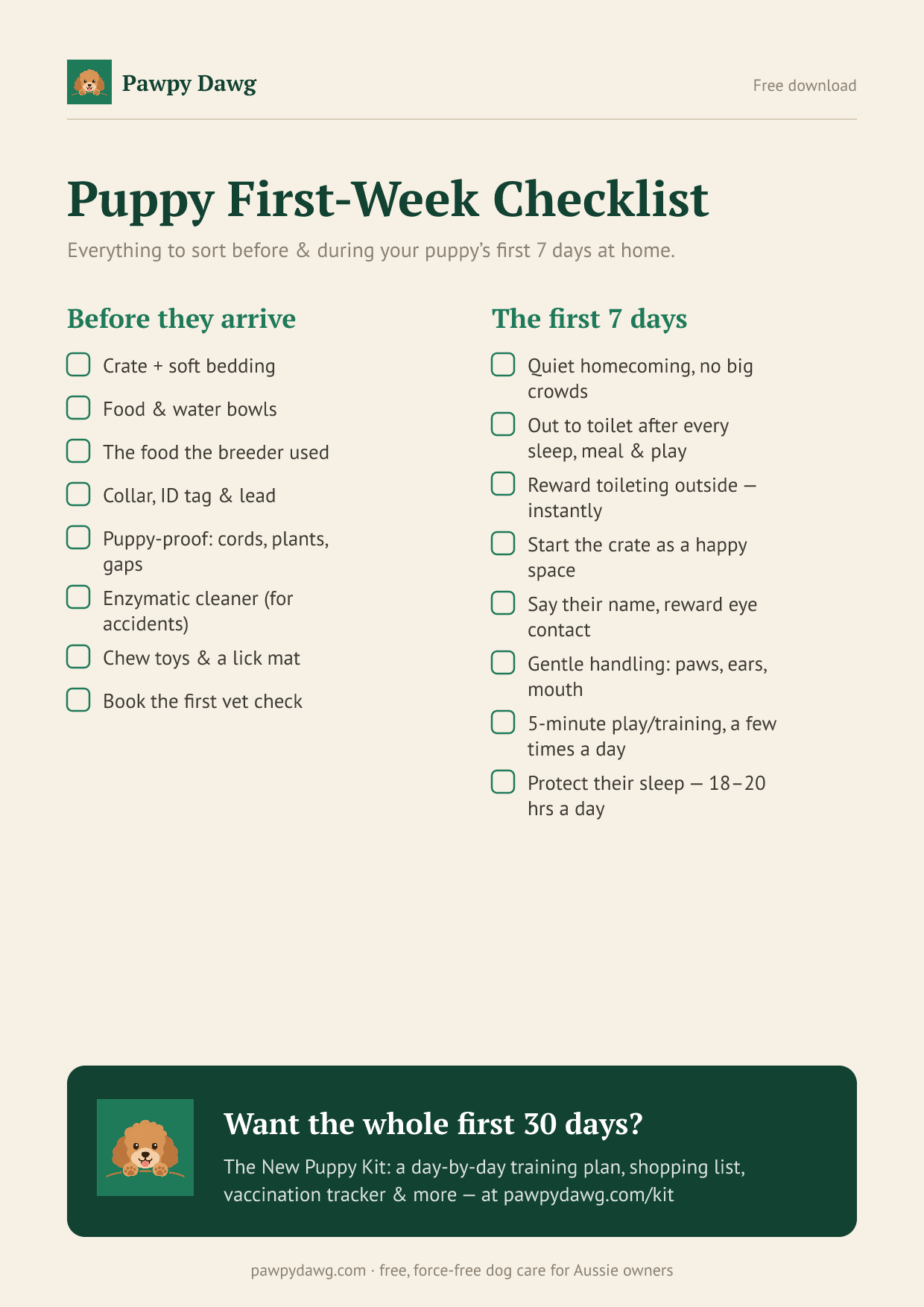
Free printable
Free: the Puppy First-Week Checklist
Everything to sort before and during your puppy's first 7 days home — a printable one-pager. Plus the occasional genuinely useful dog tip. No spam, unsubscribe anytime.
Related guides
How to Stop a Labrador Retriever Pulling on the Lead (Step-by-Step)
Tired of being dragged around the block? Here's a step-by-step positive-reinforcement plan to stop your Labrador Retriever pulling on the lead — with real timelines.
Read the guide →
How to Stop a Labrador Retriever Barking at Strangers (Step-by-Step)
Stop your Labrador Retriever barking at strangers with this step-by-step positive-reinforcement plan. Realistic timelines, common mistakes & when to call a pro.
Read the guide →
Labrador Retriever Separation Anxiety: A Step-by-Step Fix
Labrador Retriever separation anxiety is fixable. Follow this positive-reinforcement step-by-step plan, avoid common mistakes, and know when to call a pro.
Read the guide →