
How to Stop a Golden Retriever Biting and Mouthing (Step-by-Step)
Struggling with golden retriever biting and mouthing? Get a practical, positive-reinforcement plan with quick wins, real timelines, and common mistakes to avoid.

Written by Bradley Brown
Founder & editor · Reviewed 2026-07-05

Your golden retriever just left another set of teeth marks on your arm — or your toddler's sleeve — and you're done. You're not a bad owner. Golden retrievers are mouthy by design, and the behaviour you're seeing is completely normal. The good news: it's also very fixable, even if you've tried before and it hasn't stuck.
Here's a plan you can start tonight.
Your Quick Win for Tonight: The Yelp-and-Freeze Method
Before anything else, try this the next time your dog mouths you:
- The moment teeth touch skin, say "ouch" in a sharp, surprised tone (not angry — startled).
- Freeze completely. Drop your hand, go still, break eye contact.
- Wait 3–5 seconds, then calmly resume interaction.
- If the mouthing continues, stand up and turn your back for 10–15 seconds.
- Return and repeat.
This mimics how puppies learn bite inhibition from their littermates — the play stops when biting gets too hard. You're not punishing; you're communicating in a language your dog already understands.
Do this consistently every single time for 5–7 days. You should see a reduction in pressure, even if the mouthing itself continues for a few more weeks.
Why Golden Retrievers Mouth More Than Other Breeds
Goldens were bred to carry things in their mouths all day without damaging them — that's the "soft mouth" prized in retrievers. Their mouths are basically their hands. Add in the fact that puppies explore the world orally, and you've got a dog who is wired to put things in his mouth.
This is not a dominance issue. It's not aggression. It's a retriever doing retriever things. What you're teaching is bite inhibition — how to control the pressure and frequency — and eventually, how to redirect the behaviour entirely.
Step-by-Step Plan (5–10 Minutes a Day)
You don't need marathon training sessions. Short, consistent reps beat long, irregular ones every time.
Step 1: Manage the Environment First (Days 1–3)
Reduce opportunities for rehearsal. Every time your dog successfully mouths you and nothing changes, that behaviour gets stronger.
- Keep a tug toy or rope toy in your pocket or nearby at all times.
- Before greeting your dog (when excitement peaks), hold a toy out immediately — give them something legal to grab.
- Avoid rough-play with hands during this period. Hands are not toys.
Step 2: Yelp-and-Freeze Every Single Time (Ongoing)
Revisit the method above. The key word is every time. Inconsistency is the number-one reason this approach fails. If three family members are doing it but one isn't, the dog learns mouthing that person is still on the table.
Family rule to post on the fridge:
"Teeth on skin = play stops immediately. No exceptions."
Step 3: Redirect to an Appropriate Outlet (Days 3–14)
Once you've interrupted the mouthing, immediately offer an alternative:
- A cold, wet rope toy (especially good for teething puppies under 6 months)
- A bully stick or long-lasting chew for high-arousal moments
- A Kong stuffed with peanut butter and frozen for when you need a hands-free break
The sequence is: interrupt → redirect → reward the redirect. When your dog takes the toy instead of your arm, mark it with a calm "yes" and let them have it. That's the behaviour you want to grow.
Step 4: Teach "Leave It" and "Drop It" (Week 2 Onwards)
These two cues give you tools for the rest of your dog's life.
"Leave It" basics (2 minutes a day):
- Hold a treat in your closed fist.
- Let your dog sniff and paw. Say nothing.
- The second they back off even slightly, say "yes" and reward with your other hand.
- Build until they look away from your fist on cue.
"Drop It" basics:
- Let your dog chew a toy, then offer a high-value treat near their nose.
- When they release the toy to take the treat, say "drop it."
- Give the treat, then return the toy. (They need to learn drop ≠ losing the toy forever.)
Step 5: Build Calm Greetings (Week 2–4)
Most biting and mouthing spikes when owners come home or start play. Teach your dog that calm gets them what they want.
- Walk in the door and completely ignore your dog until all four paws are on the floor.
- Reward the moment they settle — even briefly.
- Repeat arrivals if needed (leave, come back in, try again).
Common Mistakes That Slow Progress
| Mistake | Why It Backfires | Fix |
|---|---|---|
| Pulling your hand away fast | Triggers chase/prey instinct | Freeze instead |
| Yelling or tapping the nose | Increases arousal or causes fear | Use calm yelp + withdrawal |
| Inconsistency between family members | Dog learns the rules are optional | One rule, posted visibly |
| Only correcting, never rewarding calm | Dog doesn't learn what TO do | Actively reward gentle mouth or no mouth |
| Expecting overnight results | Leads to giving up too soon | Trust the timeline (see below) |
Realistic Timeline
- Days 1–7: Biting pressure should soften even if frequency stays similar
- Weeks 2–4: Noticeable reduction in frequency with consistent redirection
- Weeks 4–8: Most owners see significant improvement; occasional mouthing remains
- 3–6 months: Behaviour largely resolved in most dogs, with continued reinforcement
Puppies under 5 months are still in a developmental window where mouthing is very high — be patient. Adult dogs who've been mouthing for years may take a little longer to unlearn the habit, but they absolutely can.
When to Get a Professional Involved
Most golden retriever mouthing is normal puppy or adolescent behaviour. However, speak to a certified professional dog trainer (CPDT-KA) or your vet if:
- Biting is accompanied by growling, stiffening, or a hard stare (this may be fear or resource guarding, not play)
- The biting breaks skin regularly in an adult dog (over 12 months)
- Your dog cannot be interrupted or redirected at all during mouthing
- Behaviour is escalating rather than plateauing
A good trainer charges roughly $80–$200 AUD per session in most Australian cities, and one or two sessions with a professional can reset your approach quickly. Look for trainers who use positive reinforcement methods and hold recognised qualifications.
The Short Version
Golden retrievers mouth because they're retrievers — it's in the breeding. You haven't ruined your dog. Start with the yelp-and-freeze tonight, get a toy in your hand before every greeting, and apply the same rule every time. Five consistent minutes a day will outperform one frustrated hour every weekend. You've got this.
As an Amazon Associate we earn from qualifying purchases.
Frequently asked questions
At what age do golden retrievers stop biting and mouthing?
Most golden retrievers naturally reduce mouthing between 4 and 6 months as teething eases, but without training the habit can persist well into adolescence (6–18 months). With consistent redirection and bite inhibition work, most owners see significant improvement within 4–8 weeks regardless of the dog's age.
Is it normal for a golden retriever puppy to bite hard?
Yes, it's completely normal. Puppies have not yet learned to control the pressure of their bite — that skill, called bite inhibition, is something they start learning from littermates and need to continue learning from you. Hard biting in puppies under 5 months is not aggression; it's a lack of impulse control that training addresses directly.
Should I use a spray bottle or scruff my dog to stop mouthing?
These aversive methods are not recommended by mainstream veterinary or dog training bodies. They can increase anxiety, damage trust, and sometimes escalate arousal rather than reduce it. Positive-reinforcement approaches — withdrawing attention, redirecting to a toy, rewarding calm behaviour — are more effective and have no negative side effects.
Why does my golden retriever mouth me more when I tell it off?
Raising your voice or physically reacting can actually increase your dog's excitement, which makes mouthing worse rather than better. Negative attention is still attention. The most powerful signal to a social dog is the complete removal of interaction — freezing and turning away — which is why the yelp-and-freeze method works better than scolding.
My adult golden retriever still mouths people — is it too late to fix?
It's not too late at all. Adult dogs can absolutely learn new habits; it may just take a little longer than with a puppy because the behaviour is more established. Use the same yelp-and-freeze and redirection approach, be consistent across everyone in the household, and consider one or two sessions with a qualified positive-reinforcement trainer if you're not making progress within a few weeks.
How do I stop my golden retriever mouthing children or guests?
Management first: keep a leash on the dog during guest visits so you can interrupt immediately, and always supervise interactions with children closely. Teach children to freeze like a tree (arms crossed, no eye contact) if the dog mouths them — running and squealing dramatically increases excitement. Work on 'sit' and 'leave it' cues so your dog has a trained default behaviour when meeting new people.
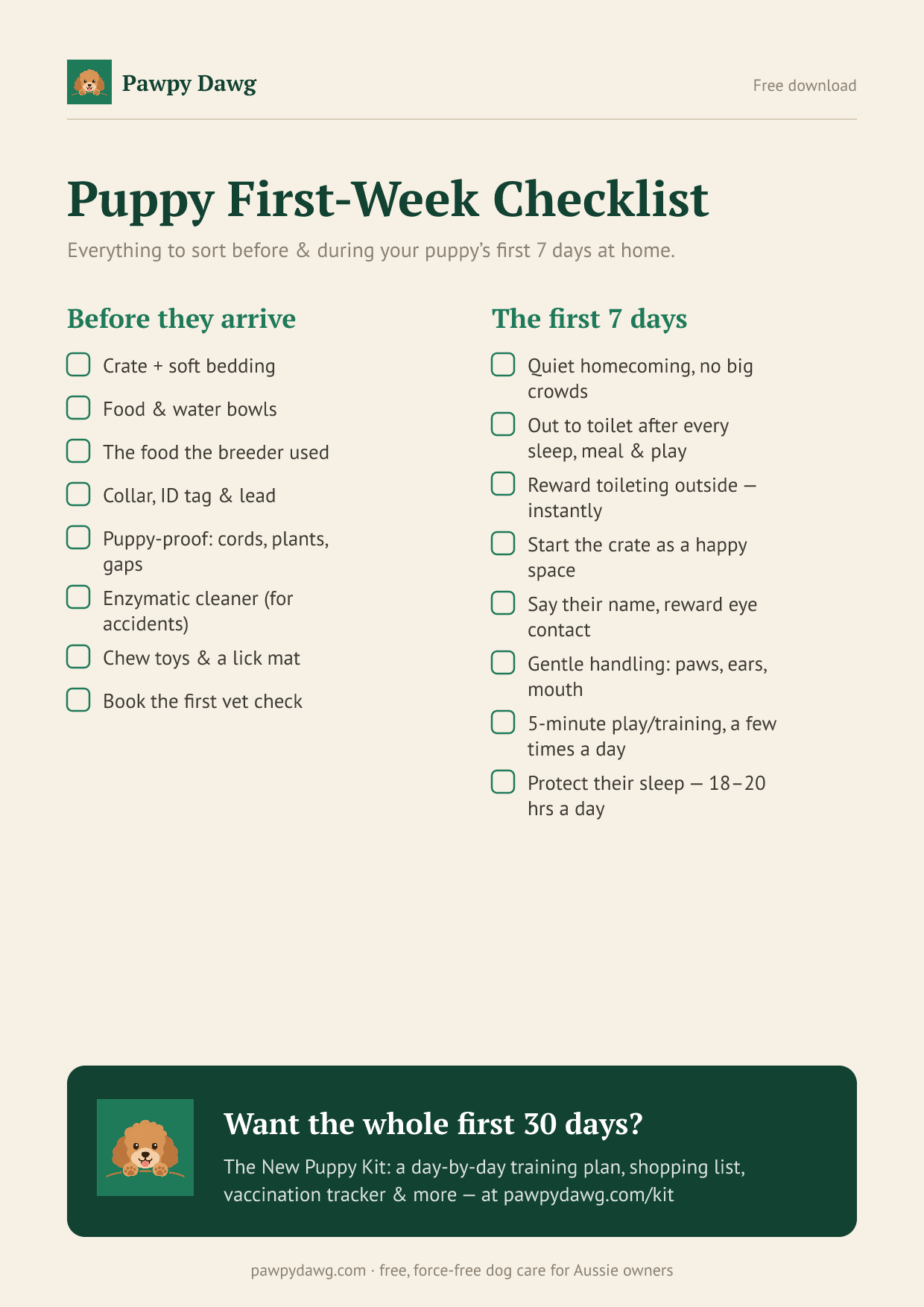
Free printable
Free: the Puppy First-Week Checklist
Everything to sort before and during your puppy's first 7 days home — a printable one-pager. Plus the occasional genuinely useful dog tip. No spam, unsubscribe anytime.
Related guides
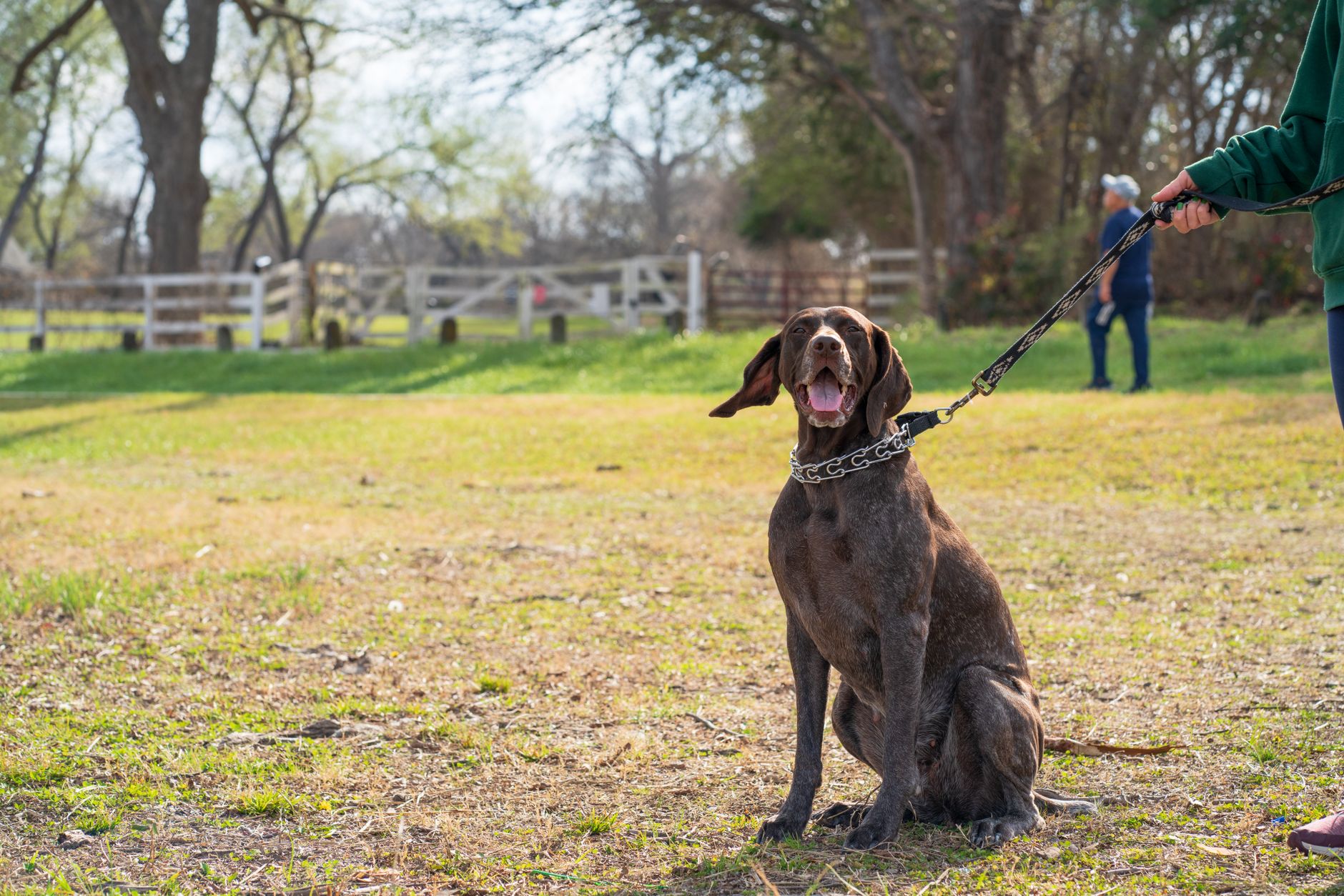
How to Stop a Golden Retriever Pulling on the Lead (Step-by-Step)
Tired of being dragged down the street? Here's a practical, positive-reinforcement plan to stop your golden retriever pulling on the lead — starting today.
Read the guide →
How to Stop a Golden Retriever Barking at Strangers (Step-by-Step)
Stop your golden retriever barking at strangers with this positive-reinforcement plan. Step-by-step training, realistic timelines & when to call a pro. 🐾
Read the guide →
Golden Retriever Separation Anxiety: A Step-by-Step Fix
Golden retriever separation anxiety is stressful — for you and your dog. Here's a realistic, step-by-step positive-reinforcement plan that actually works.
Read the guide →