
How to Stop a Golden Retriever Barking at Strangers (Step-by-Step)
Stop your golden retriever barking at strangers with this positive-reinforcement plan. Step-by-step training, realistic timelines & when to call a pro. 🐾

Written by Bradley Brown
Founder & editor · Reviewed 2026-07-04
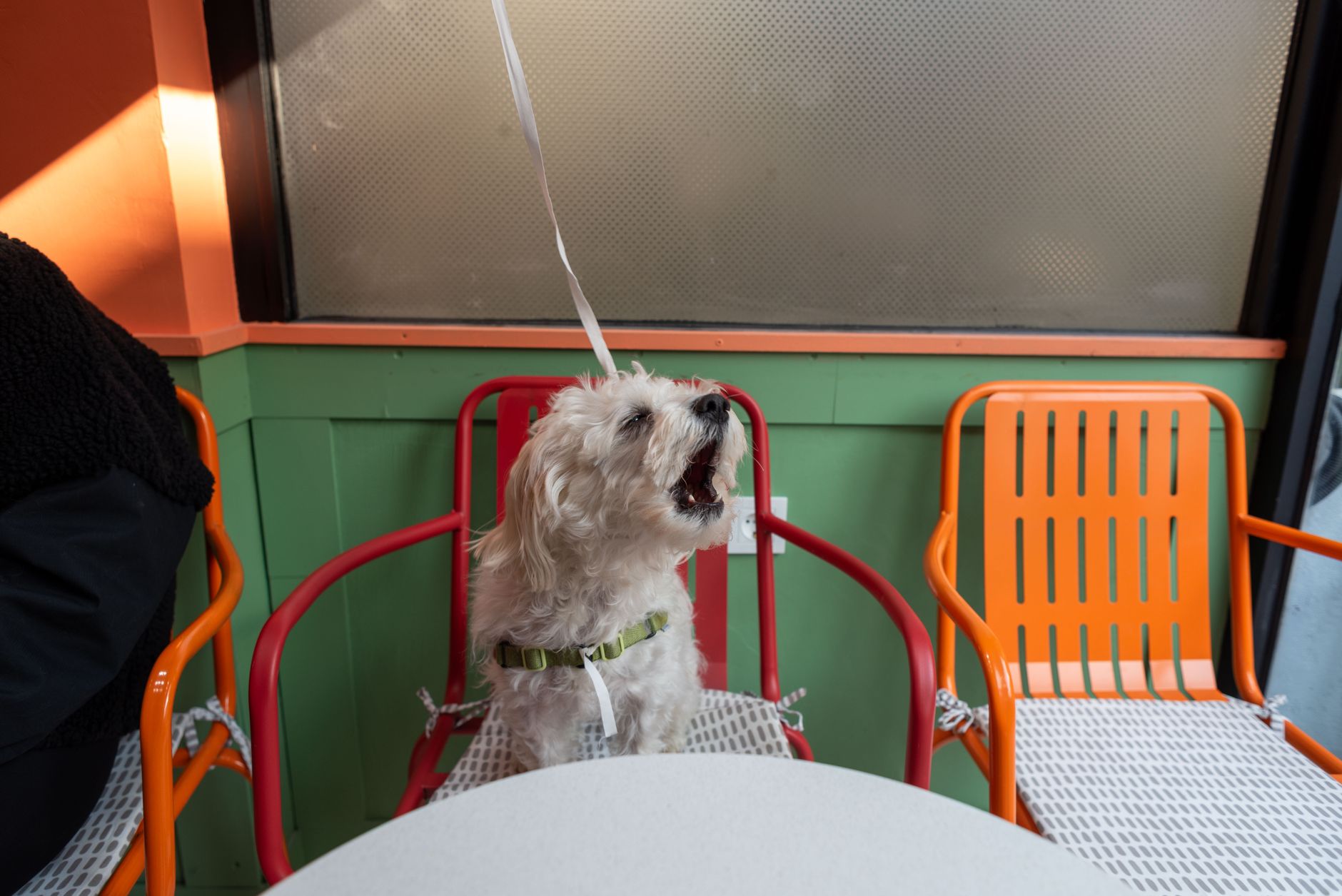
You had a vision: a golden retriever trotting happily beside you, tail wagging at everyone you pass. Instead, you've got a dog losing its mind at the postie, the neighbour's kid, or the person who dared to walk on the same footpath. You're embarrassed, you're exhausted, and you're wondering if you've somehow broken your dog.
You haven't. This is genuinely common in Goldens, and it's fixable — often faster than you'd expect.
Why Goldens Bark at Strangers (It's Not Aggression)
Golden Retrievers are famously sociable, so barking at strangers can feel confusing or alarming. In most cases it's one of three things:
- Alarm barking — "There's something new! Pay attention!"
- Frustration/excitement — They want to greet the stranger but can't, so they bark instead (common on-lead).
- Mild fear or uncertainty — Under-socialised dogs can find unfamiliar people unsettling.
True aggression in Goldens is rare. That escalating, lunging bark on a walk is almost always excitement or frustration. That distinction matters, because the fix is training — not punishment, not rehoming, not despair.
Your Quick Win for Today (5 Minutes, Right Now)
Before anything else, try the Look at That game on your next walk or in your backyard.
- Load your pocket with small, smelly treats (cheese, fritz, cooked chicken — not dry biscuits).
- The moment your dog notices a stranger but before they bark, say "yes!" in a bright, calm voice and pop a treat in their mouth.
- You're rewarding the look, not the bark. You're teaching: "Stranger appears → good things happen."
That's it. One repetition at a time. You won't fix everything today, but you'll interrupt the automatic bark-loop and give your dog something else to do with that energy. Most owners notice a difference within the first two or three sessions.
The Step-by-Step Plan (5–10 Minutes a Day)
Step 1 — Find Your Dog's "Threshold"
Your dog has a distance at which they can see a stranger and stay calm. Beyond that line? Bark city. This is called the threshold.
Start every session beyond that distance. If your dog kicks off at 10 metres, work at 15. Close the gap only when your dog is consistently relaxed — ears soft, body loose, taking treats readily.
Rushing this is the most common mistake owners make.
Step 2 — Pair Strangers with Good Things (Counter-Conditioning)
Every time a stranger appears at a safe distance:
- Say "yes!" the moment your dog looks at them.
- Deliver a high-value treat immediately.
- Repeat until the stranger moves away.
- When the stranger leaves, treats stop.
The pattern you're building: stranger = treat party; no stranger = nothing special. Dogs learn this association surprisingly quickly — usually 5–10 short sessions before you'll see a noticeable shift.
Step 3 — Add a Cue ("Watch Me" or "Leave It")
Once your dog is reliably looking at you after spotting a stranger, name it. Say "watch me" just before you say "yes!" and treat. Now you have a cue you can use proactively before the bark starts.
Practice this at home first — with zero distractions — until the response is instant. Then layer it back into real-world situations.
Step 4 — Gradually Decrease Distance
Over days or weeks (not hours), creep closer to the trigger:
- Move 1–2 metres closer each session, only if your dog stayed calm.
- If they bark, you've moved too fast. Step back to the last successful distance and stay there longer.
- Progress is not linear. A stressful week, a thunderstorm, a new environment — all can cause a temporary step backwards. That's normal.
Step 5 — Practise Controlled Greetings
If your dog barks from excitement (not fear), controlled meet-and-greets with calm strangers can help. Ask a friend to:
- Approach slowly, side-on (not face-on — that's confrontational to dogs).
- Ignore the dog entirely until all four paws are on the ground and the dog is quiet.
- Reward calmly the moment your dog settles.
No knee-ing, no shouting "off!" — just withdrawal of attention for jumping/barking, and calm praise the second they settle.
Common Mistakes to Avoid
| Mistake | Why It Backfires |
|---|---|
| Yanking the lead when they bark | Increases frustration; can escalate reactivity |
| Saying "it's okay, it's okay" repeatedly | Sounds like you're praising the barking |
| Using a muzzle as the only tool | Stops the bark but not the underlying emotion |
| Flooding (forcing them to face the trigger) | Can worsen fear significantly |
| Only training on walks | Behaviour needs practice in multiple contexts |
| Punishing the growl or first bark | Removes the warning signal; doesn't fix the root cause |
Realistic Timelines
| Situation | Likely Timeline |
|---|---|
| Excited/frustration barker, well-socialised dog | 2–6 weeks of consistent work |
| Alarm barker, limited socialisation as a pup | 6–12 weeks |
| Fear-based reactivity with a history of bad experiences | 3–6 months, ideally with pro support |
Five to ten minutes of deliberate daily training beats one heroic 45-minute session per week. Consistency is the whole game.
What Won't Help (Save Your Money)
- Anti-bark collars (citronella or static): They suppress barking through discomfort, not learning. The barking usually returns — sometimes worse — and can increase anxiety.
- Dominance-based corrections: The science on dominance theory in dogs has been thoroughly debunked. A Golden barking at strangers isn't trying to be the boss; it's overwhelmed or over-excited.
When to Call a Professional
Book a session with a qualified, force-free trainer or veterinary behaviourist if:
- The barking is paired with lunging, snapping, or growling at close range.
- Your dog has bitten someone, even lightly.
- There's been no measurable progress after 6–8 weeks of consistent training.
- You suspect the barking is driven by anxiety (the dog can't settle, has other fear behaviours, destructive when alone).
In Australia, look for trainers accredited with the Pet Professional Guild Australia or Delta Society Australia, or ask your vet for a referral to a veterinary behaviourist. A single consult — typically $150–$300 AUD — can save months of frustration.
The Reassurance You Actually Need
You did not ruin your dog. Golden Retrievers are big-feeling, big-reacting dogs. Barking at strangers is a behaviour — a learnable, trainable behaviour — not a personality flaw and not a life sentence. The fact that you're here, reading this at whatever hour it is, means you care enough to fix it. That's genuinely the most important ingredient.
Start with the Look at That game tomorrow. Keep your treats in your pocket, your expectations realistic, and your sessions short. You've got this.
Frequently asked questions
Why does my golden retriever bark at strangers but not at people they know?
Your dog has learned that familiar people are safe and predictable. Strangers are unknown quantities, which can trigger alarm, uncertainty, or pent-up excitement — especially if your dog wants to greet but can't. This is completely normal canine behaviour, not a sign your dog is aggressive or badly raised.
How long does it take to stop a golden retriever from barking at strangers?
For excited or alarm barkers with good socialisation, most owners see meaningful improvement in 2–6 weeks of daily 5–10 minute sessions. Fear-based reactivity can take 3–6 months. Consistency matters far more than session length — short and frequent beats long and occasional every time.
Should I tell my golden retriever off when it barks at strangers?
No — punishment suppresses the visible behaviour without addressing the underlying emotion, and it can make anxiety or frustration worse. It can also teach your dog to skip the warning bark and react more sharply. Positive reinforcement (rewarding calm behaviour) changes how your dog *feels* about strangers, which is where the lasting fix comes from.
Is my golden retriever barking at strangers a sign of aggression?
In most cases, no. Golden Retrievers typically bark at strangers out of excitement, frustration at being on-lead, or mild uncertainty — not true aggression. If the barking is accompanied by sustained growling, snapping, or a bite history, consult a veterinary behaviourist for a proper assessment.
Can an anti-bark collar stop my golden retriever barking at strangers?
Anti-bark collars (citronella or static) may temporarily suppress barking, but they don't address why your dog is barking. The behaviour often returns once the collar is removed, and aversive collars can increase stress and anxiety. Most force-free trainers and veterinary bodies recommend against them.
My golden retriever only barks at strangers on the lead — why?
This is called 'lead reactivity' or 'barrier frustration.' When your dog is on-lead and can't move freely, the frustration of wanting to greet (or the feeling of being trapped near something scary) amplifies into barking and lunging. Many dogs who appear aggressive on-lead are perfectly friendly off-lead. Training to focus on you, combined with counter-conditioning, resolves this well.
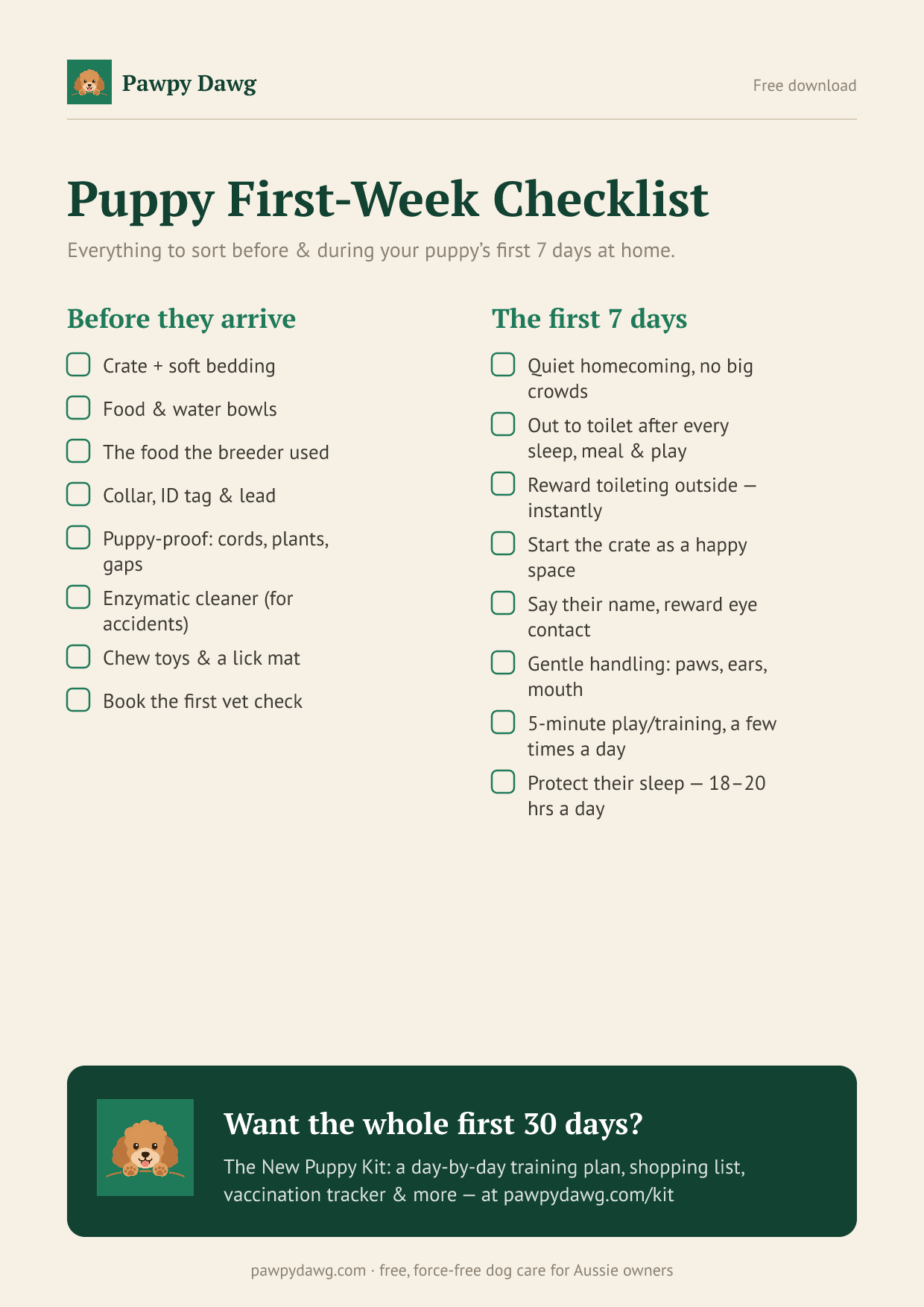
Free printable
Free: the Puppy First-Week Checklist
Everything to sort before and during your puppy's first 7 days home — a printable one-pager. Plus the occasional genuinely useful dog tip. No spam, unsubscribe anytime.
Related guides
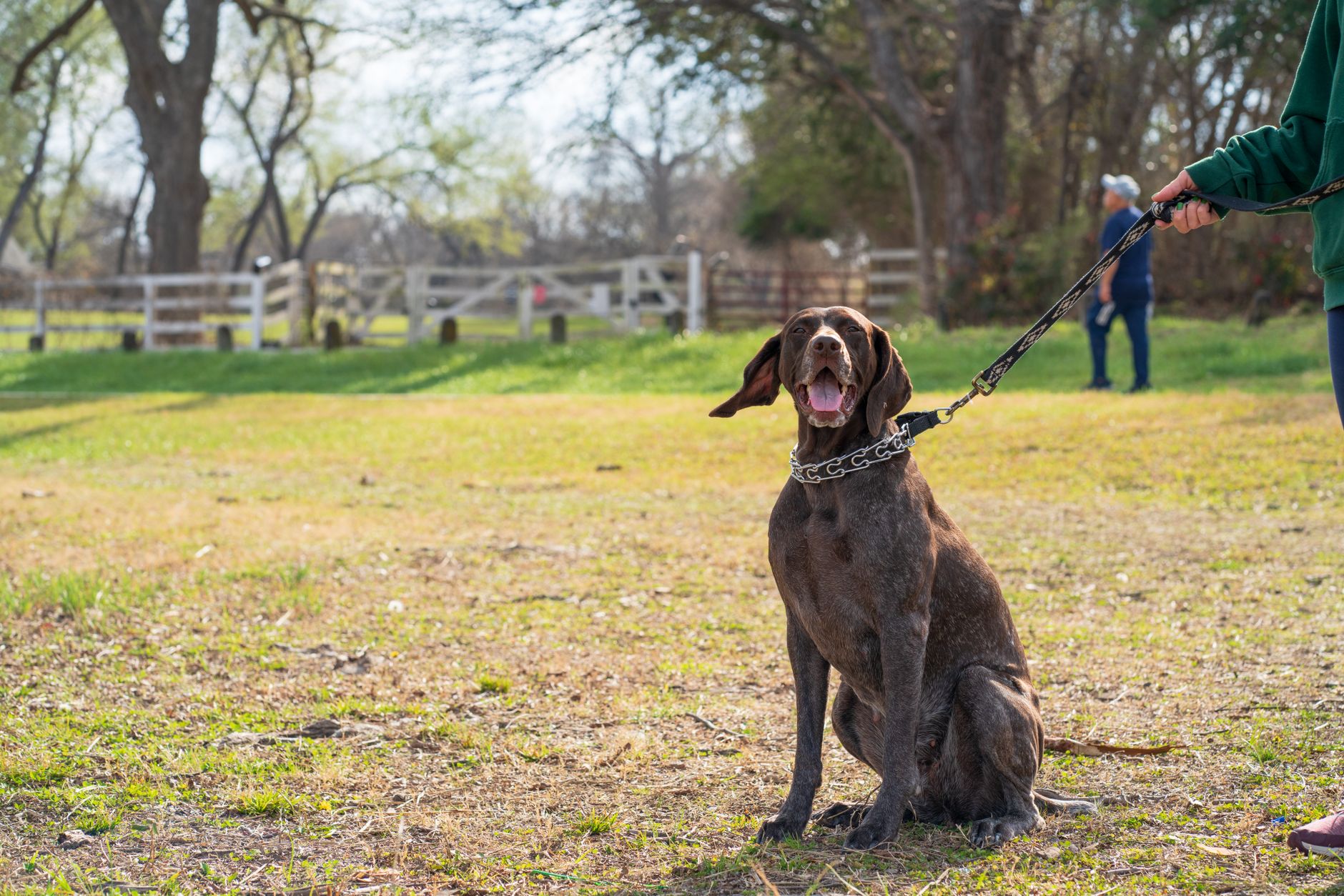
How to Stop a Golden Retriever Pulling on the Lead (Step-by-Step)
Tired of being dragged down the street? Here's a practical, positive-reinforcement plan to stop your golden retriever pulling on the lead — starting today.
Read the guide →
Golden Retriever Separation Anxiety: A Step-by-Step Fix
Golden retriever separation anxiety is stressful — for you and your dog. Here's a realistic, step-by-step positive-reinforcement plan that actually works.
Read the guide →
How to Stop a Golden Retriever Jumping Up on People (Step-by-Step)
Tired of your Golden Retriever jumping up on people? This step-by-step positive-reinforcement plan gets real results in 5–10 min/day. Start today.
Read the guide →