
How to Stop a French Bulldog Biting and Mouthing (Step-by-Step)
Struggling with french bulldog biting and mouthing? Get a realistic, positive-reinforcement plan with quick wins, common mistakes, and when to call a pro.

Written by Bradley Brown
Founder & editor · Reviewed 2026-07-07

If your French Bulldog has just left toothmarks on your hand — or your toddler's arm, or your brand-new couch — you're not a bad owner. You're a normal one. Frenchies are mouthy by nature, and nobody tells you that at the pet shop. The good news: this is one of the most fixable behaviours in dogs, and you don't need hours a day to turn it around.
Quick win you can try in the next five minutes: the moment your Frenchie's teeth touch skin, say "ouch" in a sharp, surprised tone, go completely still, and turn your back for 10–15 seconds. No yelling, no pushing away (that's a game). Just instant social withdrawal. Repeat every single time. It's boring for you, but it works — and it's exactly what their littermates would have done.
Why French Bulldogs Bite and Mouth in the First Place
Mouthing is how puppies explore the world, communicate, and play. French Bulldogs in particular were bred for companionship, which means they're highly interactive and tactile — they want to engage with you, and their mouth is their main tool.
Common triggers include:
- Teething (8 weeks – 6 months): Their gums genuinely hurt. They're not being naughty.
- Overstimulation: Frenchies can flip from calm to frantic surprisingly fast.
- Boredom or under-exercise: A bored Frenchie will find entertainment, usually on you.
- Attention-seeking: If mouthing has ever got them a reaction — even a loud "no!" — they've learned it works.
- Play style: Some Frenchies simply never learned bite inhibition from their mother or littermates, especially if weaned early.
None of this is your fault. It's normal dog behaviour that just needs redirecting.
The Core Plan: 5–10 Minutes a Day
You don't need a complicated programme. You need consistency across a few simple rules, applied by everyone in the household.
Step 1 — Teach "Ouch" (Bite Inhibition)
Dogs learn bite pressure before they learn to stop biting entirely. Start here.
- Let your Frenchie mouth your hand during play.
- The instant you feel pressure (even gentle pressure), say "ouch" once, go limp and still.
- Withdraw attention for 10–15 seconds — turn away, cross your arms, look up.
- Resume play. Repeat.
Over days, lower your threshold. Yelp at lighter and lighter pressure until any tooth-on-skin contact triggers the response. Most dogs show noticeable improvement within 1–2 weeks of consistent practice.
Step 2 — Redirect to a Legal Chew Object
Always have a toy within arm's reach. The moment teeth head toward skin, calmly offer the toy instead. Don't snatch your hand away dramatically — that triggers chase instinct. Slow, deliberate swap.
Good options for Frenchies:
- Rubber Kong or Nylabone (satisfies the chew urge)
- Rope tug toy (redirects biting and gives them an outlet for play energy)
- Chilled or frozen Kong during teething (soothes sore gums)
Aim to redirect before the bite happens. Watch for the pre-bite signals: dilated pupils, quick head movements, a low "zoomy" crouch. Intercept early.
Step 3 — End Play Sessions Proactively
Most biting escalates when a dog is overtired or overstimulated. Don't wait for the bite — end the session first.
Keep active play to 5-minute bursts, then practise a settle cue (a mat or bed they go to on cue). A 10-minute session might look like: 5 minutes play → 2 minutes settle practice → 3 minutes calm petting or training. This teaches your Frenchie that calm behaviour keeps the interaction going.
Step 4 — Reward the Absence of Biting
This is the step most owners skip. Actively reward your dog when they're near your hands and choosing not to bite. Mark the moment with "yes!" and a treat. You're teaching them that mouth-off is the more profitable choice.
Common Mistakes That Make It Worse
| Mistake | Why It Backfires |
|---|---|
| Pushing the dog away | Physical contact = play reward for many Frenchies |
| Repeating "no" loudly | Noise and drama are exciting, not punishing |
| Being inconsistent | If one person allows mouthing, the dog learns nothing sticks |
| Scruffing or alpha-rolling | Damages trust, can increase defensive biting |
| Only correcting, never rewarding calm | Dog learns what NOT to do but not what TO do |
| Giving up after a few days | Behaviour change takes weeks, not days |
Realistic Timeline
- Days 1–3: Your Frenchie will probably get worse before they get better. That's normal — they're testing whether the new rules are real.
- Week 1–2: You should see some reduction in frequency and pressure if you're consistent.
- Week 3–4: Most puppies have significantly improved. Adult dogs may take 4–8 weeks.
- Ongoing: Occasional relapses are normal, especially with new people, new environments, or periods of stress.
If you're seeing no improvement after four consistent weeks, it's time to reassess — see the section below.
What to Tell Kids and Visitors
This is where most training falls apart. Brief everyone in the household — especially children — with one simple rule: "When the dog's teeth touch skin, playtime stops immediately." No exceptions. Inconsistency from even one person resets progress significantly.
For young children who can't reliably follow this rule, management is your friend: baby gates, leashes, and structured interactions rather than unsupervised roughhousing.
When to Get Professional Help
Most French Bulldog mouthing is normal puppy behaviour that responds to the steps above. But seek help from a qualified trainer or veterinary behaviourist if:
- Your dog breaks skin consistently or bites without warning
- Biting is accompanied by growling, stiffening, or a hard stare
- The behaviour is getting worse, not better, despite 4+ weeks of consistency
- Your dog bites in response to being touched, groomed, or approached while eating (resource guarding)
- You have young children in the home and feel unsafe
Look for a trainer who uses positive reinforcement methods and holds qualifications from organisations such as the PPGA (Pet Professional Guild Australia) or Delta Society Australia. Expect to pay $80–$200 AUD for an initial consultation. It's money well spent — and far less than repairing a dog bite injury or re-homing a dog that just needed guidance.
A Note on Adult Frenchies
If you've adopted an older French Bulldog who mouths, the same steps apply — they just may take longer to override existing habits. Adult dogs are absolutely capable of learning new behaviour. Age is not an excuse, and it's not too late.
You haven't ruined your dog. You've just found out what needs work. That's the first step.
As an Amazon Associate we earn from qualifying purchases.
Frequently asked questions
At what age do French Bulldogs stop biting and mouthing?
Most French Bulldogs reduce mouthing significantly by 5–6 months as teething eases and bite inhibition develops. However, without consistent training, mouthing can persist well into adulthood as a learned habit. Active training from early on shortens this window considerably.
Is it normal for a French Bulldog puppy to bite really hard?
Yes — puppies haven't yet learned to control bite pressure, and French Bulldogs are naturally mouthy dogs. Biting hard is normal but needs to be addressed consistently through bite inhibition training. If your puppy breaks skin regularly or shows signs of aggression (growling, stiff body), consult a vet or trainer sooner rather than later.
Should I use a spray bottle or say 'no' loudly to stop my Frenchie biting?
Neither is recommended by mainstream veterinary or training bodies. Loud noises and spray bottles can increase anxiety and stress in sensitive breeds like French Bulldogs, and they don't teach the dog what to do instead. Social withdrawal and redirection to a toy are far more effective and won't damage your dog's trust in you.
My French Bulldog bites when I try to take something away — is that different?
Yes, this is likely resource guarding, which is a separate behaviour from play mouthing and needs a tailored approach. Avoid taking items directly from your dog's mouth; instead, practise a 'drop it' cue using high-value treats. If guarding involves growling or snapping, a qualified behaviourist can help you address it safely.
Why does my Frenchie get more bitey in the evening?
This is very common and often called the 'witching hour' or zoomies period — dogs, especially puppies, become overtired and overstimulated in the late afternoon or evening, and self-control drops significantly. A calm, structured wind-down routine (short training session, then a chew on their mat) about an hour before the usual chaos starts can help head it off.
Can neutering or spaying reduce biting in French Bulldogs?
Desexing can reduce hormonally-driven behaviours in some dogs, but it won't reliably fix play mouthing or learned biting habits — those are primarily training issues. Speak with your vet about the right timing for desexing your Frenchie, but don't count on it as a substitute for consistent behaviour training.
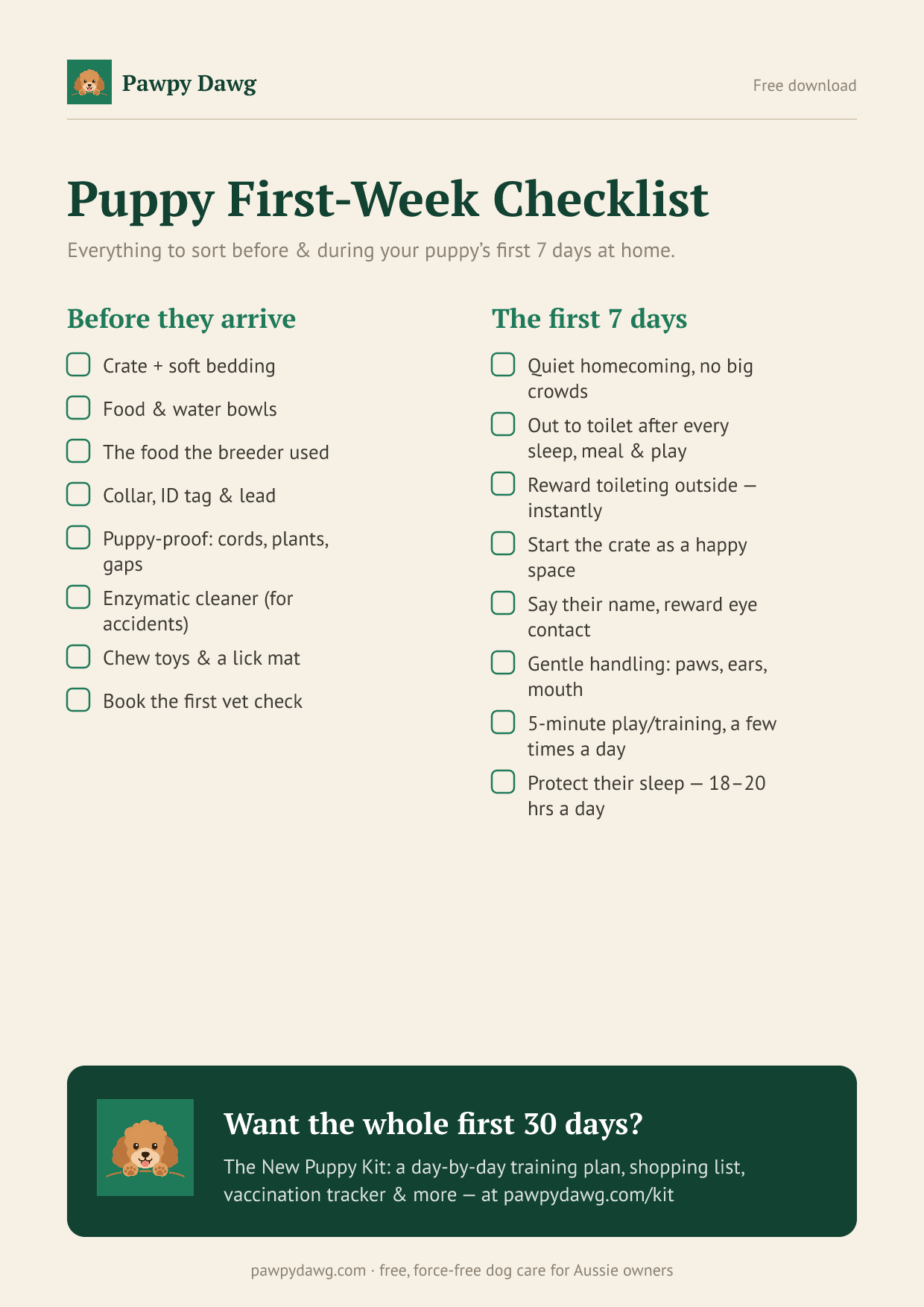
Free printable
Free: the Puppy First-Week Checklist
Everything to sort before and during your puppy's first 7 days home — a printable one-pager. Plus the occasional genuinely useful dog tip. No spam, unsubscribe anytime.
Related guides

How to Stop a French Bulldog Pulling on the Lead (Step-by-Step)
Tired of your French Bulldog pulling on the lead? This step-by-step positive-reinforcement plan delivers real results in 5–10 min daily training sessions.
Read the guide →
How to Stop a French Bulldog Barking at Strangers (Step-by-Step)
Tired of your French Bulldog barking at strangers? This step-by-step positive-reinforcement plan gives you a quick win today and a realistic timeline to fix it.
Read the guide →
French Bulldog Separation Anxiety: A Step-by-Step Fix
Struggling with French Bulldog separation anxiety? This step-by-step, positive-reinforcement plan gives you real fixes, realistic timelines & when to get pro help.
Read the guide →