
How to Stop a French Bulldog Barking at Strangers (Step-by-Step)
Tired of your French Bulldog barking at strangers? This step-by-step positive-reinforcement plan gives you a quick win today and a realistic timeline to fix it.

Written by Bradley Brown
Founder & editor · Reviewed 2026-07-06
You come home from a walk feeling embarrassed, exhausted, and a little defeated. Your Frenchie spotted someone on the footpath and went absolutely feral — lunging, barking, the works. You yanked the lead, muttered an apology to a passing stranger, and wondered what you're doing wrong.
Nothing. You're doing nothing wrong. French Bulldogs are a brachycephalic, people-oriented breed with a big personality packed into a small body. Reacting to unfamiliar people is completely normal dog behaviour — it just needs redirecting. It is not a sign you've ruined your dog, and it is absolutely fixable.
Here's something you can try on your very next walk, right now, before reading any further.
Your Quick Win: The "Look at That" Reset
The moment your Frenchie notices a stranger but before the barking starts:
- Say their name once, calmly.
- The instant they glance back at you, say "yes!" (or click if you use a clicker) and pop a high-value treat straight into their mouth.
- Keep moving. Don't linger near the trigger.
That's it. You're not correcting anything — you're interrupting the bark cycle before it starts and rewarding attention on you instead of the stranger. Even one successful rep today builds the pattern. You'll feel the difference almost immediately.
Why French Bulldogs Bark at Strangers
Understanding the "why" makes training stick.
Most Frenchie reactivity falls into one of three categories:
- Fear/uncertainty – Strangers are unpredictable. Barking makes them go away (or seem to), so the behaviour is self-rewarding.
- Frustration/excitement – Some Frenchies actually want to meet everyone and bark because they're frustrated they can't get there.
- Territorial alert – Common at home near windows, fences, or the front door.
The approach below works for all three, because it addresses the emotional state underneath the bark — not just the bark itself.
The 5-Minute Daily Training Plan
You do not need hour-long sessions. Consistency over five to ten focused minutes a day beats one heroic Saturday effort every time.
Step 1 — Build an Irresistible "Watch Me" (Days 1–3)
Before tackling strangers, your dog needs a solid attention cue at home with zero distractions.
- Hold a treat at your nose and say "watch me."
- The moment they make eye contact, mark ("yes!") and reward.
- Repeat 10–15 times. Do two short sessions a day.
Once they nail it indoors, practise in the backyard, then on a quiet street at a time when few people are around.
Step 2 — Find Your Dog's Threshold Distance (Days 3–7)
Threshold is the distance at which your Frenchie can see a stranger but remains calm enough to take a treat and respond to "watch me." This might be 20 metres. It might be five. It doesn't matter — that's your starting point.
- Walk routes where you can control distance (wide parks, quiet suburban streets early morning).
- The moment a stranger appears at threshold distance, cue "watch me," reward the attention, and move on.
- If your dog is already barking, you're too close. Increase the distance next time — that's not failure, that's information.
Step 3 — Gradual Desensitisation (Weeks 2–4)
Over multiple sessions, you very slowly decrease the distance to strangers, always staying under threshold. The goal is to change your dog's emotional association: stranger appears → good things happen → stranger moves on.
| Distance from stranger | Expected behaviour | What to do |
|---|---|---|
| Far (20+ m) | Calm, takes treats easily | Reward attention, keep walking |
| Medium (10–15 m) | Alert, but responsive | Rapid treat delivery, cue "watch me" |
| Close (under 10 m) | Stiffening, staring, or barking | Too close — increase distance, no punishment |
Never push through a full bark episode. If they've already gone over threshold, simply move away calmly and try again further away next time. Punishing a reactive dog — yelling, lead jerks, spray bottles — increases anxiety and makes reactivity worse over time.
Step 4 — Controlled Meet-and-Greets (Weeks 3–6)
Once your Frenchie is calm at close distances, you can introduce brief, structured greetings with known, calm adults (a neighbour or a friend they haven't met before).
- Ask your helper to stand still and ignore the dog completely.
- Let your Frenchie approach voluntarily at their own pace.
- Reward heavily for any calm sniff.
- Keep it to 10–15 seconds, then move away. End on a good note.
Avoid forcing greetings. A Frenchie that approaches on their own terms is far less likely to bark than one that feels cornered.
Common Mistakes That Slow Progress
- Tensing the lead the moment you see a stranger. Dogs read lead tension instantly. A tight lead signals danger and ramps up reactivity. Practise keeping a loose lead during calm moments so it becomes your default.
- Reassuring the barking. Saying "it's okay, it's okay" in a soothing voice while they're mid-bark can inadvertently reward the behaviour. Stay neutral in the moment.
- Skipping threshold work and going straight to busy areas. A crowded cafe strip on Saturday morning is the final exam, not the classroom.
- Inconsistent responses. If sometimes the barking results in leaving (rewarding), and sometimes in being held still (punishing), the dog gets confused. Pick a protocol and stick to it.
- Expecting overnight results. Reactivity that has been practised for months takes weeks to genuinely shift. A fortnight of good training will show clear improvement, but full reliability takes longer.
Realistic Timeline
| Timeframe | What you'll likely see |
|---|---|
| Day 1–3 | Dog starts offering eye contact before you cue it |
| Week 1–2 | Fewer barking episodes; threshold distance reduces slightly |
| Week 3–4 | Noticeably calmer on routes with occasional pedestrians |
| Week 6–8 | Reliable response to "watch me" near strangers in most contexts |
| 3+ months | Generalised calm behaviour, including busier environments |
These are realistic averages for a consistent owner doing five to ten minutes daily. Setbacks are normal — a bad week doesn't erase progress.
When to Call a Professional
Some situations genuinely benefit from hands-on help, and there's no shame in that.
Consider consulting a certified dog trainer or veterinary behaviourist if:
- Your Frenchie has snapped at or bitten a stranger (even once).
- The barking is escalating despite weeks of consistent training.
- The reactivity is paired with extreme anxiety in other contexts (separation distress, generalised fearfulness).
- You feel unsafe on walks.
In Australia, look for trainers accredited through the Delta Society Australia or the Pet Professional Guild Australia, both of which require force-free methods. A good behaviourist may also recommend your vet assess whether anxiety medication could support the training — in severe cases, this combination is far more effective than behaviour work alone.
A Note on Management While You Train
Training takes time. In the meantime, management reduces stress for everyone:
- Walk at quieter times — early morning or after 8 pm on weekdays.
- Use a front-clip harness — reduces pulling and gives you better directional control without discomfort.
- Cross the street early — before your dog hits threshold, not after.
- Cover windows at home if fence or street barking at passers-by is a separate issue.
Management isn't giving up. It's preventing the rehearsal of unwanted behaviour while the new behaviour takes root.
As an Amazon Associate we earn from qualifying purchases.
Frequently asked questions
Why does my French Bulldog bark at strangers but not at people it knows?
This is classic reactivity driven by uncertainty — strangers are unpredictable and your Frenchie hasn't built up a positive history with them yet. Dogs generalise slowly, so familiar faces feel safe while new ones trigger a defensive or excited response. With consistent desensitisation training, your dog learns that strangers predict good things and the barking fades.
How long does it take to stop a French Bulldog from barking at strangers?
Most owners see a noticeable improvement within two to four weeks of consistent daily training, but reliable calm behaviour in busy environments typically takes six to twelve weeks. Dogs that have been practising reactive behaviour for years may take longer. Consistency matters far more than session length — five minutes every day beats an hour once a week.
Should I socialise my French Bulldog with strangers to fix the barking?
Yes, but carefully. Forcing your Frenchie into close contact with strangers before they're ready can backfire and increase anxiety. The key is gradual, controlled exposure — starting at a distance where your dog stays calm, rewarding that calm, and only decreasing the distance over time. Structured meet-and-greets with calm, cooperative adults work well once your dog is already relaxed at close range.
Is it okay to tell strangers not to approach my barking French Bulldog?
Absolutely — and it's actually the right thing to do. Well-meaning strangers who rush up to a reactive dog can undo weeks of training in seconds. A simple 'he's in training, please don't approach' is perfectly reasonable. Most people respect it, and protecting your dog's threshold is part of the training process.
Can I use a bark collar to stop my French Bulldog barking at strangers?
Bark collars — whether spray, vibration, or shock — are not recommended for reactivity. They suppress the bark without addressing the underlying emotion, which can increase anxiety and sometimes cause the dog to escalate to biting without warning. Positive-reinforcement-based desensitisation changes the emotional response and produces lasting, safer results.
My French Bulldog only barks at strangers on the lead — why?
This is called barrier frustration or on-lead reactivity, and it's very common. The lead restricts your dog's ability to approach or retreat, which amplifies their emotional response. Off-lead, many of these dogs would simply sniff and move on. A front-clip harness, a loose lead technique, and threshold-based training all help significantly with this specific pattern.
Free printable
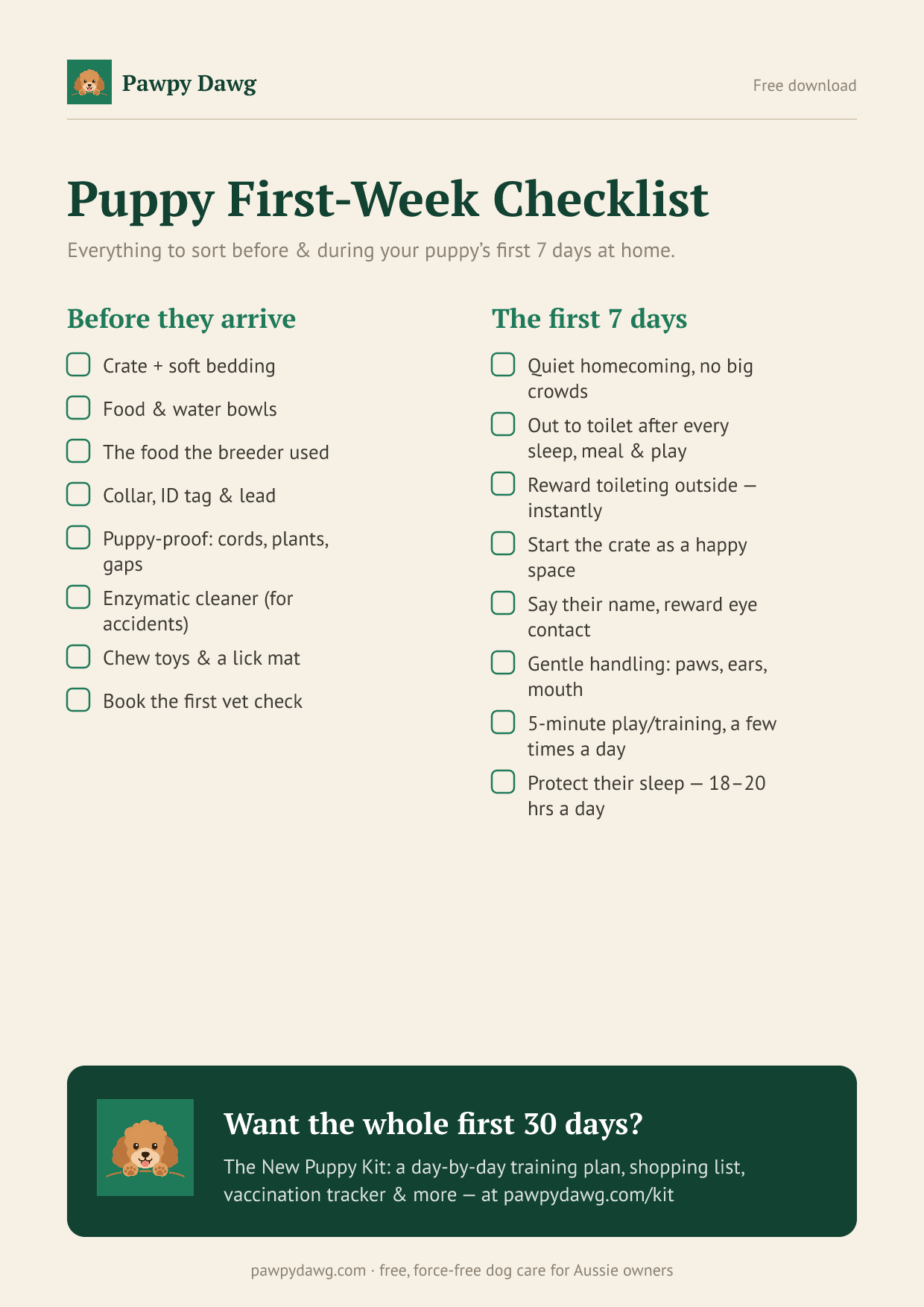
Free: the Puppy First-Week Checklist
Everything to sort before and during your puppy's first 7 days home — a printable one-pager. Plus the occasional genuinely useful dog tip. No spam, unsubscribe anytime.
Related guides
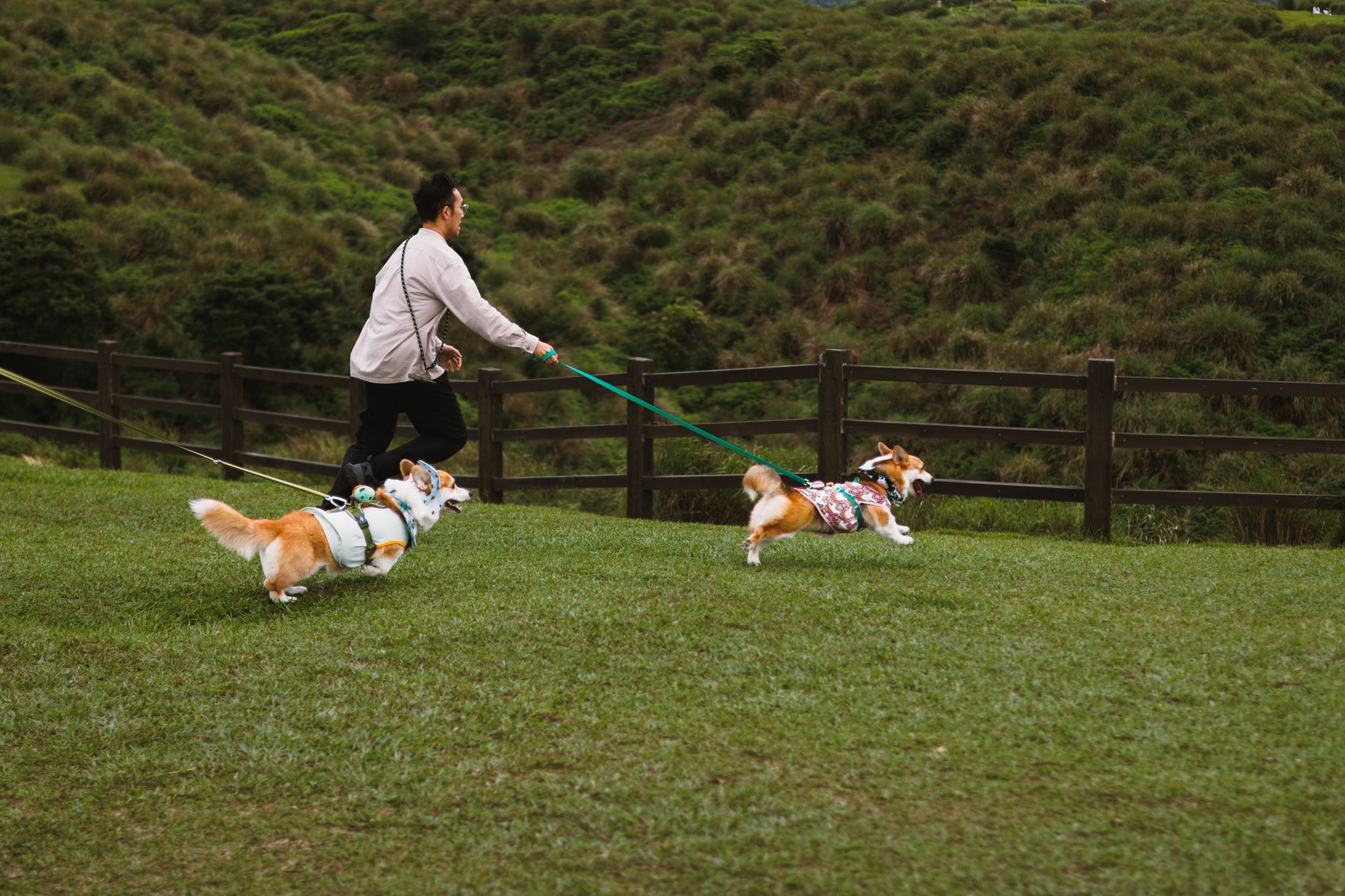
How to Stop a French Bulldog Pulling on the Lead (Step-by-Step)
Tired of your French Bulldog pulling on the lead? This step-by-step positive-reinforcement plan delivers real results in 5–10 min daily training sessions.
Read the guide →
French Bulldog Separation Anxiety: A Step-by-Step Fix
Struggling with French Bulldog separation anxiety? This step-by-step, positive-reinforcement plan gives you real fixes, realistic timelines & when to get pro help.
Read the guide →
How to Stop a French Bulldog Jumping Up on People (Step-by-Step)
Tired of your French Bulldog jumping up on people? This step-by-step positive-reinforcement plan gets real results in 5–10 min/day. Realistic timelines included.
Read the guide →