
How to Toilet Train a Border Collie: A Realistic Plan
Master border collie toilet training with this step-by-step positive-reinforcement plan. Realistic timelines, common mistakes, and when to call a pro.

Written by Bradley Brown
Founder & editor · Reviewed 2026-06-30

Border Collies are one of the sharpest breeds on the planet, which cuts both ways during toilet training. They pick up routines fast — but they also notice every inconsistency you make and will exploit it. The good news: a structured, reward-based plan gets most Border Collies reliably clean indoors within four to eight weeks. Here's exactly how to do it.
What You Need Before You Start
Gather these before bringing a puppy home or starting fresh with an older dog:
- An enzymatic cleaner (e.g., Nature's Miracle or BioZet Attack) — standard cleaners leave odour traces that draw dogs back to the same spot
- High-value treats cut small (think pea-sized chicken, cheese, or liver treats)
- A crate or pen sized so your dog can stand, turn around, and lie down — not a bedroom
- A consistent outdoor toilet spot — same patch of grass every single time
- A simple log — a notes app on your phone works fine — to track when your dog eats, drinks, sleeps, and toilets
Step-by-Step Border Collie Toilet Training Plan
Step 1: Build a Tight Feeding and Watering Schedule
Free feeding makes toilet timing unpredictable. Feed your Border Collie at the same times daily — typically morning, midday (for puppies), and evening. Pick up the bowl after 15–20 minutes whether the food is finished or not. Most puppies need to toilet within 5–30 minutes of eating, so a predictable feeding schedule gives you predictable toilet windows.
Do not restrict water, but note when your dog drinks heavily — a big drink usually means a toilet trip within 20–40 minutes.
Step 2: Know the Go-Times
Border Collie puppies need to go out at these moments without exception:
- Immediately after waking (morning, naps, any sleep)
- Within 15–30 minutes after every meal
- After any exciting play session
- Every 1–2 hours during the day (8-week-old pups have bladder control for roughly one hour per month of age, so an 8-week puppy can hold it for about 2 hours maximum — and that's pushing it)
- Last thing at night, right before crating
Step 3: Introduce a Toilet Cue Word
Choose a word — "toilet", "go wee", "outside" — and say it calmly once as your dog begins to squat and eliminate. After they finish, mark the behaviour with "yes!" or a clicker and deliver a treat within three seconds. The timing matters enormously. Treating inside the house after coming back in teaches the dog that coming inside earns the reward, not the elimination itself.
Step 4: Use Confinement Strategically, Not Punitively
A crate is not a punishment box — it's a management tool. Dogs instinctively avoid soiling their sleeping area, so a correctly sized crate prevents accidents when you can't supervise. Keep crate time reasonable:
- Under 16 weeks: no more than 1–2 hours during the day
- 4–6 months: up to 3–4 hours
- Never crate all day as a primary solution
When your dog is out of the crate and inside, keep them in the same room as you. Tether them to your belt with a lead if needed. If you can't watch them, they go in the crate or pen.
Step 5: Handle Accidents Without Drama
If you catch your dog mid-accident, calmly interrupt with a neutral sound (a quiet "ah-ah"), scoop them up or lead them outside to finish, then reward if they complete the act outdoors. Do not scold, rub their nose in it, or raise your voice — this creates anxiety, not understanding, and anxious Border Collies often toilet more, not less.
If you find the accident after the fact, say nothing to the dog. Clean it thoroughly with enzymatic cleaner and adjust your supervision. The accident is information: your routine has a gap.
Step 6: Fade Supervision Gradually
Once your dog has gone two full weeks without an indoor accident, start giving them slightly more unsupervised freedom — one room at a time, for short periods. This is where most owners rush and trigger a regression. Treat two weeks clean as a checkpoint, not graduation.
Realistic Timeline
| Age / Stage | Typical Milestone |
|---|---|
| 8–10 weeks | Learning the routine, accidents daily |
| 10–14 weeks | Fewer accidents, starting to signal |
| 4–6 months | Mostly reliable with supervision |
| 6–12 months | Solid reliability indoors |
| Adult rescue dog | 2–6 weeks to re-pattern with consistency |
Border Collies often show faster progress than many breeds, but individual variation is real. Some pups crack it at 12 weeks; others take until six months. Health issues, stress, and owner consistency all shift the timeline.
Common Mistakes That Stall Progress
Rewarding at the wrong moment. Treating the dog after you've walked back inside rewards the walk, not the toilet. Stay outside until elimination happens, treat immediately, then go in.
Inconsistent family rules. If one person lets the dog roam unsupervised while others don't, the dog never fully generalises the rule. Everyone in the household must follow the same protocol.
Punishing old accidents. Dogs live in the present. Scolding for an accident found an hour later achieves nothing except damaging your relationship.
Underestimating stress. A move, a new pet, a change in schedule — any significant stressor can trigger regression in a dog who was previously reliable. Respond by tightening supervision again, not punishment.
Skipping the enzymatic cleaner. If the smell remains, the spot will be reused. Standard household cleaners don't break down the urine proteins dogs can still detect.
Expecting too much too fast. Full bladder and bowel control isn't physically possible in young puppies. You're managing their biology as much as training their behaviour.
Quick Checklist: Are You On Track?
- Fixed meal times with food picked up after 15–20 minutes
- Taking the dog to the same outdoor spot every time
- Rewarding within 3 seconds of elimination outdoors
- Supervising or confining when unsupervised indoors
- Using enzymatic cleaner on every accident
- Tracking go-times to spot patterns
- Keeping calm during and after any accident
When to Get Professional Help
If your Border Collie is older than six months, has been on a consistent plan for four or more weeks, and is still having daily accidents, rule out medical causes first. A vet check for urinary tract infections, incontinence, or intestinal issues costs around $80–$150 AUD for a standard consult and is worth doing before assuming it's purely a training problem.
If the vet gives the all-clear, a certified professional dog trainer (look for members of the Delta Society Australia or PPG Australia) can assess your specific situation. One or two sessions — typically $100–$200 AUD per session — often identifies the exact gap in your approach. For Border Collies with anxiety-related toileting (submissive urination, fear responses), a trainer experienced in behaviour modification will get results far faster than generic advice.
As an Amazon Associate we earn from qualifying purchases.
Frequently asked questions
How long does border collie toilet training take?
Most Border Collie puppies reach reliable indoor cleanliness between four and twelve months of age, with many showing strong progress by four to six months. Adult rescue Border Collies can often be re-patterned within two to six weeks on a consistent routine. Speed depends heavily on the owner's consistency, the dog's health, and how stressful the environment is.
Why does my Border Collie keep having accidents even after weeks of training?
The most common causes are inconsistent supervision, rewarding the dog at the wrong moment (indoors rather than the instant they toilet outside), or a lingering scent from previous accidents that wasn't fully removed. Rule out a medical cause — urinary tract infections are common in young dogs and cause urgent, frequent accidents that look like a training failure.
Should I use puppy pads for a Border Collie?
Puppy pads can work for very young puppies in apartments without easy outdoor access, but they add an extra step — you'll eventually need to train the dog off the pad and onto grass. For most situations, going straight to outdoor toilet training is simpler and faster. If you do use pads, move them progressively closer to the door and then outside over several weeks.
At what age can a Border Collie puppy be expected to be fully toilet trained?
Physically, puppies don't have full bladder and bowel control until around four to six months. 'Fully trained' in the sense of being reliable without constant supervision usually comes between six and twelve months. An 8-week-old pup simply cannot hold on for long periods no matter how well you train — biology is the limiting factor.
Is it normal for a toilet-trained Border Collie to suddenly start having accidents?
Yes, regression is common and usually has a clear trigger — a house move, a new pet, a change in routine, or a stressful event. Medical causes like UTIs, gastrointestinal upsets, or hormonal changes (particularly in intact females around seasons) are also common culprits. If regression appears suddenly without an obvious cause, a vet check is the right first step.
Can I toilet train an older Border Collie or a rescue dog?
Absolutely. Older dogs and rescues often train faster than puppies because they have better bladder control and learn associations more quickly. The same principles apply — consistent schedule, reward at the right moment, enzymatic cleaner on accidents, and calm responses to mistakes. Expect a realistic window of two to six weeks rather than the months required for a very young puppy.
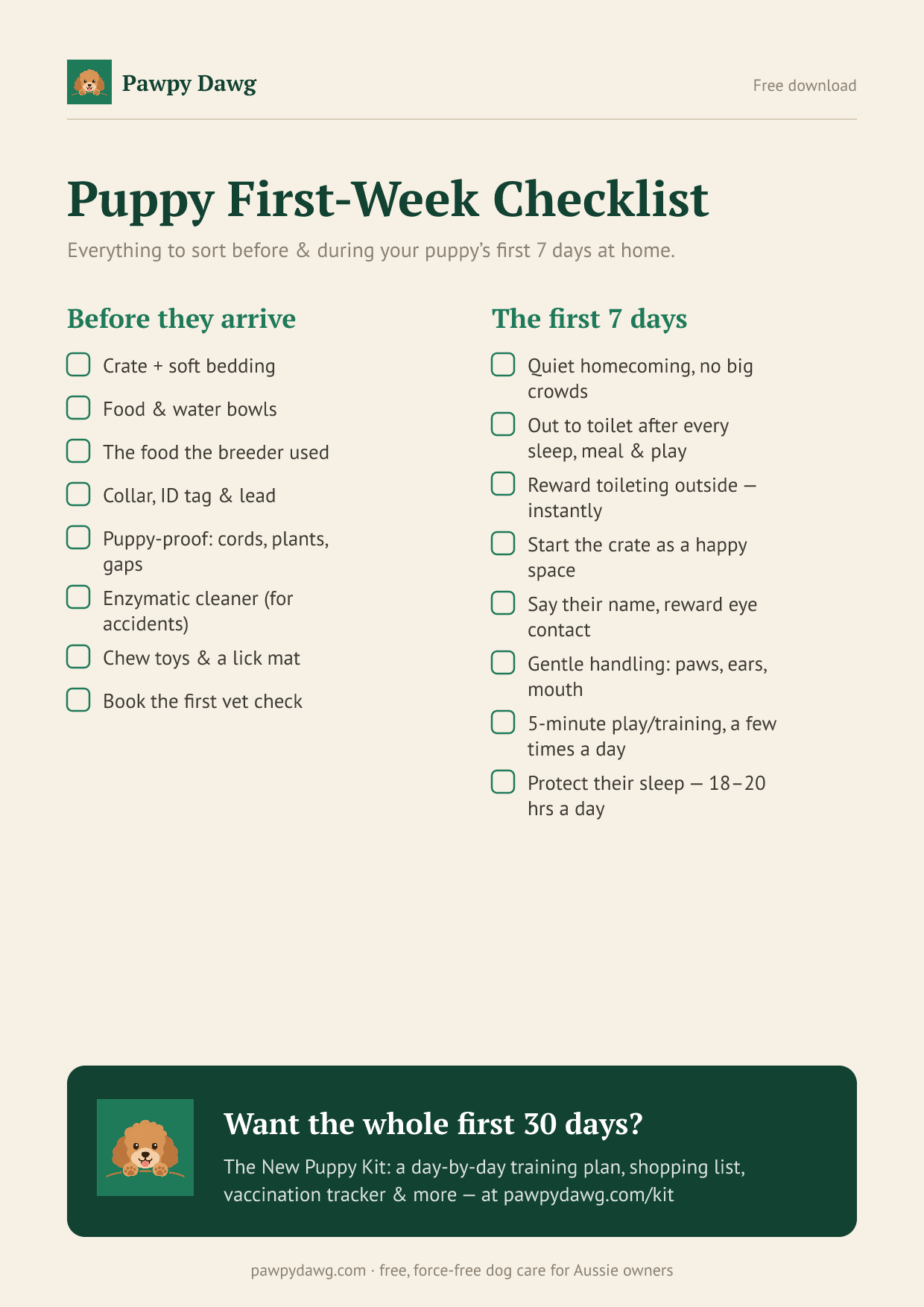
Free printable
Free: the Puppy First-Week Checklist
Everything to sort before and during your puppy's first 7 days home — a printable one-pager. Plus the occasional genuinely useful dog tip. No spam, unsubscribe anytime.
Related guides

How to Stop a Border Collie Pulling on the Lead (Step-by-Step)
Stop your Border Collie pulling on the lead with this step-by-step positive reinforcement plan. Realistic timelines, common mistakes & when to get pro help.
Read the guide →
How to Stop a Border Collie Barking at Strangers (Step-by-Step)
Border collie barking at strangers? Follow this step-by-step positive-reinforcement plan with realistic timelines, common mistakes, and when to call a pro.
Read the guide →
Border Collie Separation Anxiety: A Step-by-Step Fix
Practical step-by-step plan to treat border collie separation anxiety using positive reinforcement. Realistic timelines, common mistakes & when to get vet help.
Read the guide →