
Groodle Training Guide: A Realistic 8-Week Plan
A realistic 8-week groodle training plan built around their clever, eager temperament — 5–10 minutes a day, no experience needed.

Written by Bradley Brown
Founder & editor · Reviewed 2026-07-16
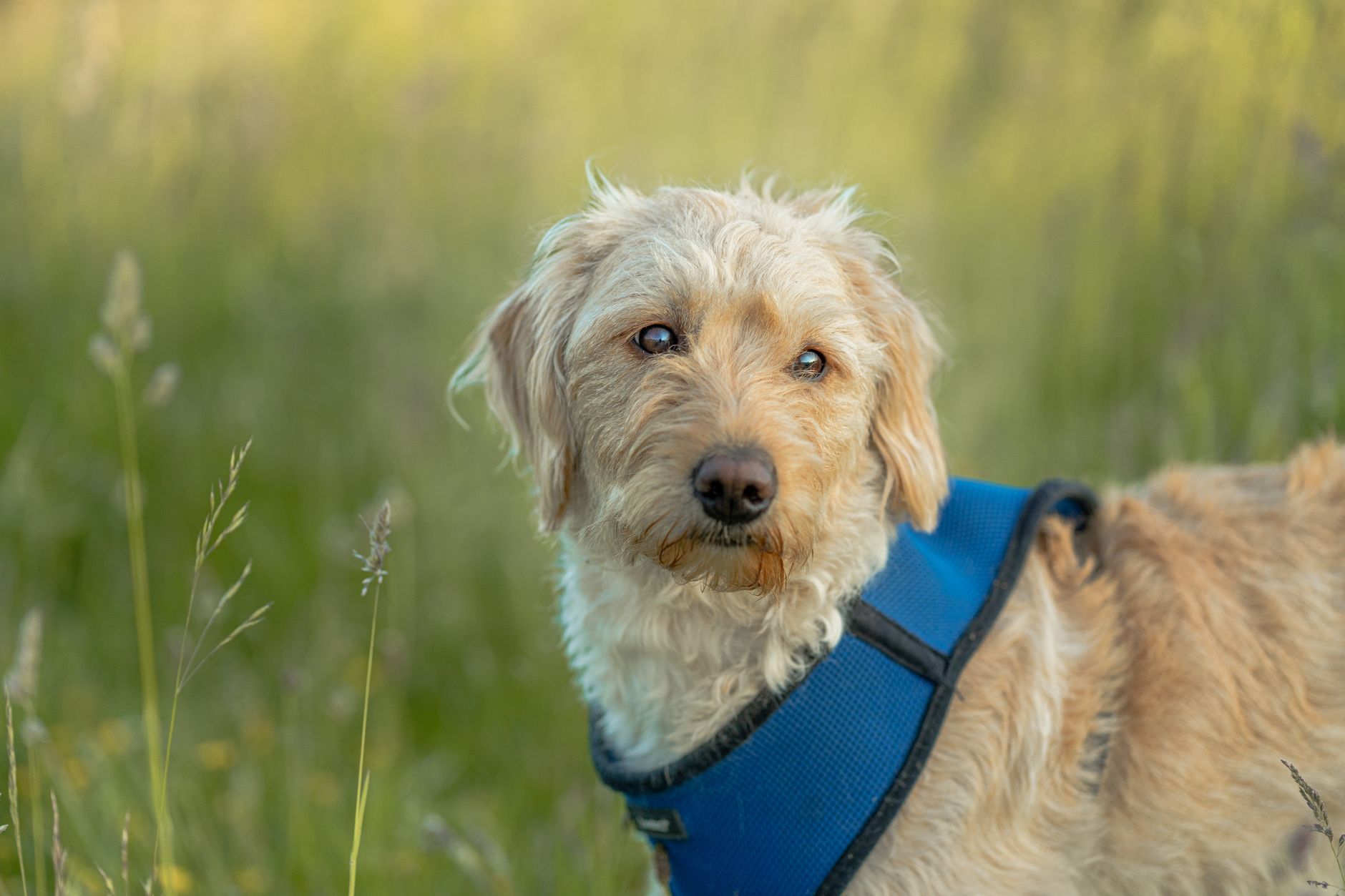
Groodles are bright, people-oriented dogs that genuinely want to get things right — which makes training a pleasure when you meet them where they are. This clinic answers the questions owners actually ask, week by week, so you can stop second-guessing and start making progress.
Is my Groodle too hyper to focus on training right now?
Almost certainly not. What looks like an inability to focus is usually a combination of under-stimulated energy and a training session that's gone on too long. Groodles inherit the Golden Retriever's sociability and the Poodle's intensity, which means they fire up fast — and switch off just as fast if they're bored or overwhelmed.
The fix is short, sharp sessions: five minutes, twice a day, beats thirty minutes once a week every single time. Start training after a walk or backyard play session so the edge is off, then train before their meal so food rewards land with real value. Most owners find their Groodle's focus clicks into place within a few days of this structure alone.
One more thing worth knowing: puppies under 16 weeks have an attention span measured in seconds. If yours is young, lower your expectations, celebrate tiny wins, and know that the "scatterbrained puppy" phase is temporary and completely normal.
What should weeks 1 and 2 actually look like?
Weeks one and two are about foundations, not party tricks. The three skills worth your entire focus are: name recognition, sit, and coming when called — in that order.
Name recognition is simpler than it sounds. Say the name once, the moment your dog looks at you, mark it with a cheerful "yes!" and give a treat. Repeat ten times per session. Within two or three days, most Groodles are whipping their heads around reliably.
Sit follows naturally. Hold a treat to your dog's nose, move it slowly back over their head — the bottom will lower as the nose follows up. The moment the bum touches the ground, mark and reward. Avoid pushing the hindquarters down; luring is faster and kinder.
Recall — coming when called — is the skill that could one day save your dog's life, so practise it daily even when it feels easy. Call once (never repeat the command if they don't come), crouch down, open your arms, and throw a small party when they arrive. Never call your dog to you for something they dislike, like nail clipping or a bath, during this early period. You want "come" to mean "good things happen."
How do I handle weeks 3 and 4 without losing momentum?
By week three, the novelty has worn off for owners far more often than it has for the dog. Groodles are social learners — they thrive on interaction — so this is the time to add variety rather than drill the same commands robotically.
Build on what you have:
- Drop (down): from a sit, lure the treat to the floor between the front paws, then forward along the ground. When elbows hit the floor, mark and reward.
- Stay: ask for a sit, take one small step back, return immediately and reward before they get up. Add distance and duration in tiny increments — one step at a time, one extra second at a time.
- Leave it: hold a treat in a closed fist, wait for your dog to stop nosing and pawing at it, then reward with a different treat from your other hand. This keeps the value of "leave it" honest.
Keep sessions at five to ten minutes. If your Groodle starts sniffing the ground, yawning, or looking away, the session is over — end on a win by asking for something easy, rewarding well, and calling it done.
Weeks 5 and 6: When can I start proofing and working off-lead?
"Proofing" just means practising what your dog already knows in new places and with new distractions — because a Groodle who sits perfectly in your kitchen may look at you blankly in the park, and that's not disobedience, it's just how dog learning works. Skills don't automatically transfer to new environments; they need to be taught there too.
Start by taking your week 1–4 skills to slightly more distracting locations: the front yard, a quiet street, a friend's backyard. Reward more heavily in distracting environments, not less — the competition for your dog's attention is higher, so your treats need to be better (think small pieces of cooked chicken or cheese, not plain kibble).
Off-lead work in a safe, enclosed space can begin now for dogs who have a reliable recall indoors and in the garden. A 10-metre long-line is invaluable here: it gives freedom while keeping you in control, and it prevents the bad habit of your dog learning they can ignore you when there's no lead attached. Avoid retractable leads — they teach dogs to pull and give you very little control if something goes wrong.
Weeks 7 and 8: What does "finished" training actually look like?
Honest answer: it doesn't look like anything finished. Training is an ongoing conversation between you and your dog — but by week eight, you should have a dog who responds to their name, sits, drops, stays for 20–30 seconds, comes when called in low-distraction environments, and can leave something tempting alone on cue. That's a genuinely well-mannered dog.
In weeks seven and eight, shift your focus to real-life practice rather than formal sessions. Ask for a sit before the food bowl goes down. Ask for a drop before throwing the ball. Use "leave it" on the footpath. These micro-training moments take ten seconds and compound into rock-solid habits because they happen dozens of times a day in contexts that actually matter to your dog.
If you haven't already, this is also a good time to book a group obedience class — not because you've done anything wrong, but because the controlled distraction of other dogs and people is incredibly useful for proofing, and a good trainer will catch anything that's drifting before it becomes a habit. Group classes in Australia typically run $180–$280 for a six-week course, and they're worth every cent at this stage.
My Groodle is picking things up fast — am I going too slow?
Probably not, but it's a fair question. Groodles often progress quickly on individual commands and then plateau when complexity increases, so the risk of going too fast is creating a dog who performs beautifully in easy conditions and falls apart when life gets complicated.
If your dog is genuinely nailing every session, you have two good options: raise the criteria (longer stays, greater distances, noisier environments) or add new skills like heel position, place/mat training, or the beginning of impulse control games like "it's yer choice." These build the mental self-regulation that makes a Groodle genuinely easy to live with, rather than just a dog who knows a few tricks.
What you don't need to do is feel guilty about pace. A Groodle who has solid fundamentals at eight weeks of consistent training is ahead of the curve. The owners who get into trouble are the ones who rush to advanced skills before the basics are reliable — so your caution is actually good judgement.
Frequently asked questions
How trainable are Groodles compared to other breeds?
Groodles rank among the more trainable breeds available in Australia, inheriting the Poodle's problem-solving ability and the Golden Retriever's eagerness to please. They respond well to positive reinforcement and tend to pick up new commands quickly. The main challenge is their sociability — they can be easily distracted by people and other dogs, so proofing in real-world environments is important.
What age should I start training my Groodle puppy?
Training can begin the day your puppy comes home, typically from around eight weeks of age. Early puppyhood is a critical socialisation and learning window, so gentle exposure to people, surfaces, sounds, and basic cues during this period pays dividends for years. Keep sessions very short — two to three minutes — and focus on name recognition, sit, and recall before anything else.
Do Groodles need professional training or can I do it myself?
Most owners can handle foundational groodle training at home using positive reinforcement techniques. A group obedience class around the eight-week mark is a worthwhile addition, mainly for the structured distraction and professional oversight rather than because home training is insufficient. If you're seeing significant anxiety, aggression, or resource guarding, consult a qualified trainer or veterinary behaviourist sooner rather than later.
Why does my Groodle listen inside but ignore me at the park?
This is normal and happens because dogs learn skills in context — a command learned in the lounge room hasn't automatically been learned at the park. You need to re-teach and reward the same cues in new environments, starting with low-distraction outdoor spaces and working up gradually. Increasing the value of your rewards (better treats, more enthusiasm) in distracting places helps bridge the gap faster.
How much exercise does a Groodle need during the training period?
Adult Groodles generally need 45–60 minutes of physical activity per day, while puppies should follow the rough guideline of five minutes of structured exercise per month of age to protect developing joints. Mental stimulation from training sessions, puzzle feeders, and sniff walks counts toward their daily needs. A well-exercised Groodle is significantly easier to train because excess energy isn't competing with their focus.
Is clicker training better than using a verbal marker for Groodles?
Both work well — the key is consistency rather than the tool itself. A clicker offers a precise, neutral sound that's distinct from your voice, which some dogs respond to very clearly. A verbal marker like 'yes!' is simpler to use because you always have it with you. Many trainers start with a verbal marker and introduce a clicker later if they want extra precision for more complex skills.
Free printable
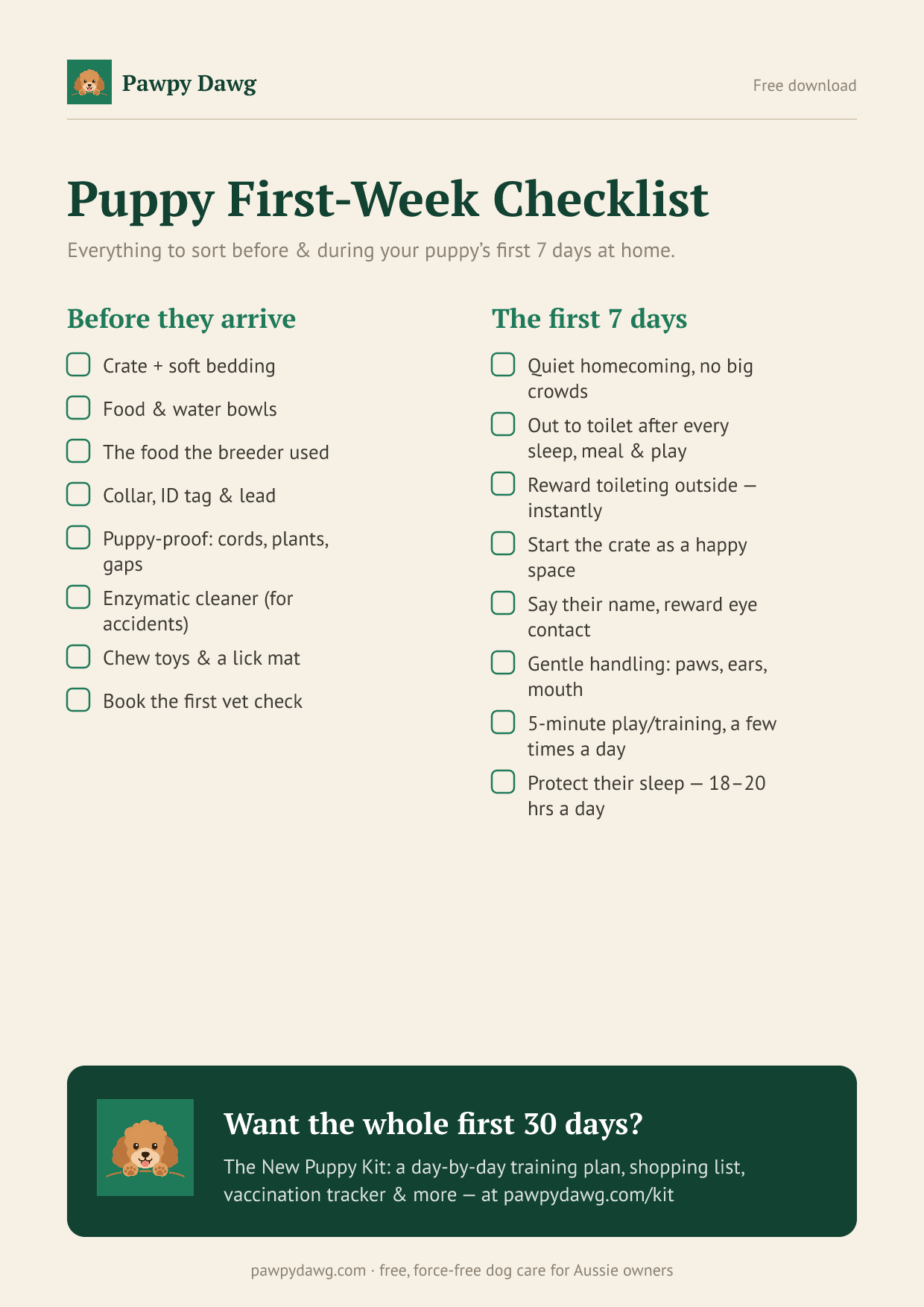
Free: the Puppy First-Week Checklist
Everything to sort before and during your puppy's first 7 days home — a printable one-pager. Plus the occasional genuinely useful dog tip. No spam, unsubscribe anytime.
Related guides
How to Stop a Groodle Pulling on the Lead (Step-by-Step)
Groodle pulling on the lead? Get a step-by-step positive-reinforcement plan, realistic timelines, common mistakes, and when to call a pro trainer.
Read the guide →
How to Stop a Groodle Barking at Strangers (Step-by-Step)
Groodle barking at strangers driving you mad? Follow this positive-reinforcement plan with realistic timelines, common mistakes, and when to call a pro.
Read the guide →
Groodle Separation Anxiety: A Step-by-Step Fix
Groodle separation anxiety is stressful — for you and your dog. This step-by-step positive-reinforcement plan gets results in minutes a day.
Read the guide →