
Border Collie Training Guide: A Realistic 8-Week Plan
A realistic 8-week border collie training plan built for busy owners — short daily sessions, breed-specific tips, and fixes for common BC problem behaviours.

Written by Bradley Brown
Founder & editor · Reviewed 2026-07-02

If your Border Collie has just herded the cat into a corner, shredded the recycling, or turned your evening walk into a full-contact sport — you're not alone, and you haven't ruined your dog. Border Collies are wired to work, think, and move constantly. When that drive has nowhere to go, the couch pays the price. The good news: their legendary intelligence means they respond to training faster than almost any other breed. You don't need hours. You need a plan.
Quick win you can try tonight: Grab 10 pieces of your BC's kibble. Ask for a sit, reward the moment their bottom hits the floor, repeat until the kibble's gone. Done. You've just had your first training session and reminded your dog that listening to you is the most rewarding game in the house.
Understanding the Border Collie Brain Before You Train
Border Collies were bred to make hundreds of independent decisions a day while mustering sheep. That means they are:
- Highly sensitive to movement and sound — they'll notice and react to things you haven't even registered yet
- Prone to obsessive behaviours (ball fixation, shadow chasing, light chasing) when under-stimulated
- Easily over-aroused — excitement tips into chaos quickly if thresholds aren't managed
- Incredibly fast learners — which also means they learn bad habits at the same speed as good ones
The goal of this plan isn't to suppress that drive. It's to give it a legal outlet.
The Golden Rules for This Plan
- Sessions are 5–10 minutes, twice a day. BCs reach mental saturation fast; short sessions beat long ones every time.
- End before they want to. Always finish on a success, while they're still keen.
- Mental work counts as exercise. A 10-minute training session can tire a BC more than a 30-minute walk.
- Consistency beats intensity. Five minutes every day outperforms a 45-minute Saturday session.
Week-by-Week Plan
Week 1 – Foundation (Attention and Impulse Control)
Your BC can't learn anything useful if they can't focus on you first.
- Name game: Say their name once, the moment they glance at you, mark with "yes!" and reward. Do this 10 times per session, twice a day.
- Sit: Lure with a treat above the nose, reward the instant the bottom drops. Fade the lure by day 4.
- Four-on-the-floor: Any time all four paws are on the ground when you arrive home or enter a room, drop a treat quietly at their feet. Ignore jumping completely — no eye contact, no "off."
This week's goal: 8/10 responses to their name before moving on.
Week 2 – Down and Stay Foundations
- Teach down from a sit: lure the nose toward the floor between their front paws.
- Introduce duration in tiny increments: 2 seconds of sit-stay, then 3, then 5. Use a release word ("free" or "OK") every time.
- Begin hand-targeting (nose to palm): a brilliant focus tool for hectic moments.
Week 3 – Loose-Lead Walking
This is where most BC owners hit a wall. Their dog isn't pulling to be dominant — they're pulling because forward movement has always been rewarded by reaching the exciting thing.
- Stand still the moment the lead goes tight. No yanking, no verbal correction.
- The instant the lead goes slack, mark and take one step forward. That step is the reward.
- Practise in the backyard or driveway first — not on a busy footpath.
- Keep sessions to the end of the driveway and back for the first few days. Progress, not perfection.
Week 4 – Impulse Control and the "Leave It" Cue
Border Collies with poor impulse control are a liability near livestock, cyclists, and kids. This week builds the off switch.
- Leave it: Place a treat on the floor, cover with your foot. When they stop trying to get it and look at you, reward with a different treat from your hand. Never reward with the item they were told to leave.
- Wait at doorways: Ask for a wait before going through any door. Release them through after 3–5 seconds. This one habit changes the whole dynamic of your relationship.
Week 5 – Recall
A reliable recall is a safety skill, not a trick.
- Start indoors. Say their name + "come," open your arms, back away a few steps, reward lavishly when they arrive.
- Move to the backyard on a 5-metre long line.
- Never call them to you for something unpleasant (a bath, nail trim, end of play). Go and get them instead. Poisoning the recall is the most common mistake owners make.
Week 6 – Adding Distractions
Take every skill from Weeks 1–5 and practise it somewhere slightly harder:
- Front yard instead of back yard
- A quiet park at an off-peak time
- With a family member walking past as a distraction
Lower your expectations when you raise the difficulty. If they're failing 50% of the time, you've moved too fast — back up one level.
Week 7 – Building a "Settle" Cue
A BC that can switch off on cue is a BC you can take anywhere.
- Put a mat or folded towel on the floor.
- Reward any interaction with it (sniffing, stepping on it).
- Shape toward lying down on it, then add the word "settle."
- Build duration to 2 minutes over the week.
- Eventually, bring the mat to cafés, friends' houses, the vet waiting room.
Week 8 – Proofing and Real-World Practice
This week is about reliability, not new skills.
- Run through your full repertoire in three new locations.
- Practise loose-lead walking past a trigger (another dog, a cyclist) at a distance where your BC can still think.
- Celebrate what you've built. A BC with solid Week 1–7 skills is genuinely well-trained by any standard.
Week-by-Week Progress Checklist
| Week | Key Skill | Daily Time |
|---|---|---|
| 1 | Name response, sit, four-on-floor | 2 × 5 min |
| 2 | Down, stay, hand target | 2 × 7 min |
| 3 | Loose-lead foundations | 2 × 10 min |
| 4 | Leave it, wait at doors | 2 × 7 min |
| 5 | Recall on long line | 2 × 10 min |
| 6 | Distraction proofing | 2 × 10 min |
| 7 | Settle on mat | 2 × 7 min |
| 8 | Real-world proofing | 2 × 10 min |
Handling the Most Common BC Problem Behaviours
Obsessive ball/toy fixation: Use the toy as a reward, not a free-for-all. Put it away after play and bring it out only for structured games. Teach "drop" before throwing again.
Herding children or other pets: This is normal breed behaviour, not aggression. Redirect with an incompatible cue (sit, hand target) the moment you see the stalking crouch begin. Management (baby gates, tethering) protects everyone while training takes effect.
Excessive barking: Identify the trigger. If it's alert barking at movement outside, block visual access to the window as a management step. Reward quiet with calm praise — don't shout at a barking dog, you're just joining in.
When to Call a Professional
If your BC shows resource guarding (growling over food or toys), fear-based reactivity (lunging and barking at dogs or people), or any behaviour that feels unsafe, bring in a certified professional trainer or a veterinary behaviourist before it escalates. These issues are fixable with proper help, and early intervention is always easier than late. Expect to pay $A80–$A180 per session for a qualified private trainer in most Australian capitals — it's money well spent.
As an Amazon Associate we earn from qualifying purchases.
Frequently asked questions
How much exercise does a Border Collie need each day?
Adult Border Collies generally need 60–90 minutes of physical activity daily, but mental stimulation is just as important. A 10-minute training session, a puzzle feeder, or a scent game can meaningfully reduce problem behaviours caused by boredom. Puppies under 12 months should follow the five-minute rule — five minutes of structured exercise per month of age, twice a day — to protect developing joints.
At what age should I start training my Border Collie?
As soon as they come home, typically around 8 weeks of age. Puppies are already learning from their environment from day one, so early, positive experiences and simple cues (sit, name response) set the foundation. Socialisation — calm exposure to different people, surfaces, sounds, and animals — is the most critical work you can do before 16 weeks.
Why does my Border Collie herd my kids or other pets?
Herding is a deeply instinctive behaviour in Border Collies — it's not dominance or aggression, it's the breed doing what thousands of years of selective breeding shaped it to do. Management (separating the dog when you can't supervise) combined with redirecting to an incompatible behaviour like 'sit' or 'go to mat' is the most effective approach. Consistent training reduces it significantly over weeks.
Is it too late to train an adult Border Collie?
Not at all. Adult dogs are often easier to train than puppies because they have longer attention spans and aren't in a constant state of teething-fuelled chaos. The same principles apply regardless of age — short sessions, high-value rewards, and consistency. Deeply ingrained habits take longer to change than new ones, but adult BCs are still highly responsive to reward-based training.
What rewards work best for Border Collie training?
Most Border Collies are highly food motivated, making small, soft treats (chicken, cheese, commercial training treats) ideal for quick repetition. However, many BCs value play and toy rewards just as highly — a brief game of tug or a ball throw can be a powerful reinforcer. Vary your rewards to keep sessions interesting and identify what your individual dog finds most motivating.
Should I use an e-collar or prong collar on my Border Collie?
The mainstream veterinary and animal behaviour consensus — including guidance from the Australian Veterinary Association — recommends against aversive tools like e-collars and prong collars. Border Collies are sensitive dogs and can develop anxiety, fear-based reactivity, or suppressed warning signals when trained with pain or fear. Reward-based methods are well supported by research and are highly effective for this breed.
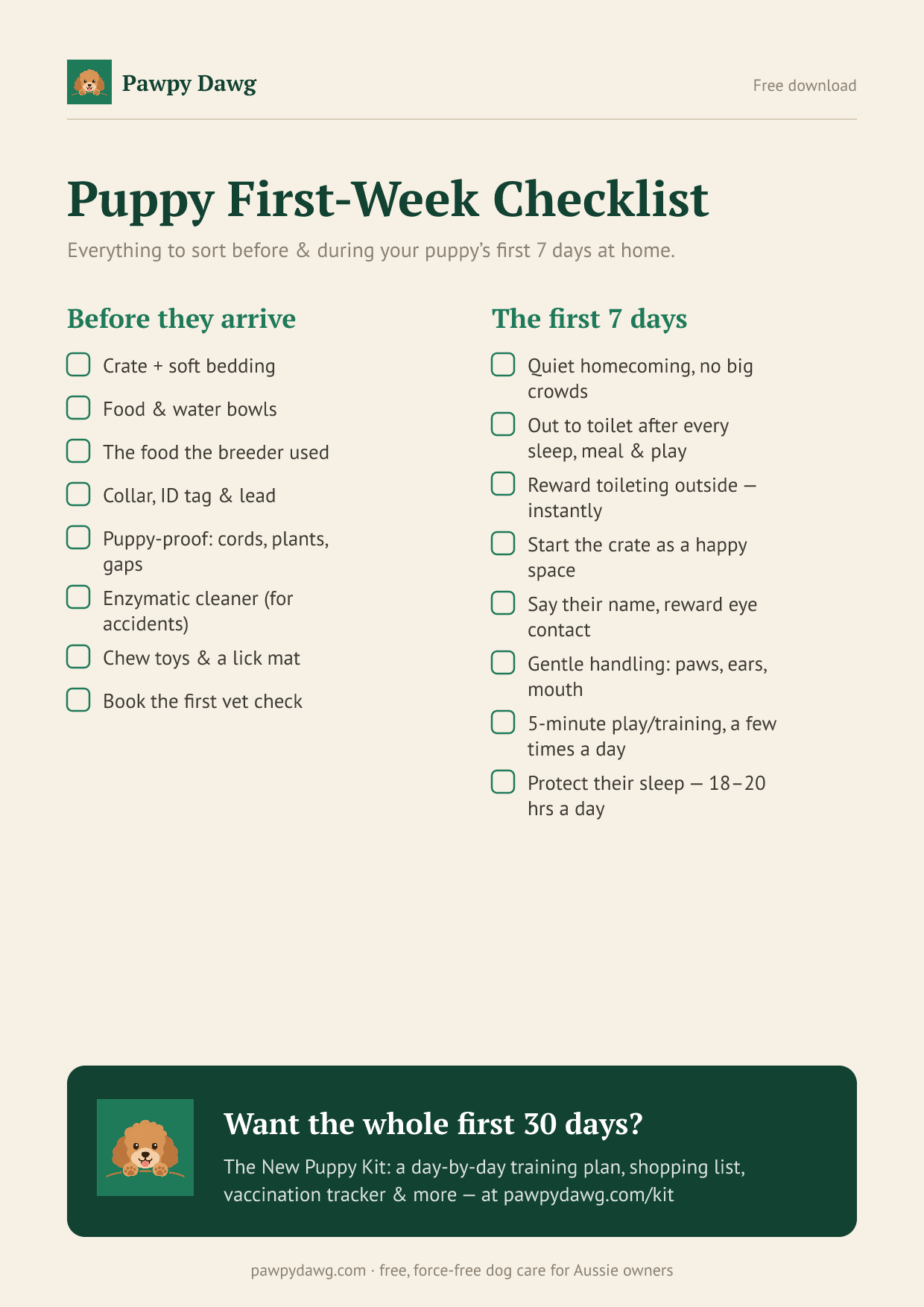
Free printable
Free: the Puppy First-Week Checklist
Everything to sort before and during your puppy's first 7 days home — a printable one-pager. Plus the occasional genuinely useful dog tip. No spam, unsubscribe anytime.
Related guides

How to Stop a Border Collie Pulling on the Lead (Step-by-Step)
Stop your Border Collie pulling on the lead with this step-by-step positive reinforcement plan. Realistic timelines, common mistakes & when to get pro help.
Read the guide →
How to Stop a Border Collie Barking at Strangers (Step-by-Step)
Border collie barking at strangers? Follow this step-by-step positive-reinforcement plan with realistic timelines, common mistakes, and when to call a pro.
Read the guide →
Border Collie Separation Anxiety: A Step-by-Step Fix
Practical step-by-step plan to treat border collie separation anxiety using positive reinforcement. Realistic timelines, common mistakes & when to get vet help.
Read the guide →