
Kids and Dogs: Teaching Children to Be Safe Around Dogs
Practical kids and dogs safety rules by age, plus how to read warning signs and set up spaces that actually prevent bites — without the lecture.

Written by Bradley Brown
Founder & editor · Reviewed 2026-11-15
Most dog bites to children happen in the family home, with the family dog, while an adult is nearby. That stat isn't meant to scare you — it's meant to redirect your attention. The risk isn't a stranger's dog down the street. It's the ordinary Tuesday afternoon when everyone's tired and nobody's watching closely enough.
Here's what actually works, broken down by the three decisions every household with kids and dogs has to make.
Option A: Age-by-Age Rules (What Kids Can Actually Handle)
Children aren't small adults. Their impulse control, coordination, and ability to read a dog's body language all develop at different rates. Matching your rules to your child's age is the fastest way to reduce incidents.
Toddlers (under 4): No unsupervised contact, ever. Toddlers grab, shriek, fall onto dogs, and make eye contact in ways dogs find threatening. Their job is to learn one rule only: pat gently on the chest, not the head. Head-patting is uncomfortable for most dogs and provokes more defensive reactions than almost anything else.
Primary school (5–9): Kids this age can learn to ask permission before approaching a dog — including your own. Teach them to offer a closed fist at nose height and wait. They can learn to recognise a loose, wiggly dog versus a stiff, still one. Five minutes a few times a week practising on your own dog is plenty.
Tweens and teens (10+): Old enough to understand that a dog growling is communicating, not being naughty, and that punishing a growl removes the warning system. This age group can take on supervised responsibility for feeding, walking, and basic training — which builds genuine dog-reading skills over time.
Who this suits: Every household. These aren't aspirational rules — they're a floor, not a ceiling.
Who it doesn't suit: Families who want a single rule for all ages. It doesn't exist. A 3-year-old and a 12-year-old need genuinely different frameworks.
Option B: Reading the Dog's Warning Signs (Before It Escalates)
Dogs almost always warn before they bite. The problem is that humans — including adults — routinely miss or dismiss those warnings.
The signs, roughly in order from early to late:
- Turning the head away, licking lips, or yawning when nothing is relaxing
- Showing the whites of the eyes ("whale eye")
- Stiffening the body or tail, even if the tail is still wagging (a stiff, low wag is not a happy wag)
- Growling or showing teeth
- Air snap (bite directed away from the target — a final polite warning)
| Warning Signal | What It Means | Correct Response |
|---|---|---|
| Lip lick / yawn | Mild stress | Give the dog space |
| Whale eye | Increasing discomfort | Remove the child immediately |
| Stiff body | High alert | Intervene now, calmly |
| Growl / snarl | Serious warning | Move child away; do not punish the dog |
| Air snap | Last resort warning | Separate completely; reassess setup |
If your dog is regularly reaching the growl stage, that's information: something in the daily routine is pushing the dog past its comfort threshold. That's worth a conversation with a vet or a certified trainer — not a reason to panic, but not something to wait out either.
Option C: Safe Spaces That Do the Heavy Lifting
The most underused tool in kids and dogs safety is architecture. A dog that can leave a situation rarely needs to escalate.
Every dog needs at least one place where children cannot follow — a crate with the door open, a bed behind a baby gate, a laundry with a dog door. When the dog goes there, interaction stops. No exceptions, no "just one more pat."
Teach children that the dog's space is a no-go zone, full stop. Frame it positively: "That's his quiet spot, same as your bedroom." Kids as young as 3 can grasp this if it's consistent.
Feeding time and sleeping dogs are the two highest-risk moments. A gate across the feeding area costs about $40–$80 at any hardware store and eliminates one of the most common bite scenarios entirely.
The Setup That Prevents the Most Bites
If you're choosing one approach to prioritise, choose Option C — the safe space — and build Options A and B around it. Here's why: rules and body-language reading both require consistent adult attention. Safe spaces work even when you're distracted, on a call, or just human.
Set up the physical environment first. Then teach the age-appropriate rules. Then layer in body-language awareness as your children get older. Each step makes the next one easier, and the whole system takes less daily attention than you'd expect — once it's set up, it mostly runs itself.
You haven't ruined anything. You're just setting it up properly now.
As an Amazon Associate we earn from qualifying purchases.
Frequently asked questions
At what age can children be left alone with a dog?
There's no universal age, but most child safety and veterinary organisations recommend children under 10 always have adult supervision around dogs. Even older children should be assessed individually — maturity, the specific dog's temperament, and how well the child reads dog body language all matter more than age alone.
My dog growled at my child — does that mean it's dangerous?
A growl is a warning, not an attack, and it's actually a healthy communication signal. The more important question is why the dog felt the need to warn — something in the interaction pushed it past its comfort level. Review what led up to it, ensure the dog has a safe retreat space, and consult a vet or certified trainer if it happens regularly.
How do I teach a toddler to be gentle with a dog?
Keep it to one rule: gentle pats on the chest, not the head. Demonstrate on the dog yourself and guide their hand the first few times. Toddlers can't reliably self-regulate, so physical supervision — not just verbal reminders — is essential. Never leave them together unattended, even briefly.
What should I do immediately after a dog snaps at or bites my child?
Separate the dog and child calmly. Attend to any wound first — even minor bites should be cleaned thoroughly and assessed by a doctor, as dog bites carry infection risk. Then review the circumstances without punishing the dog until you understand what triggered it. A vet or behaviourist can help determine whether the household setup needs to change.
Is it safe to let kids help feed the dog?
With supervision and the right setup, yes — but feeding time is a known high-risk moment. A baby gate across the feeding area lets older children place the bowl without entering the dog's space. Young children should not handle the food bowl at all until they're old enough to understand and consistently follow the boundary.
How do I approach a strange dog safely — and teach my kids the same?
Always ask the owner's permission first. If they say yes, approach from the side rather than head-on, offer a closed fist at the dog's nose height, and wait for the dog to sniff and move toward you. Teach kids the same steps, and practise on your own dog so it becomes automatic before they encounter unfamiliar dogs.
Free printable
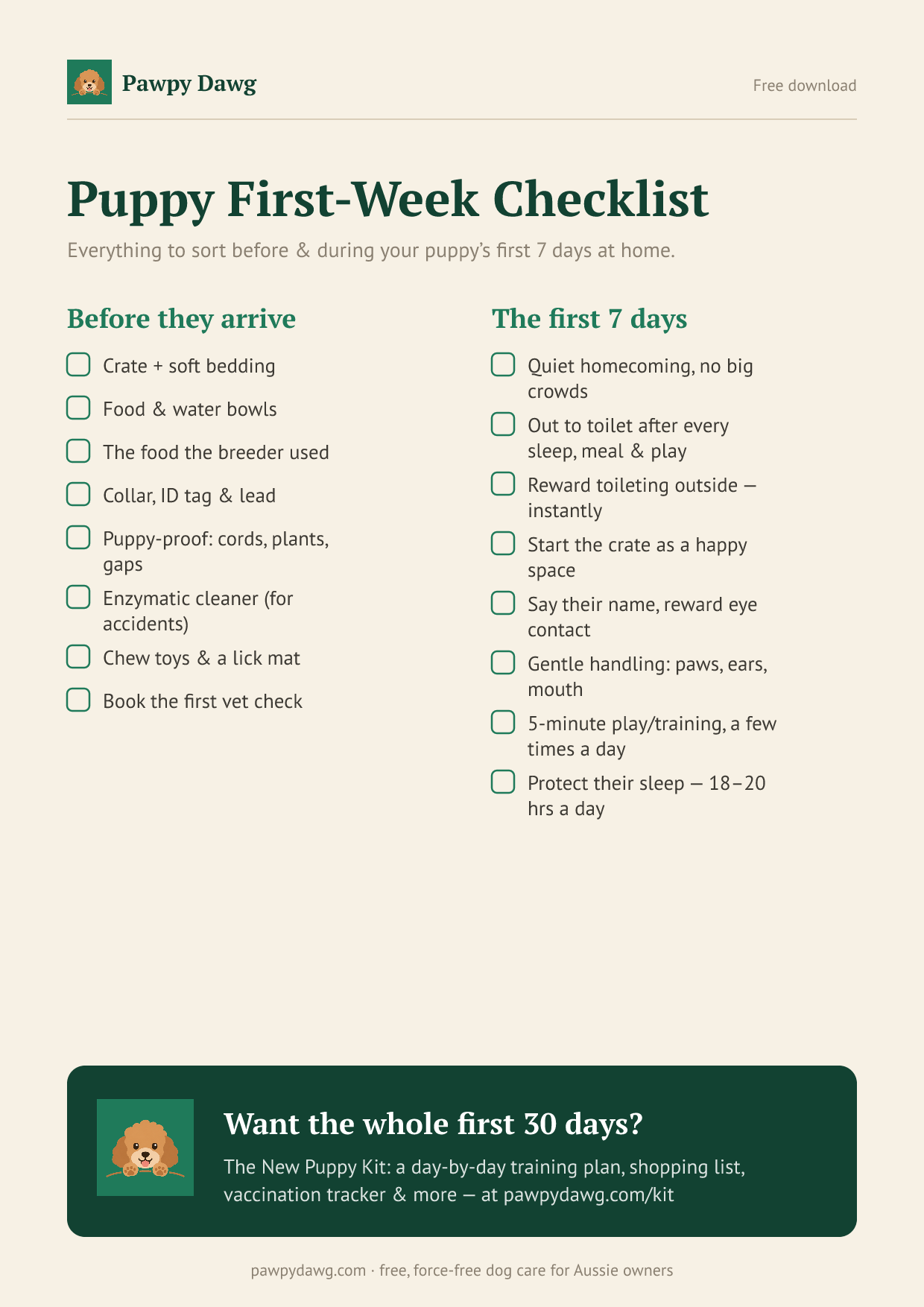
Free: the Puppy First-Week Checklist
Everything to sort before and during your puppy's first 7 days home — a printable one-pager. Plus the occasional genuinely useful dog tip. No spam, unsubscribe anytime.
Related guides
Is Pet Insurance Worth It in Australia? The Honest Maths
Is pet insurance worth it in Australia? We crunch real premiums vs real vet bills — cruciate surgery, snake bite & more — so you can decide with confidence.
Read the guide →
How Much a Dog Really Costs Per Year in Australia (2026 Breakdown)
How much does a dog cost per year in Australia? 2026 line-item breakdown covering food, vet, insurance, grooming & the costs first-timers always miss.
Read the guide →
Dog Vaccination Schedule in Australia: What, When and What It Costs
Confused by C3, C5 and kennel cough? Here's your complete dog vaccination schedule Australia cost guide — puppy timelines, adult boosters & typical AUD prices.
Read the guide →