
Is Pet Insurance Worth It in Australia? The Honest Maths
Is pet insurance worth it in Australia? We crunch real premiums vs real vet bills — cruciate surgery, snake bite & more — so you can decide with confidence.

Written by Bradley Brown
Founder & editor · Reviewed 2026-07-03

A quick note: this guide is general information, not veterinary advice. For anything urgent or specific to your dog, your vet is always the right call.
You just got a quote for pet insurance and your eye is twitching a little. Fair enough. Somewhere between $60 and $120 a month for something you might never use feels like a big ask — especially when the excess, the sub-limits, and the "we don't cover that" clauses are buried in a 40-page PDS. This article does the maths honestly, so you can make a call that actually suits your situation.
The Quick Win: Do This Before You Decide Anything
Before comparing a single policy, open your banking app right now and check whether you have at least $5,000 sitting in a dedicated account you would genuinely not touch for anything other than a vet emergency. If yes, you have real options. If no — or if the honest answer is "it'd come from the credit card" — that changes everything, and insurance deserves a serious look. Keep that number in mind as you read.
What Pet Insurance Actually Costs in Australia (2024 Ranges)
Premiums vary enormously by breed, age, location, and cover level. Here are realistic ballpark figures for a healthy, adult, medium-breed dog with a mid-tier comprehensive policy from major Australian providers (RSPCA Insurance, Bow Wow Meow, PetSure/affiliated brands, Woolworths Pet Insurance):
| Dog profile | Monthly premium (approx.) | Annual cost |
|---|---|---|
| Small breed, under 3 yrs | $45 – $75 | $540 – $900 |
| Medium breed, under 3 yrs | $60 – $100 | $720 – $1,200 |
| Large breed, under 3 yrs | $75 – $130 | $900 – $1,560 |
| Any breed, 7–9 yrs | $100 – $180+ | $1,200 – $2,160+ |
| Any breed, 10+ yrs | $150 – $250+ | $1,800 – $3,000+ |
Key variables that inflate your premium: brachycephalic breeds (Bulldogs, Pugs, French Bulldogs), large breeds prone to orthopaedic issues (Labs, German Shepherds, Golden Retrievers), and dogs over six years old. Premiums typically rise 10–20% at each annual renewal.
Most policies also carry:
- An excess of $100–$200 per condition or per claim (read the PDS — "per condition" is far more expensive over time than "per claim")
- A benefit percentage of 70–90% of the eligible vet bill
- Sub-limits on things like cruciate ligament repairs, dental illness, or cancer treatment — often capped at $2,000–$5,000 even on "comprehensive" policies
Real Vet Bills vs What Insurance Pays
Here's where the rubber meets the road. These are realistic Australian vet costs as of 2024 (costs vary by city, specialist vs general practice):
Cruciate Ligament Surgery (TPLO)
- Total bill: $4,500 – $7,000 per leg (some large breeds need both)
- What insurance pays (80% benefit, $200 excess, $5,000 sub-limit): roughly $3,800 – $4,000
- Your out-of-pocket: $700 – $3,000+
- Verdict: Insurance wins clearly here — this is the single most common large claim for dogs in Australia
Snake Bite (Eastern Brown, Tiger Snake)
- Total bill: $3,000 – $10,000+ depending on antivenom doses required, ICU time
- What insurance pays (80% benefit, $200 excess, no sub-limit): $2,240 – $7,840
- Verdict: Insurance wins decisively — this is a genuine financial emergency
Gastroenteritis / Foreign Body Ingestion (surgery)
- Total bill: $2,500 – $5,000
- What insurance pays: $1,800 – $3,800
- Verdict: Insurance wins
Skin allergies (ongoing)
- Annual vet spend: $800 – $2,500 in consults, Cytopoint injections, Apoquel, special food
- What insurance pays: Often poorly — many policies exclude "food" costs, apply low dermatology sub-limits, or exclude pre-existing conditions after the first year
- Verdict: Self-funding often wins here; read the fine print carefully
Routine care (vaccinations, desexing, dental cleans)
- Verdict: Most comprehensive policies don't cover routine/preventive care at all. Wellness add-ons exist but rarely pay for themselves
When a Savings Account Beats Insurance
A self-funded "vet fund" wins if all of the following are true:
- ✅ You have — or can build — $5,000–$8,000 in a dedicated savings account within 12 months
- ✅ Your dog is a low-risk breed (mixed breed dogs statistically have fewer hereditary conditions)
- ✅ Your dog is under five years old and has no known health issues
- ✅ You are genuinely disciplined about not touching those savings
- ✅ You can absorb the psychological risk of a bad-luck year before the fund is built
A high-yield savings account (currently 4.5–5.5% p.a. with some Australian banks) means your fund earns money while it sits there — something premiums never do.
The Fine Print Traps to Check Before You Sign
These are the clauses that cause the most pain at claim time:
- Pre-existing condition exclusions — Any condition your vet has noted in records before the policy start date (or during the waiting period) is typically excluded for life. A single vet visit for limping before you sign can exclude all orthopaedic claims.
- Bilateral condition clauses — If your dog tears one cruciate ligament, many insurers treat the other leg as automatically pre-existing or apply a separate excess/sub-limit.
- Waiting periods — Most policies have a 30-day waiting period for illness (sometimes longer for orthopaedic conditions — up to 6 months). Emergency accident cover usually kicks in after 48 hours.
- Percentage of benefit vs schedule of fees — Some insurers pay 80% of their internal fee schedule, not 80% of your actual bill. If your specialist charges more than the schedule, you pay the gap.
- Annual premium increases — Premiums are not locked in. A $70/month policy at age two can become $160/month by age eight, precisely when you most want the cover.
- Lifetime vs annual limits — A $12,000 annual limit sounds generous until your dog has a $6,000 cruciate surgery and then develops cancer in the same policy year.
A Simple Decision Framework
Lean toward insurance if:
- Your dog is a breed with known hereditary risks (Labradors, Cavaliers, Bulldogs, German Shepherds)
- You live in a snake-prone area of Australia
- You don't have $5,000+ readily accessible without financial stress
- You know yourself — you'd choose euthanasia over debt, and insurance removes that awful choice
Lean toward a self-funded vet account if:
- Your dog is a young, healthy mixed breed
- You can commit to saving $150–$200/month automatically (equal to or more than a premium)
- You're comfortable with some financial risk in exchange for flexibility
Do both (the hybrid approach): Some owners insure for catastrophic cover only (accident-only policies run $20–$40/month for many breeds) and self-fund routine and mid-range costs. This caps your worst-case exposure without paying for benefits you'll rarely use.
How to Compare Policies Without Losing Your Mind
- Get quotes from at least three providers — try Bow Wow Meow, RSPCA Insurance, Woolworths Pet Insurance, and PetSure-backed brands. Use the same excess and benefit percentage for each so you're comparing apples with apples.
- Download and search the PDS — Ctrl+F "cruciate", "bilateral", "pre-existing", and "sub-limit". What you find in those sections matters more than the headline price.
- Call the insurer before you buy — ask: "If my dog tears one cruciate ligament, how does that affect a future claim on the other leg?" Their answer tells you everything.
- Check the waiting periods — don't sign up the week after your dog starts limping.
- Review annually — if your premium jumps more than 15% and your dog has no claims history, shop around. Loyalty rarely pays with pet insurance.
Frequently asked questions
Is pet insurance worth it for a young, healthy dog in Australia?
It depends on your finances and your dog's breed. For a young mixed-breed dog with no hereditary risk factors, a dedicated savings account can be just as effective and more flexible. For higher-risk breeds like Labradors, Cavaliers, or Bulldogs, insurance from a young age locks in lower premiums before health issues emerge and become pre-existing exclusions.
What does pet insurance typically not cover in Australia?
Most Australian pet insurance policies exclude pre-existing conditions, routine and preventive care (vaccinations, desexing, dental cleans), and often have sub-limits on specific conditions like cruciate ligament repairs or skin allergies. Some policies also exclude bilateral conditions — meaning if one leg is injured, cover for the other leg may be restricted. Always read the Product Disclosure Statement before purchasing.
How much does pet insurance cost per month in Australia?
For a comprehensive policy on a medium-breed adult dog, expect to pay roughly $60–$100 per month. Premiums increase significantly as your dog ages, with older dogs (10+) often costing $150–$250+ per month. Brachycephalic breeds and large breeds with orthopaedic risk profiles attract higher premiums from most insurers.
What is the biggest vet bill pet insurance covers in Australia?
TPLO cruciate ligament surgery ($4,500–$7,000 per leg) and snake bite treatment ($3,000–$10,000+) are among the most common high-cost claims. These are also the scenarios where insurance provides the clearest financial benefit, assuming the condition isn't excluded as pre-existing and no restrictive sub-limits apply.
Can I get pet insurance for an older dog in Australia?
Yes, most Australian insurers will cover dogs up to around 8–9 years old for new policies, though some accept older dogs. Premiums are substantially higher, and any condition already documented in your dog's vet history will be excluded. It's worth getting quotes, but do the maths carefully — annual premiums for a 10-year-old dog can exceed $2,500, which may rival the expected benefit.
Is an accident-only pet insurance policy worth considering?
Accident-only policies are a genuine middle ground — they typically cost $20–$40 per month and cover emergencies like snake bites, car accidents, and foreign body ingestion, while excluding illness. Paired with a self-funded savings account for illness costs, this hybrid approach can cap your worst-case financial exposure at a much lower ongoing cost than full comprehensive cover.
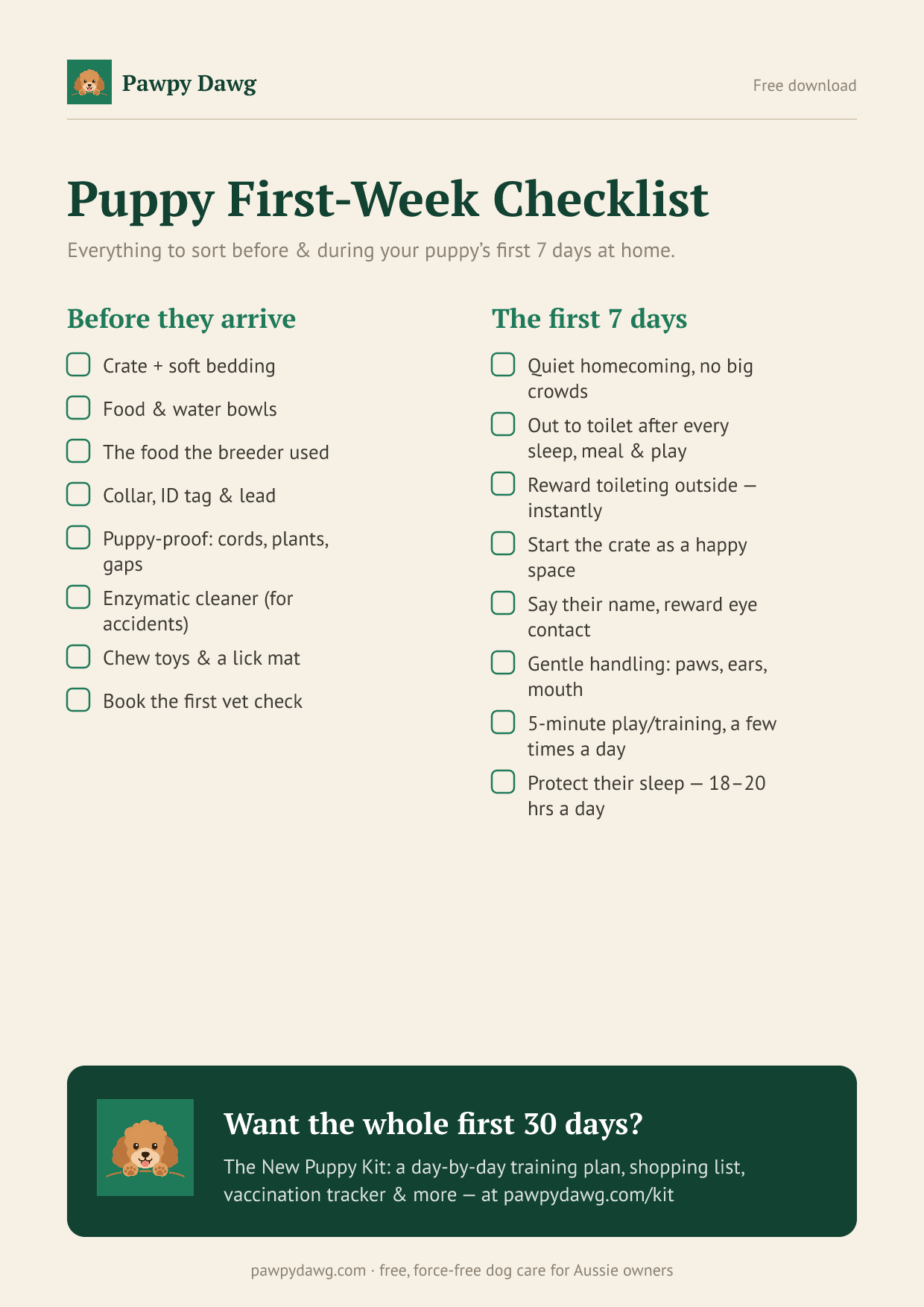
Free printable
Free: the Puppy First-Week Checklist
Everything to sort before and during your puppy's first 7 days home — a printable one-pager. Plus the occasional genuinely useful dog tip. No spam, unsubscribe anytime.
Related guides

How Much a Dog Really Costs Per Year in Australia (2026 Breakdown)
How much does a dog cost per year in Australia? 2026 line-item breakdown covering food, vet, insurance, grooming & the costs first-timers always miss.
Read the guide →
Dog Vaccination Schedule in Australia: What, When and What It Costs
Confused by C3, C5 and kennel cough? Here's your complete dog vaccination schedule Australia cost guide — puppy timelines, adult boosters & typical AUD prices.
Read the guide →
Dog Desexing Costs in Australia: Prices, Timing and Recovery
Dog desexing cost Australia: price ranges by size & state, best timing, low-cost clinic options, and recovery tips every owner needs to know.
Read the guide →