
How to Stop a Kelpie Barking at Strangers (Step-by-Step)
Kelpie barking at strangers driving you mad? Get a realistic, positive-reinforcement plan with quick wins you can try today — no punishment needed.

Written by Bradley Brown
Founder & editor · Reviewed 2026-07-10
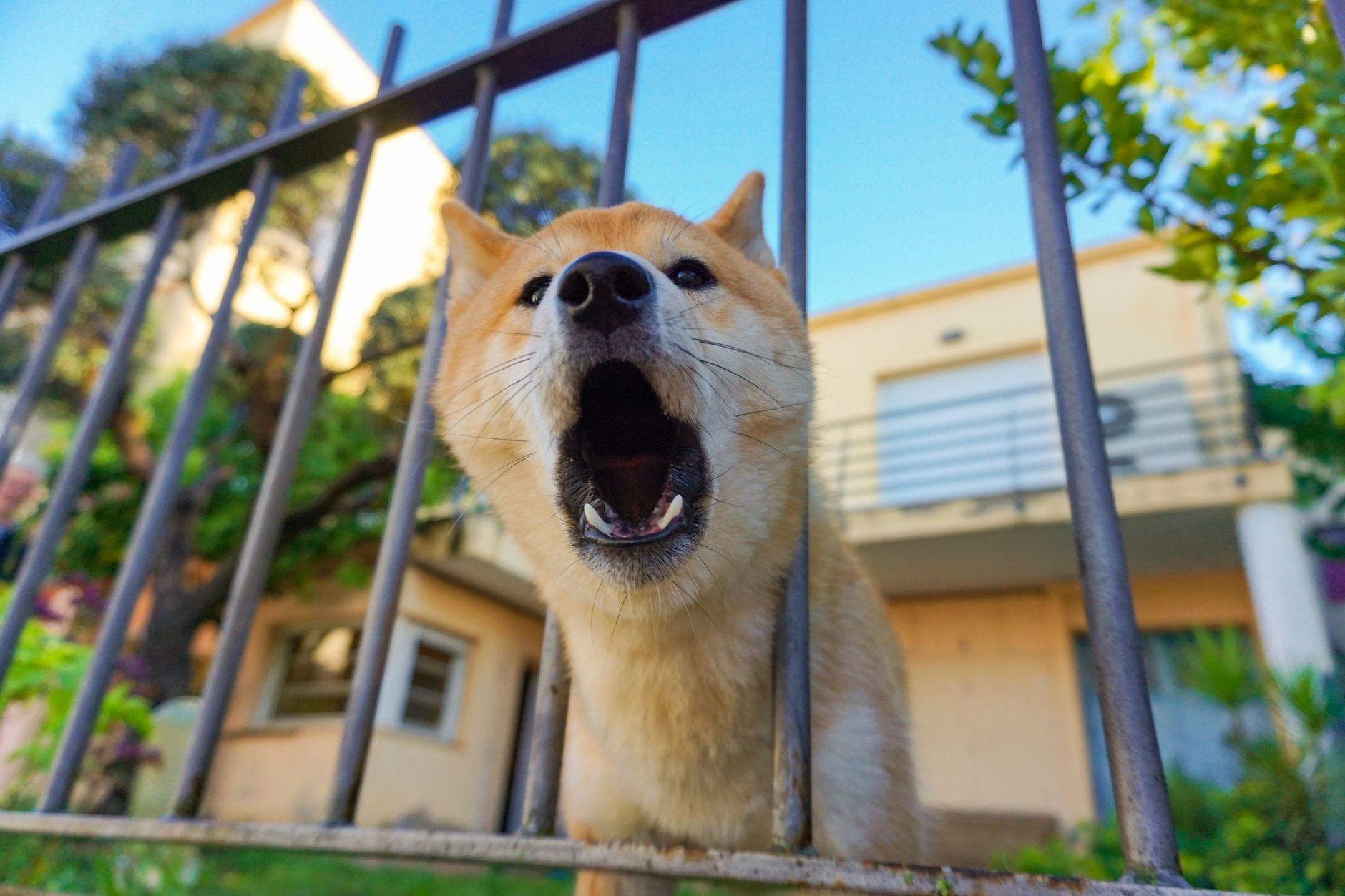
You come home from a walk feeling embarrassed, frustrated, and maybe a little defeated. Your Kelpie launched into a full barking frenzy at the neighbour again, and now you're wondering if you've somehow broken your dog. You haven't. And you're not alone.
Kelpies are working dogs hardwired to notice, assess, and react to movement and strangers — it's literally what they were bred for on Australian properties. That bark isn't defiance or a personality flaw. It's a dog doing what its genetics are screaming at it to do. The good news: it's absolutely fixable with the right approach, even in short daily sessions.
Your Quick Win for Today
Before you read another word, try this on your next walk:
The "find it" interrupt. The moment your Kelpie notices a stranger but before the barking starts, toss a small, high-value treat (chicken, cheese, fritz) on the ground between your dog's front paws and say "find it" in a calm voice. Your dog sniffs the ground, the stranger passes, and the moment ends positively. That's it. One small technique that breaks the reactive loop, starting today.
Why Kelpies Bark at Strangers (It's Not What You Think)
Most owners assume their Kelpie is being aggressive or dominant. In reality, the barking is almost always one of two things:
- Alarm/arousal: "There's a thing! I must alert the herd!" — pure herding instinct.
- Fear or uncertainty: The stranger is unpredictable, and barking creates distance. This is especially common in Kelpies that didn't get a lot of varied socialisation before 16 weeks.
Neither of these is your fault, and neither means the dog is dangerous. Both respond well to the same approach: classical counter-conditioning paired with distance management.
The Step-by-Step Plan (5–10 Minutes a Day)
Step 1: Find Your Dog's Threshold Distance
Your Kelpie has a "threshold" — the distance at which they notice a stranger but can still take a treat and stay below full arousal. Inside that distance, they lose the plot. Outside it, they're calm.
How to find it:
- Take your dog somewhere strangers pass at a predictable pace (a quiet footpath, a park edge).
- Stand still and watch your dog. The moment their body stiffens, ears go up, or they stare hard — that's the threshold edge.
- Take a mental note of the distance. Start your training 3–5 metres beyond that point.
This is your baseline. Don't rush it.
Step 2: Counter-Condition at a Safe Distance (Week 1–2)
The goal: Strangers = cheese rains from the sky. That's it.
- Stand at your safe distance. When a stranger appears in view → feed treats continuously until the stranger is gone.
- No commands needed yet. No "sit," no "leave it." Just: stranger appears → treats flow.
- Keep sessions to 5–8 minutes. Quit before your dog hits threshold. End on a calm moment.
- Repeat daily. Even once-a-day consistency beats three sessions on the weekend.
Over time, you'll notice your dog looking at you when a stranger appears instead of barking. That's called "auto-checking" — it means the association is working.
Step 3: Add a Cue and Slowly Decrease Distance (Week 2–4)
Once your Kelpie is reliably checking in at their safe distance:
- Add a calm verbal marker like "yes!" the moment they look at you instead of barking.
- Feed a treat immediately.
- Very gradually — we're talking half a metre at a time, over multiple sessions — move a little closer to where strangers pass.
- If barking returns, you've moved too fast. Back up. No drama, no punishment.
Rule of thumb: If your dog barks more than twice in a session, you're too close or the environment is too busy. Adjust the distance, not your expectations of the dog.
Step 4: Practise in New Locations
A Kelpie that's calm outside the school at 9am might still lose it at a busy café. Dogs don't generalise well — skills learned in one spot need to be practised in others.
Rotate through 3–4 different locations over weeks 3–6:
- Quiet suburban street
- Café or shopping centre carpark (at a distance)
- Dog-friendly area where strangers walk by
- Near a children's playground (with ample distance)
Each new location effectively resets to "week 1 difficulty." That's normal.
Common Mistakes That Slow Progress
| Mistake | Why It Backfires | What to Do Instead |
|---|---|---|
| Pulling the lead and saying "no!" | Increases arousal and stress, confirms the threat | Calmly increase distance, keep treats flowing |
| Flooding (forcing closeness to "get used to it") | Traumatises sensitive dogs, worsens reactivity | Always work below threshold |
| Inconsistent practice | The brain needs repetition to rewire | Even 5 minutes daily beats sporadic hour-long efforts |
| Using punishment (spray bottles, check chains) | Suppresses the bark without fixing the emotion; can escalate to biting | Positive reinforcement only |
| Expecting a 2-week cure | Reactivity can take 2–6 months of consistent work | Track small wins week by week |
What "Good Progress" Actually Looks Like
Forget the Hollywood version where the dog is suddenly perfect. Real progress looks like:
- Week 1–2: Dog takes treats at safe distance without barking.
- Week 3–4: Dog occasionally glances at you when a stranger appears.
- Week 6–8: Dog reliably checks in at the original safe distance; you've moved 2–3 metres closer.
- Month 3–4: Dog passes strangers on a normal footpath with minor or no reaction.
Celebrate every single small win. You're literally changing your dog's emotional response — that takes time.
Is It Ever Just Too Much Stimulation?
Kelpies need a lot of mental and physical output. A dog that hasn't been worked or mentally stimulated will have a much lower threshold for everything. Before any walk where you're practising:
- Do a 10-minute sniff session in the backyard (scatter kibble in the grass).
- Try 5 minutes of basic nose work or hide-and-seek with food.
- Give a frozen Kong or chew to take the edge off arousal.
A tired brain is a calmer brain.
When to Call in a Professional
Most Kelpie owners can make solid progress with the steps above. But call a certified, force-free dog trainer or veterinary behaviourist if:
- Your dog has snapped at or made contact with a stranger.
- The barking is accompanied by lunging that you physically can't manage.
- There's been no improvement after 8 weeks of daily, consistent work.
- The behaviour is getting worse, not better.
Look for trainers with credentials from the Delta Society Australia, PPGA (Pet Professional Guild Australia), or IAABC. Avoid anyone who recommends prong collars, e-collars, or alpha theory — these approaches are not consistent with current veterinary behavioural science.
A good behaviourist session typically costs $150–$350 AUD and can save months of frustration.
A Note on Muzzle Training
If your Kelpie's barking is intense and you're worried about safety in public during the training period, a well-fitted basket muzzle (not a fabric muzzle for extended use) is a responsible, humane option. Condition it slowly with treats — never just shove it on. A dog that's comfortable in a muzzle is not a "bad dog." It's a safe dog whose owner is doing the right thing while the training catches up.
The fact that you're reading this at whatever hour it is, after a rough walk or a frustrating week, means you care enough to find a better way. That's exactly what your Kelpie needs.
As an Amazon Associate we earn from qualifying purchases.
Frequently asked questions
Why does my Kelpie bark at strangers but not at people it knows?
Kelpies are highly alert working dogs that instinctively assess unfamiliar people as potential threats or unpredictable elements. People they know have a track record — strangers don't. This is a normal breed trait rooted in herding instinct, not aggression, and it responds well to gradual counter-conditioning.
How long does it take to stop a Kelpie from barking at strangers?
Realistic timelines are 2–6 months of consistent daily practice, depending on the dog's history, the severity of the reactivity, and how consistently you train. You'll typically see meaningful improvement within 4–8 weeks if you work below the dog's threshold every day, even for just 5–8 minutes.
Should I tell strangers to ignore my barking Kelpie?
Yes — asking strangers not to approach, make eye contact, or reach out to your dog during training is very helpful. Unwanted approaches can spike arousal and undo a session's progress. A calm 'he's in training, please don't approach' is all you need to say.
Is my Kelpie dangerous if it barks at strangers?
Barking at strangers is not automatically a sign of danger. Most reactive dogs are frustrated or anxious, not aggressive. However, if your dog has lunged and made contact, snapped, or broken skin, consult a veterinary behaviourist promptly — that's a different risk level that needs professional assessment.
Can I use a no-bark collar on my Kelpie?
No-bark collars — whether citronella or electric — are not recommended by veterinary behavioural science for reactivity. They suppress the bark without addressing the underlying emotion, which can increase anxiety and, in some cases, escalate behaviour to biting. Positive reinforcement counter-conditioning is safer and more effective long-term.
My Kelpie is fine off-lead but goes crazy on the lead — why?
This is called 'leash reactivity' and it's extremely common. On a lead, your dog can't create distance from a perceived threat by running away, so it escalates to barking and lunging instead. The frustration of being physically constrained also ramps up arousal. The counter-conditioning plan in this article addresses leash reactivity specifically.
Free printable
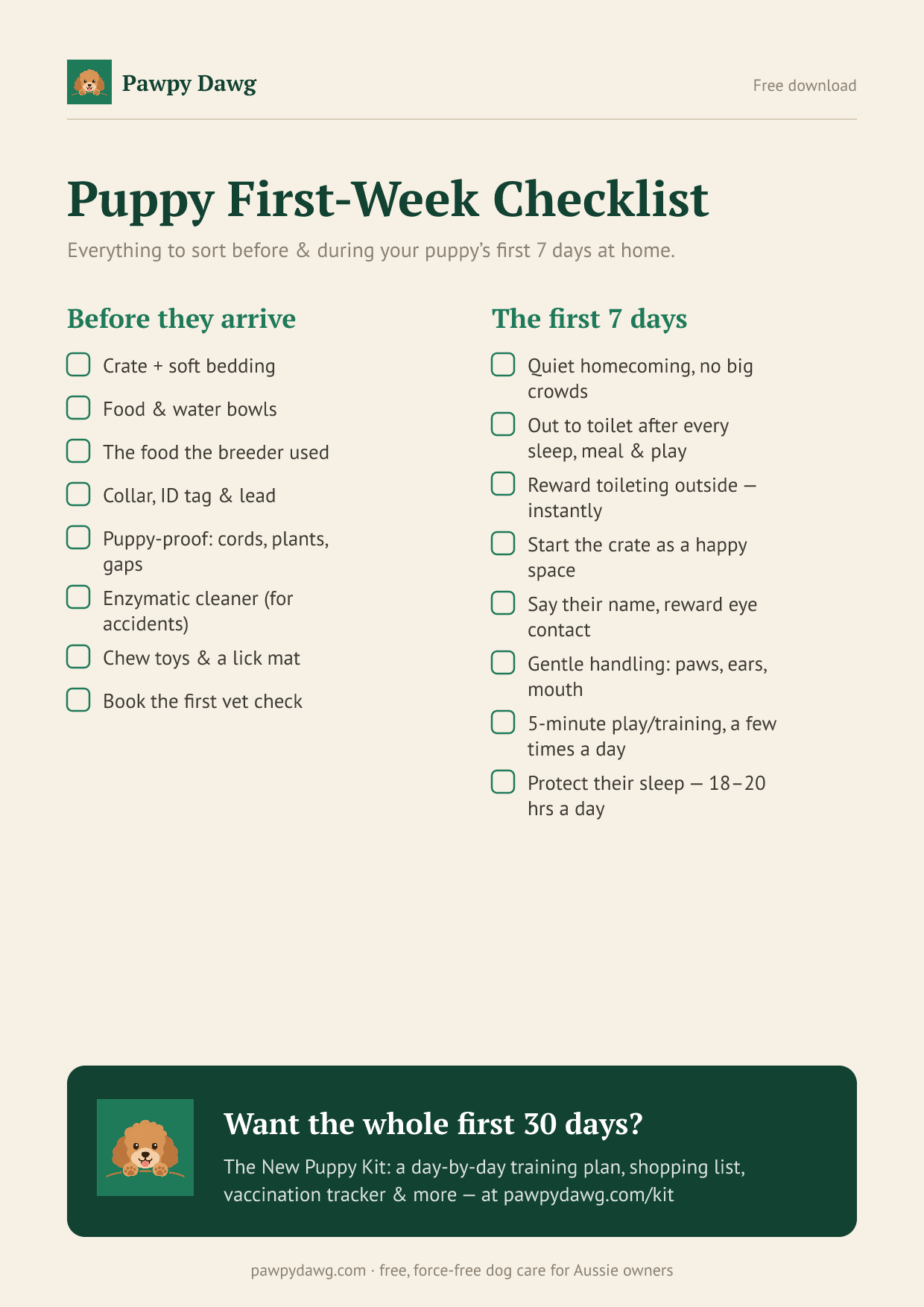
Free: the Puppy First-Week Checklist
Everything to sort before and during your puppy's first 7 days home — a printable one-pager. Plus the occasional genuinely useful dog tip. No spam, unsubscribe anytime.
Related guides
How to Stop a Kelpie Pulling on the Lead (Step-by-Step)
Tired of being dragged around the block? Fix kelpie pulling on the lead with this step-by-step positive-reinforcement plan, realistic timelines & pro tips.
Read the guide →
Kelpie Separation Anxiety: A Step-by-Step Fix
Kelpie separation anxiety is exhausting — but fixable. Get a realistic, positive-reinforcement plan, quick wins for today, and honest timelines.
Read the guide →
How to Stop a Kelpie Jumping Up on People (Step-by-Step)
Tired of your Kelpie jumping up on people? This step-by-step positive-reinforcement guide gives you a realistic plan, quick wins, and common mistakes to avoid.
Read the guide →