
From Chaos to Calm: Fixing Biting and Mouthing in Your Cocker Spaniel
Struggling with cocker spaniel biting and mouthing? Cut through the bad advice with this myth-busting, positive-reinforcement guide. Real fixes, realistic timelines.

Written by Bradley Brown
Founder & editor · Reviewed 2026-07-18

The single most common piece of advice handed out at dog parks, in Facebook groups, and even by well-meaning vets is this: ignore it and it'll stop on its own. For some mild mouthing in older puppies, that's occasionally true. For most Cocker Spaniels — a breed wired for enthusiasm, sensitivity, and an almost comical need for interaction — ignoring the behaviour without replacing it with something else usually makes things worse. The mouthing escalates, the owner gets frustrated, and the dog learns nothing useful.
Cocker Spaniel biting and mouthing is almost always normal puppy or adolescent behaviour, not a sign of aggression and not evidence that you've raised a dangerous dog. The biology is straightforward: puppies explore the world with their mouths, teething hurts, and play biting is how they rehearsed social skills with their littermates. Your job isn't to suppress the dog — it's to redirect and teach. Here's where most owners go wrong.
"Just Yelp Like Another Puppy Would"
This advice comes from a real instinct: in a litter, a bitten sibling yelps and the play stops. So replicate it, right?
In practice, a sharp yelp often has the opposite effect on Cocker Spaniels. These are high-energy, emotionally reactive dogs. A sudden noise frequently amps them up, triggering a second lunge rather than a pause. Some sensitive individuals shut down entirely from the shock, which tells you nothing useful and frightens them unnecessarily.
What actually works: a calm, flat "too bad" or "oops," followed immediately by removing your attention. Stand up slowly, turn your back or leave the room for 10–20 seconds, then return and offer a legal outlet — a tug toy, a stuffed Kong, a short scatter-feed on the floor. You're teaching a two-part lesson: teeth on skin ends the fun, and this (the toy) keeps it going. Repeat this every single time, with everyone in the household. Consistency across all humans is more important than any individual technique.
"He Knows He's Doing Wrong — He Has That Guilty Look"
The "guilty look" — ears back, eyes averted, slow tail — is one of the most thoroughly misread signals in dog behaviour. Research, including a well-cited 2009 study by Alexandra Horowitz, found that dogs display this body language in response to an owner's tone and posture, not because they understand they've done something wrong. Your Cocker isn't being defiant. He's reading your energy and appeasing you.
Punishing mouthing after the fact — even seconds later — teaches nothing except that you sometimes become unpredictable and scary. It erodes trust, which matters enormously with a breed that is famously people-oriented.
What actually works: catch it in the moment, respond calmly and consistently (see above), and build in prevention before the dog gets to practice the behaviour. Most Cocker Spaniels mouth most when they're overtired, overstimulated, or under-exercised. A five-minute sniff walk before the evening witching hour, a frozen Kong during post-dinner zoomie time, or a short training session that burns mental energy — these are often more effective than any correction.
"He Just Needs to Learn 'No' — Firmly"
Physical corrections — nose taps, scruff shakes, holding the muzzle shut — appear in a lot of older training literature and still circulate online. The logic sounds reasonable: make the biting unpleasant and the dog will stop. The problem is that pain and intimidation don't teach a dog what to do. They also backfire badly with Cocker Spaniels, a breed with a long history of learned helplessness when trained harshly. You risk a dog who becomes hand-shy, mouthy out of anxiety, or — in a small number of cases — one who escalates because the threat triggers a defensive response.
The Australian Veterinary Association's position on canine behaviour management, consistent with international bodies, explicitly discourages punishment-based methods for biting due to these escalation risks.
What actually works: teach an incompatible behaviour. A Cocker Spaniel who is asked to "sit" or "find it" (a scatter-feed cue) the moment a mouthing trigger appears — a hand reaching down, a child running past — literally cannot bite and comply at the same time. Build these alternative responses with treats and repetition over a few weeks, and you'll find the mouthing opportunities shrink dramatically.
"This Should Be Fixed in a Week"
Unrealistic timelines are the number one reason owners give up. They try a technique for five days, see no improvement, and conclude it isn't working or that their dog is "too far gone."
Cocker Spaniel biting and mouthing typically shows meaningful improvement in three to six weeks of consistent daily practice — and "consistent" means every person in the house responding the same way, every time. Individual sessions need to be short: five to ten minutes of deliberate training, multiple times a day. Long, exhausting sessions don't accelerate the process; they frustrate both of you.
Here's a realistic week-by-week sketch of what to expect:
- Weeks 1–2: The behaviour may briefly get worse before it improves. This is called an extinction burst — the dog is trying harder at the old strategy before abandoning it. Stay the course.
- Weeks 3–4: Mouthing starts to reduce in frequency and intensity. You'll notice the dog redirecting to toys more readily.
- Weeks 5–6: The new habit is forming. Management tools (Kongs, tethers, baby gates) can start to be phased back.
If there's been no meaningful change after six weeks of genuine consistency, or if your dog's biting breaks skin, is accompanied by growling and stiff body language, or is getting worse rather than better, it's time to bring in a certified professional. Look for a trainer who holds a Certificate IV in Companion Animal Services or is accredited with the Pet Professional Guild Australia — both align with force-free, evidence-based methods. Budget roughly $120–$200 AUD per private session; many offer packages that reduce the per-session cost.
The vast majority of Cocker Spaniels who mouth and bite are simply young, unguided, and full of energy. A calm structure, predictable responses, and a little patience will get you most of the way there.
As an Amazon Associate we earn from qualifying purchases.
Frequently asked questions
At what age do Cocker Spaniels stop biting and mouthing?
Most Cocker Spaniels naturally reduce mouthing as their adult teeth finish coming in around five to six months, and again as adolescence settles around 12–18 months. With consistent training, most owners see significant improvement well before that — typically within six to eight weeks of starting a clear, calm routine.
Is my Cocker Spaniel mouthing a sign of aggression?
In most cases, no. Mouthing and play biting in puppies and young dogs is normal exploratory and social behaviour, not aggression. True aggression usually involves stiff body posture, a fixed stare, and growling in context — not the bouncy, wiggly energy of a puppy nipping during play. If you're seeing genuinely threatening body language alongside biting, consult a vet or accredited behaviourist.
My Cocker Spaniel bites my kids more than adults — why?
Children move unpredictably, make high-pitched sounds, and often play at the dog's eye level, all of which trigger arousal and mouthing behaviour. It doesn't mean the dog dislikes your children — it means kids are more exciting. Teach children to stand still and 'be a tree' when the dog gets nippy, and supervise all interactions until the behaviour is reliably under control.
Should I use a spray bottle or bitter spray to stop the biting?
Bitter sprays applied to skin can deter some dogs, but they don't teach the dog what to do instead, and many Cocker Spaniels simply ignore them. Spray bottles used as a deterrent are a form of punishment and can damage trust with this sensitive breed. Redirection and consistent attention withdrawal are more effective and longer-lasting approaches.
How do I stop my Cocker Spaniel from mouthing when I come home?
Greeting excitement is one of the most common triggers for mouthing. The fix is to keep arrivals low-key: no eye contact, no talking, no touching until the dog has all four paws on the floor and is calm. Keep a favourite toy near the door so you can give the dog something legal to carry and chew the moment you walk in.
When should I see a professional about my Cocker Spaniel's biting?
Seek professional help if the biting breaks skin regularly, is getting worse despite six weeks of consistent training, or is accompanied by growling, stiffening, or snapping in non-play contexts. Look for a trainer certified with the Pet Professional Guild Australia or holding a Certificate IV in Companion Animal Services, and ask specifically about force-free methods.
Free printable
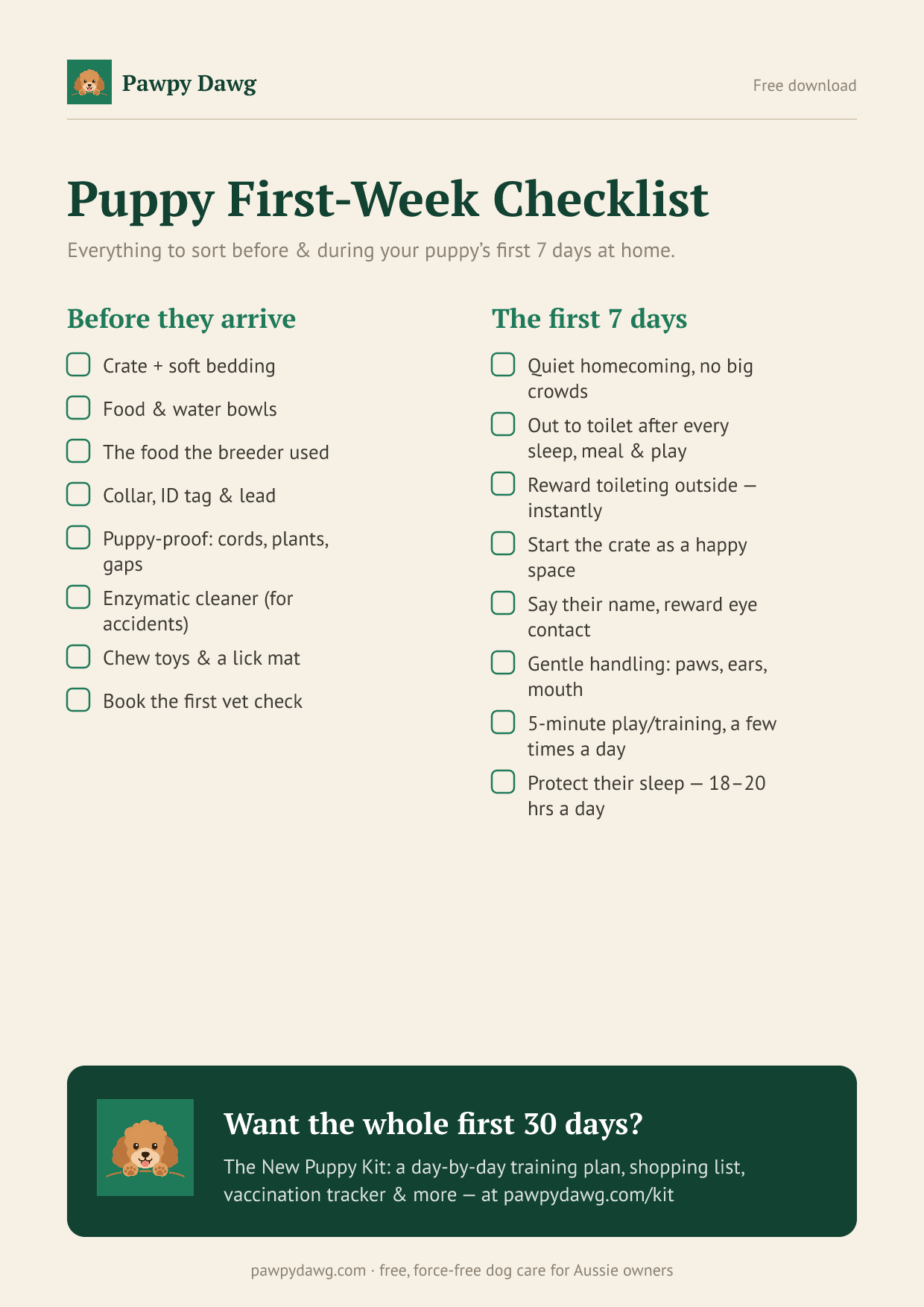
Free: the Puppy First-Week Checklist
Everything to sort before and during your puppy's first 7 days home — a printable one-pager. Plus the occasional genuinely useful dog tip. No spam, unsubscribe anytime.
Related guides

Stop Your Cocker Spaniel Pulling on the Lead — the Calm, Force-Free Way
Tired of being dragged around the block? Fix cocker spaniel pulling on the lead with this calm, force-free plan — realistic timelines, common mistakes & pro tips.
Read the guide →
Why Your Cocker Spaniel Barks at Strangers (and How to Turn It Around)
Cocker spaniel barking at strangers? Discover why it happens and get a realistic, positive-reinforcement plan to fix it — in just 5–10 minutes a day.
Read the guide →