
Choosing Puppy Food in Australia: A No-Nonsense Guide
Confused by puppy food labels? Our no-nonsense guide to the best puppy food in Australia covers AAFCO standards, breed size, and real cost comparisons.

Written by Bradley Brown
Founder & editor · Reviewed 2026-07-03

You grabbed the bag with the cutest puppy on it, your pup seems happy enough, and then someone at the dog park raised an eyebrow. Sound familiar? Choosing puppy food in Australia is genuinely confusing — the shelves are wall-to-wall options, the marketing is loud, and the advice online is either brand-sponsored or written for a US audience.
Here's the good news: you haven't ruined your dog. Puppies are resilient, and switching to a better-matched food is straightforward once you know what to look for. You don't need a degree in animal nutrition — you need about ten minutes and this checklist.
Quick win you can do right now: Flip your current bag over and find the "nutritional adequacy statement." If it says "for all life stages" or "growth and reproduction," your puppy is covered nutritionally. If it says "maintenance" only, swap it this week — that's genuinely the most important label check there is.
What Australian Puppy Food Standards Actually Mean
Australia doesn't have mandatory government-regulated pet food standards (yet — the ACCC has been pushing for change). In practice, reputable manufacturers follow two frameworks:
- AAFCO (Association of American Feed Control Officials): An American body whose nutrient profiles are widely used in Australia. Look for "formulated to meet AAFCO nutrient profiles for growth" or "feeding trials conducted according to AAFCO procedures." Feeding-trial claims carry more weight — they mean real dogs ate the food and thrived.
- PFIAA (Pet Food Industry Association of Australia): The local industry body. Members follow the Australian Standard AS 5812, which covers labelling, hygiene, and safety. It's a baseline, not a gold standard, but PFIAA membership is a reasonable minimum bar.
What to do: On the bag or can, look for either AAFCO growth claim or AS 5812 compliance. If neither appears anywhere on the packaging, put it back.
How to Read a Puppy Food Label in 5 Minutes
1. Ingredient List
Ingredients are listed by weight before cooking. Meat listed first is a good sign, but don't obsess — "chicken meal" (dried, concentrated protein) after a named meat is perfectly fine and often nutritionally superior to a fresh meat listed first.
Red flags:
- Vague terms like "meat by-products" or "animal digest" with no species named
- Added sugars (glucose, corn syrup)
- Artificial colours — puppies don't care if their kibble is orange
2. Guaranteed Analysis
This panel lists minimum crude protein and fat, and maximum crude fibre and moisture. For puppies, aim for:
| Nutrient | Recommended minimum (dry matter basis) |
|---|---|
| Crude protein | 22–28% |
| Crude fat | 8–17% |
| Calcium | 1.0–1.8% |
| Phosphorus | 0.8–1.6% |
Note: Calcium is critical and often unlisted. If you're feeding a large-breed puppy, this matters enormously — see below.
3. The Nutritional Adequacy Statement
As mentioned above, this is the single most important line on the bag. It must say "growth" or "all life stages" — not "complementary," "treat," or "adult maintenance."
Large-Breed vs Small-Breed Formulas: This Is Not Marketing
This distinction is real and matters for bone development.
Large breeds (expected adult weight >25 kg — think Labrador, Golden Retriever, German Shepherd):
- Rapid growth is the enemy. Too much calcium and calories accelerates skeletal development faster than joints can keep up, increasing risk of hip dysplasia and developmental orthopaedic disease.
- Choose a food labelled specifically for large-breed puppies — it will have controlled calcium levels (typically 1.0–1.5%) and a lower energy density.
- Avoid "all life stages" foods that are also labelled for large breeds unless calcium is confirmed within the safe range.
Small breeds (expected adult weight <10 kg — think Cavoodle, Chihuahua, Miniature Dachshund):
- Higher metabolic rate means they need energy-dense food in small bites.
- Small-breed puppy formulas have smaller kibble size and more calories per gram.
- Risk of hypoglycaemia (low blood sugar) is real in toy breeds — little and often is wise.
Medium breeds (10–25 kg): A standard puppy formula works fine. You don't need a "medium breed" specific product — that's largely marketing.
Wet Food, Dry Food, or Raw? A Realistic Look
| Format | Pros | Cons | Avg. weekly cost (AUD) |
|---|---|---|---|
| Dry kibble | Convenient, dental benefit, calorie-dense | Lower moisture, some dogs find it boring | $15–$40 |
| Wet/canned | High palatability, good hydration | Expensive, messy, needs refrigeration after opening | $35–$80 |
| Raw/BARF | Highly palatable, owner control | Risk of bacterial contamination, nutritional imbalance if DIY | $30–$70+ |
| Fresh-cooked commercial | Balanced, palatable | Expensive, requires freezer space | $50–$120 |
Cost estimates based on a medium-sized puppy (~10 kg). Prices vary by brand tier and where you buy (supermarket vs. vet vs. specialty pet store).
Most Australian vets recommend starting with a complete, commercially prepared food — dry or wet — from a brand that uses AAFCO feeding trials. Raw feeding is a legitimate choice but warrants a conversation with your vet first, especially for puppies whose immune systems are still developing.
A Practical Label Checklist
Before you buy, run through this in the aisle (takes under two minutes):
- Nutritional adequacy statement says "growth" or "all life stages"
- Named meat source in the first two ingredients
- AAFCO feeding-trial claim or AS 5812 compliance noted
- Breed-size appropriate (large-breed formula if your pup will exceed 25 kg)
- No unnamed "animal" by-products or artificial colours
- Feeding guide on pack includes a weight range that matches your puppy
How Much Should You Actually Spend?
You do not need to buy the most expensive food on the shelf to feed your puppy well. Mid-tier brands that use AAFCO feeding trials and named protein sources consistently outperform cheap supermarket lines — but premium boutique brands don't always outperform mid-tier.
A useful rule of thumb: spend enough to clear the AAFCO/AS 5812 bar, and not much more unless your vet has a specific reason. For most Australian puppy owners, that lands somewhere between $25–$50/week for dry food (medium breed), depending on where you shop.
Vet clinics, specialty pet stores (such as PetStock or PetBarn), and online retailers (My Pet Warehouse, VetShopAustralia) all carry reputable mid-tier options — and online often undercuts bricks-and-mortar by 15–25% for the same product.
When to Ask Your Vet
A food change or first-time puppy food choice doesn't automatically require a vet visit — but loop in your vet if:
- Your puppy is a large or giant breed (nutrition errors compound over months of rapid growth)
- Your pup has loose stools, vomiting, or low energy after a food transition
- You want to feed raw or home-cooked
- Your puppy was diagnosed with any health condition at their first check-up
Transitioning foods? Do it gradually over 7–10 days — 25% new food, then 50%, then 75%, then fully switched. Gut bacteria need time to adjust, and a rushed switch is the most common cause of puppy digestive upset.
Frequently asked questions
What is the best puppy food in Australia?
There's no single best brand — the best puppy food is one that carries an AAFCO growth claim or AS 5812 compliance, lists a named protein source early in the ingredients, and is appropriately formulated for your puppy's expected adult size. Mid-tier brands that use AAFCO feeding trials consistently perform well and don't require you to spend a fortune.
Is grain-free puppy food better for my puppy?
Not necessarily. Grain-free diets became popular based on human food trends, not veterinary evidence. In fact, the US FDA investigated a potential link between grain-free diets and dilated cardiomyopathy (DCM) in dogs, though research is ongoing. Unless your vet has identified a specific grain intolerance, there's no proven benefit to going grain-free for puppies.
How do I switch my puppy to a new food without causing stomach upset?
Transition gradually over 7–10 days: start with 25% new food mixed into 75% old food, then move to 50/50, then 75% new, then fully switched. Rushing the transition is the most common cause of loose stools and vomiting in puppies during a food change.
Do large-breed puppies really need a special formula?
Yes — this is one of the few puppy food distinctions that's backed by solid veterinary science. Large and giant breeds grow rapidly, and excess calcium and calories during this phase can contribute to developmental orthopaedic problems like hip dysplasia. Look for a food specifically labelled for large-breed puppies with controlled calcium levels.
Can I feed my puppy adult dog food in a pinch?
Occasionally and briefly, yes — it won't cause immediate harm. However, adult maintenance formulas are not designed to meet the higher protein, fat, and mineral demands of a growing puppy. Get back to an appropriate puppy formula as soon as possible, especially if your dog is a large breed.
How much should I feed my puppy each day?
Follow the feeding guide on the packaging as a starting point — it's based on your puppy's current weight and age. Adjust based on body condition: you should be able to feel (but not see) your puppy's ribs. Most puppies do best on three meals a day until around 6 months, then transition to two meals daily.
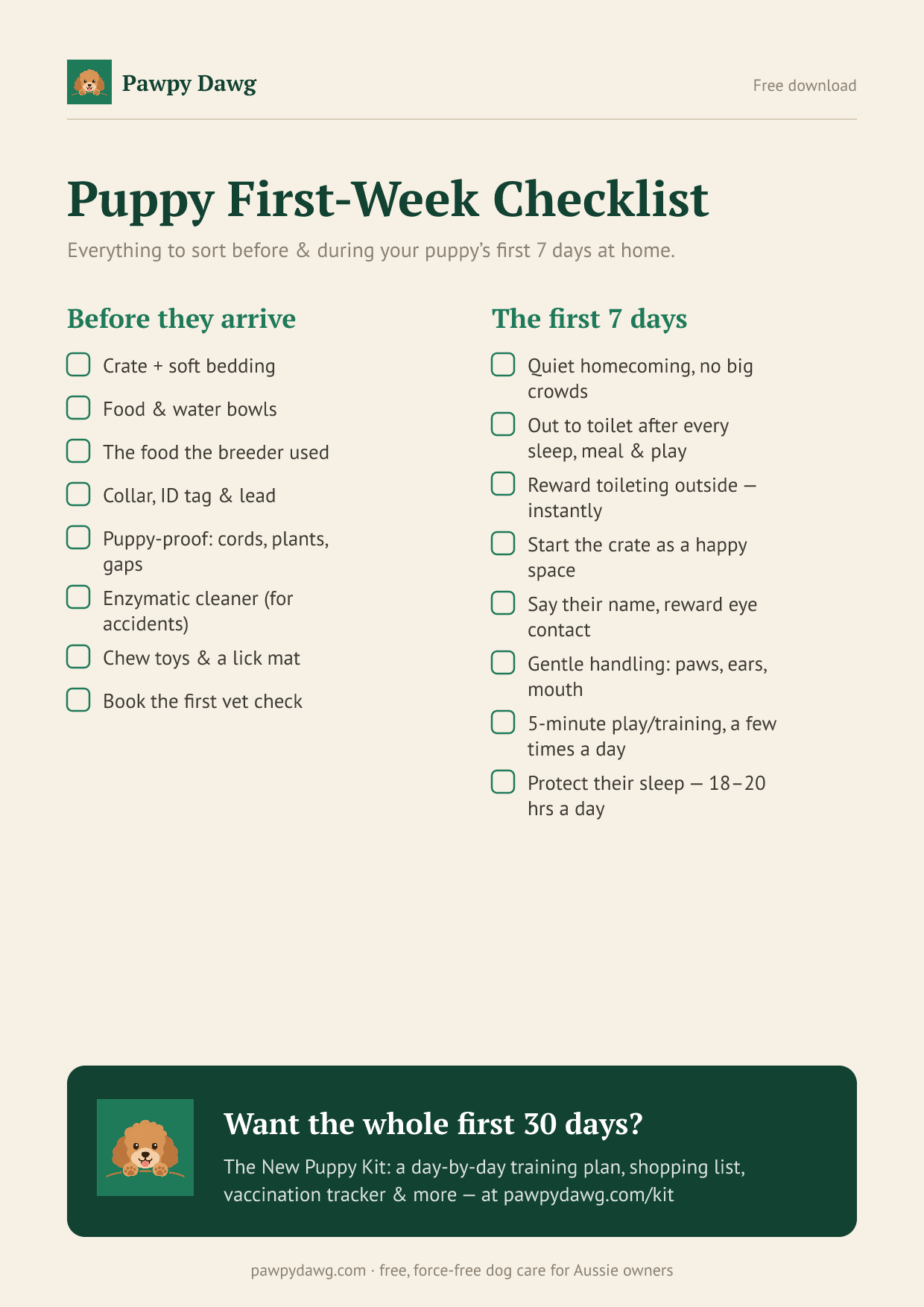
Free printable
Free: the Puppy First-Week Checklist
Everything to sort before and during your puppy's first 7 days home — a printable one-pager. Plus the occasional genuinely useful dog tip. No spam, unsubscribe anytime.
Related guides

Is Pet Insurance Worth It in Australia? The Honest Maths
Is pet insurance worth it in Australia? We crunch real premiums vs real vet bills — cruciate surgery, snake bite & more — so you can decide with confidence.
Read the guide →
How Much a Dog Really Costs Per Year in Australia (2026 Breakdown)
How much does a dog cost per year in Australia? 2026 line-item breakdown covering food, vet, insurance, grooming & the costs first-timers always miss.
Read the guide →
Dog Vaccination Schedule in Australia: What, When and What It Costs
Confused by C3, C5 and kennel cough? Here's your complete dog vaccination schedule Australia cost guide — puppy timelines, adult boosters & typical AUD prices.
Read the guide →