
Choosing a Dog Trainer in Australia: Qualifications, Costs and Red Flags
Choosing a dog trainer in Australia? Learn what qualifications actually mean, what to pay for group vs private lessons, and the red flags that signal outdated methods.

Written by Bradley Brown
Founder & editor · Reviewed 2026-11-14

You've searched, asked around, and probably watched a few too many YouTube videos — and you're still not sure who to trust with your dog. That's completely reasonable. In Australia there's no single government licence required to call yourself a dog trainer, which means the market is wide open and confusing. Here's how to cut through it quickly.
The One Thing You Can Do Right Now
Before you book anything, Google the trainer's name alongside "NDTF", "PPGA", or "Delta". If their name appears as a member or graduate of a reputable body, that's a good starting signal. If their website leads only with military-style language like "pack leader", "dominance correction", or "alpha", close the tab.
What Australian Trainer Qualifications Actually Mean
Australia has no mandatory licensing for dog trainers, which surprises most owners. What exists instead is a patchwork of voluntary certifications and industry bodies — some rigorous, some not.
The ones worth knowing:
- NDTF (National Dog Trainers Federation) — One of Australia's oldest and most recognised training organisations. Graduates complete practical and theory-based assessments.
- Delta Institute — Offers the Delta Canine Good Citizen program and professional trainer courses with an emphasis on evidence-based methods.
- PPGA (Pet Professional Guild Australia) — A force-free membership organisation. Members commit to using only positive reinforcement and no aversive tools.
- Certificate III or IV in Dog Behaviour and Training (nationally accredited) — A formal VET-sector qualification. Completion means a trainer has met a standardised curriculum, though practical hours vary between providers.
- IAABC (International Association of Animal Behavior Consultants) — A globally recognised credential for more complex behavioural casework. An IAABC-accredited consultant is relevant if your dog has fear, aggression, or anxiety issues beyond basic manners.
A certificate alone doesn't make someone skilled, and skilled trainers sometimes lack a certificate. What it tells you is whether someone has invested in formal learning and whether they're part of a community with accountability.
Group Classes vs Private Lessons: What to Expect to Pay
Prices vary significantly by city, experience level, and what's included. These are realistic 2024 Australian ranges:
| Format | Typical Cost (AUD) | Best For |
|---|---|---|
| Group puppy class (6-week block) | $180–$320 | Socialisation, basic manners, new owners |
| Group adult manners class | $200–$350 for a course | Dogs needing refreshers or structure |
| Private in-home session (1 hour) | $120–$220 per session | Specific problems, fear, reactivity |
| Private session at trainer's facility | $100–$180 per session | Owners who prefer a neutral space |
| Board and train (per week) | $800–$1,800+ | Complex cases or owners who can't train daily |
Board-and-train (where your dog lives with the trainer) deserves a note of caution: results depend entirely on how well the trainer transfers the skills back to you. Without a solid handover session, many dogs revert quickly at home because you weren't part of the learning.
Questions Worth Asking Before You Book
You don't need to quiz a trainer like you're hiring a barrister. Three or four honest questions will tell you everything:
- What methods do you use if my dog doesn't respond or gets it wrong? — You want to hear about redirecting, withholding rewards, or adjusting criteria. You don't want to hear "corrections", "giving them a fright", or anything involving a prong or e-collar as a default tool.
- Can I watch a group class before I enrol? — Reputable trainers almost always say yes. Hesitation is a flag.
- What's your experience with [your dog's specific issue]? — Reactivity, resource guarding, and separation anxiety are specialist areas. A puppy-class trainer may not be the right fit for a dog with fear-based aggression.
- What will I need to do at home between sessions? — Good trainers give you short, clear homework. If the answer is vague, their follow-through may be too.
Red Flags That Signal Outdated or Harmful Methods
The science of how dogs learn has advanced enormously over the past two decades. Training based on dominance theory — the idea that dogs are constantly trying to assert rank over humans — has been comprehensively discredited by animal behaviour researchers, including by the original wolf-study authors who later retracted their own conclusions.
Watch out for:
- Alpha rolls, scruff shakes, or "flooding" (forcing a fearful dog to face its fear without choice) — these increase stress and damage trust.
- Choke chains, prong collars, or e-collars used as a first-line tool — aversive tools can suppress behaviour without resolving the underlying cause, and research links them to increased anxiety and aggression.
- Guarantees — no ethical trainer guarantees results because behaviour involves a living animal and an owner who practises at home.
- Refusing to let you observe — if a trainer doesn't want you watching, ask yourself why.
- Dismissing your vet's input — good trainers work alongside vets and veterinary behaviourists, especially for fear or anxiety cases where medication may be part of the solution.
When a Veterinary Behaviourist Is the Better First Step
If your dog is biting, has severe separation anxiety, or shows fear so intense it affects their daily life, consider starting with a veterinary behaviourist rather than a general trainer. These are registered vets with specialist qualifications in animal behaviour — they can diagnose, prescribe where appropriate, and often work alongside a trainer. The Australian College of Veterinary Scientists lists board-certified specialists at acvs.org.au.
For most dogs with everyday training needs — pulling on lead, jumping up, inconsistent recall — a qualified, positive-reinforcement trainer is exactly what you need. The goal is a trainer who makes both you and your dog look forward to the next session. That's not a high bar, but it's the right one.
Frequently asked questions
Do dog trainers in Australia need to be licensed?
No. There is currently no mandatory government licence required to work as a dog trainer in Australia. Anyone can legally use the title. This is why checking for voluntary credentials — such as NDTF, Delta, PPGA membership, or a nationally accredited Certificate III/IV — is an important step before booking.
How much does a dog trainer cost in Australia?
Group classes typically run $180–$350 AUD for a multi-week course, while private one-on-one sessions generally cost $100–$220 AUD per hour depending on the city and the trainer's experience. Board-and-train programs are significantly more expensive, often $800–$1,800+ AUD per week.
What is the difference between a dog trainer and a veterinary behaviourist?
A dog trainer helps owners teach skills and modify everyday behaviour. A veterinary behaviourist is a registered vet who has completed specialist post-graduate training in animal behaviour — they can diagnose behavioural conditions and prescribe medication where needed. For severe fear, aggression, or anxiety, a vet behaviourist is often the better starting point.
Are e-collars (shock collars) legal in Australia?
The rules vary by state. E-collars are banned for use on dogs in Queensland, South Australia, and the ACT, among others. Even where legal, mainstream animal behaviour organisations and veterinary bodies advise against their use due to the risk of increased fear and aggression.
Is a group puppy class better than private lessons for a new puppy?
For most puppies, a well-run group class offers something private lessons can't fully replicate: structured socialisation with other dogs and people during the critical developmental window (roughly up to 16 weeks). Private lessons are better if your puppy has a specific problem, is unvaccinated, or if you need more individual attention on your handling skills.
What does 'force-free' or 'positive reinforcement' training actually mean?
These terms mean the trainer relies on rewarding behaviours they want to see more of — using food, play, or praise — rather than punishing or correcting unwanted behaviours physically or with aversive tools. This approach is backed by decades of learning science and is recommended by most veterinary and animal behaviour peak bodies worldwide.
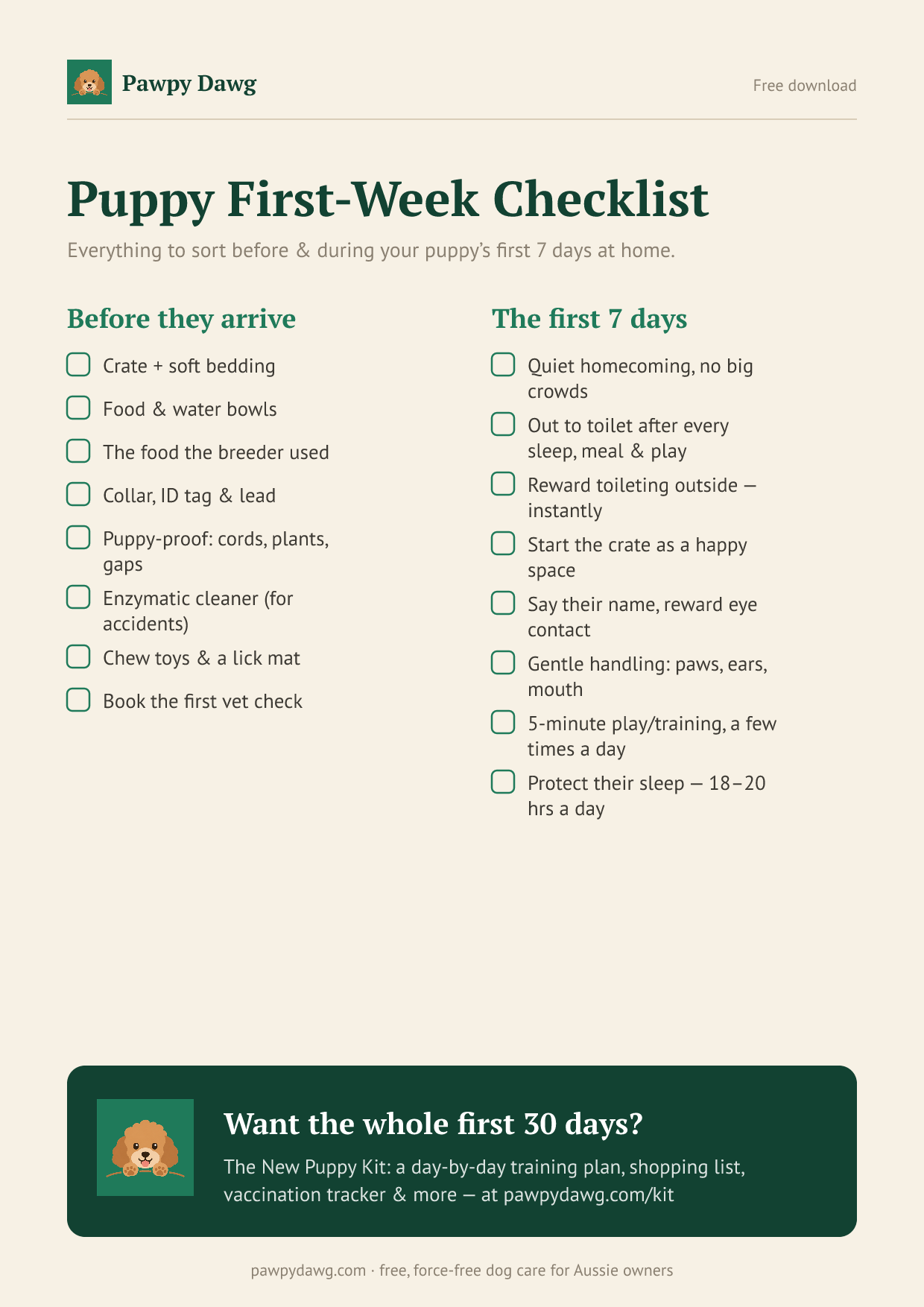
Free printable
Free: the Puppy First-Week Checklist
Everything to sort before and during your puppy's first 7 days home — a printable one-pager. Plus the occasional genuinely useful dog tip. No spam, unsubscribe anytime.
Related guides

Is Pet Insurance Worth It in Australia? The Honest Maths
Is pet insurance worth it in Australia? We crunch real premiums vs real vet bills — cruciate surgery, snake bite & more — so you can decide with confidence.
Read the guide →
How Much a Dog Really Costs Per Year in Australia (2026 Breakdown)
How much does a dog cost per year in Australia? 2026 line-item breakdown covering food, vet, insurance, grooming & the costs first-timers always miss.
Read the guide →
Dog Vaccination Schedule in Australia: What, When and What It Costs
Confused by C3, C5 and kennel cough? Here's your complete dog vaccination schedule Australia cost guide — puppy timelines, adult boosters & typical AUD prices.
Read the guide →