
Microchipping and Council Registration for Dogs in Australia: The Rules by State
Dog registration and microchipping Australia: state-by-state rules, fees, desexing discounts, how to update chip details, and the fines that catch owners out.

Written by Bradley Brown
Founder & editor · Reviewed 2026-11-07

A quick note: this guide is general information, not veterinary advice. For anything urgent or specific to your dog, your vet is always the right call.
Most Australian dog owners know microchipping and registration are legally required — but the specifics differ enough between states that it's easy to assume you're compliant when you're not. Here's what the rules actually say, state by state, so you can tick every box without the guesswork.
Is microchipping compulsory everywhere in Australia, and when does it have to happen?
Yes, microchipping is mandatory in every Australian state and territory, but the timing varies slightly. As a general rule across the country, dogs must be microchipped by 12 weeks of age or before they're sold or given away — whichever comes first. In practice, most reputable breeders and rescue organisations microchip before the puppy or dog leaves their care, so if you've adopted or purchased a dog, it's almost certainly already chipped.
The microchip is a passive RFID device about the size of a grain of rice, implanted under the skin between the shoulder blades by a vet or accredited implanter. It carries a unique 15-digit number that links to your contact details on a database. The chip itself never needs replacing — it has no battery and no moving parts.
Where owners get caught out is assuming the chip is the registration. It isn't. Microchipping and council registration are two separate legal obligations, and you need both.
How does council registration work, and do the rules differ by state?
Registration is handled by your local council, not the state government directly, which is why fees and exact processes vary even within a state. That said, the state legislation sets the framework — councils work within it.
New South Wales: Dogs must be registered by 6 months of age under the Companion Animals Act 1998. Registration is lifelong (you pay once, not annually) for desexed dogs. The standard lifetime fee for a desexed dog is around $65 AUD; an entire (undesexed) dog costs significantly more. Pensioners receive concessions. NSW also runs the NSW Pet Registry, where microchip and registration details are stored and can be updated online.
Victoria: Registration is annual and managed by local councils under the Domestic Animals Act 1994. Dogs must be registered by 3 months of age. Fees vary by council but typically range from around $35–$100 AUD per year for a desexed dog, with entire dogs paying considerably more — often double or triple. Many councils offer further discounts for pensioners or for dogs that have completed an approved obedience course.
Queensland: Under the Animal Management (Cats and Dogs) Act 2008, dogs must be microchipped and registered by 12 weeks of age. Registration is handled by local councils; fees and discount structures differ across the state. Desexed dogs are substantially cheaper to register. Some councils have moved to lifetime registration for desexed animals.
South Australia: The Dog and Cat Management Act 1995 governs registration, which must happen by 3 months of age. Registration is annual. Fees are set by councils; desexed dogs attract a lower rate, and pensioner discounts apply widely.
Western Australia: Under the Dog Act 1976, dogs must be registered by 3 months of age. Fees are set by local governments and are annual. Desexed dogs are cheaper to register, and there are concessions for eligible pensioners.
Tasmania: The Dog Control Act 2000 requires registration by 6 months of age. Annual registration fees are set locally.
ACT: Dogs must be registered by 3 months of age. The ACT uses a centralised system through Access Canberra. Desexed dogs enjoy a significantly reduced annual fee.
Northern Territory: Registration requirements exist under local council bylaws; check with your council directly as rules vary more here than elsewhere.
The practical takeaway: once your dog is microchipped, contact your local council to register — don't wait to see if anyone chases you up.
Why is desexing such a big deal for registration fees?
Every state and territory uses fee structures that make registering an entire (undesexed) dog noticeably more expensive. The gap can be substantial — in some Victorian councils, an entire dog might cost $200+ AUD per year to register versus $40–$60 AUD for a desexed dog. The policy rationale is managing stray and unwanted dog populations, but the practical effect for owners is a strong financial incentive to desex.
If you desex your dog after the initial registration, let your council know immediately and provide your vet's certificate. Your fee will be recalculated, often with a partial refund or reduced renewal the following year. Don't leave it sitting there — councils don't automatically know your dog has been desexed, and you'll keep paying the higher rate until you tell them.
Working dogs registered as such, and dogs used in certain assistance or law enforcement roles, may qualify for separate exemptions or reduced fees. Check with your council if this applies to you.
What happens if the microchip details are wrong or out of date?
This is one of the most common and consequential oversights in dog registration and microchipping Australia-wide. Shelters regularly scan lost dogs whose chips link to old phone numbers, previous owners, or addresses from three moves ago. The chip is useless if the data behind it doesn't reach you.
To update your details, you need to know which database your dog is registered on. Australia has several authorised microchip registries, including:
- NSW Pet Registry (NSW)
- Victorian Dog & Cat Registry (Victoria — centralised from 2020 for dogs sold or given away)
- PetAddress, Central Animal Records, Australasian Animal Registry, and others (national databases accepted in most states)
The vet or shelter that implanted the chip should have given you paperwork indicating which registry was used. If you've lost that, your vet can scan the chip, retrieve the number, and help you search the relevant database. Updates typically cost nothing or a small admin fee (around $10–$20 AUD depending on the registry). Do it every time you move or change your phone number — it takes five minutes online.
What are the fines for not microchipping or registering, and how do owners actually get caught?
The fines are real and council rangers do enforce them, particularly after complaints about wandering dogs or following any incident involving your dog. Penalty amounts vary by state but to give a sense of scale:
- In NSW, failure to microchip or register can attract on-the-spot penalty notices of several hundred dollars, with court-imposed fines reaching $5,500 AUD for repeated or aggravated non-compliance.
- In Victoria, infringement notices for unregistered dogs commonly run to $330 AUD or more per offence.
- In Queensland, similar fines apply, and councils can impound unregistered dogs.
How owners get caught: a ranger scans a lost or wandering dog and finds no registration; a neighbour complains about a nuisance dog and a ranger visits; your dog is involved in an attack or bite incident and the first thing checked is registration status. Some councils also run periodic door-to-door compliance checks in residential areas.
The simplest protection is a current registration tag on your dog's collar at all times — rangers typically check the tag before scanning. But the tag alone doesn't cover you if the underlying registration has lapsed.
Can you transfer registration if you move interstate?
Yes, but you need to re-register with your new local council — registration doesn't follow you across state borders. You'll generally have a grace period after moving (commonly 30 days, though this varies) before you're technically non-compliant. Update your microchip database details at the same time so both records reflect your new address.
When you move interstate, contact the new council, provide proof of microchipping (your chip number and implant certificate), and complete their registration process. If your dog is desexed, bring the vet certificate — councils will ask for it to apply the lower fee. Some states charge a reduced rate for dogs already registered elsewhere; it's worth asking.
The same applies within a state if you move to a new council area — registration is council-specific, not state-wide (Victoria's centralised registry is a partial exception, but council registration still applies locally).
Frequently asked questions
At what age does a puppy need to be microchipped in Australia?
In most states, puppies must be microchipped by 12 weeks of age or before they are sold or given away, whichever comes first. Reputable breeders and rescue organisations typically microchip before the puppy leaves their care. Check your state's specific legislation for any minor variations.
How much does dog registration cost in Australia?
Registration fees are set by local councils and vary widely, but desexed dogs are always cheaper to register. As a rough guide, annual fees for a desexed dog commonly range from around $35–$100 AUD in most states, while entire dogs can pay double or triple that amount. NSW offers lifetime registration for desexed dogs for around $65 AUD. Pensioner concessions are available in most councils.
How do I update my dog's microchip details in Australia?
Find out which database your dog is registered on — the paperwork from your vet or shelter at the time of implanting should say. Log in to that registry's website (such as the NSW Pet Registry, PetAddress, or Central Animal Records) and update your contact details directly. If you're unsure which database was used, your vet can scan the chip number and help you track it down. Updates are free or cost a small admin fee.
What is the fine for not registering my dog in Australia?
Fines vary by state and council, but they are significant. In NSW, on-the-spot penalty notices can run to several hundred dollars, with court fines reaching $5,500 AUD for serious non-compliance. In Victoria, infringement notices for unregistered dogs are commonly $330 AUD or more. Councils can also impound unregistered dogs.
Do I need to re-register my dog if I move to a different state?
Yes. Registration is council-specific and does not transfer across state borders automatically. You'll need to register with your new local council, usually within 30 days of moving. Update your microchip database details at the same time to keep both records current.
Is a microchip the same as council registration for dogs?
No — they are two separate legal requirements. Microchipping identifies your dog with a unique chip number linked to a national database. Council registration is a separate process with your local council that requires payment of a fee and results in an annual (or lifetime) registration tag. You need both to be fully compliant.
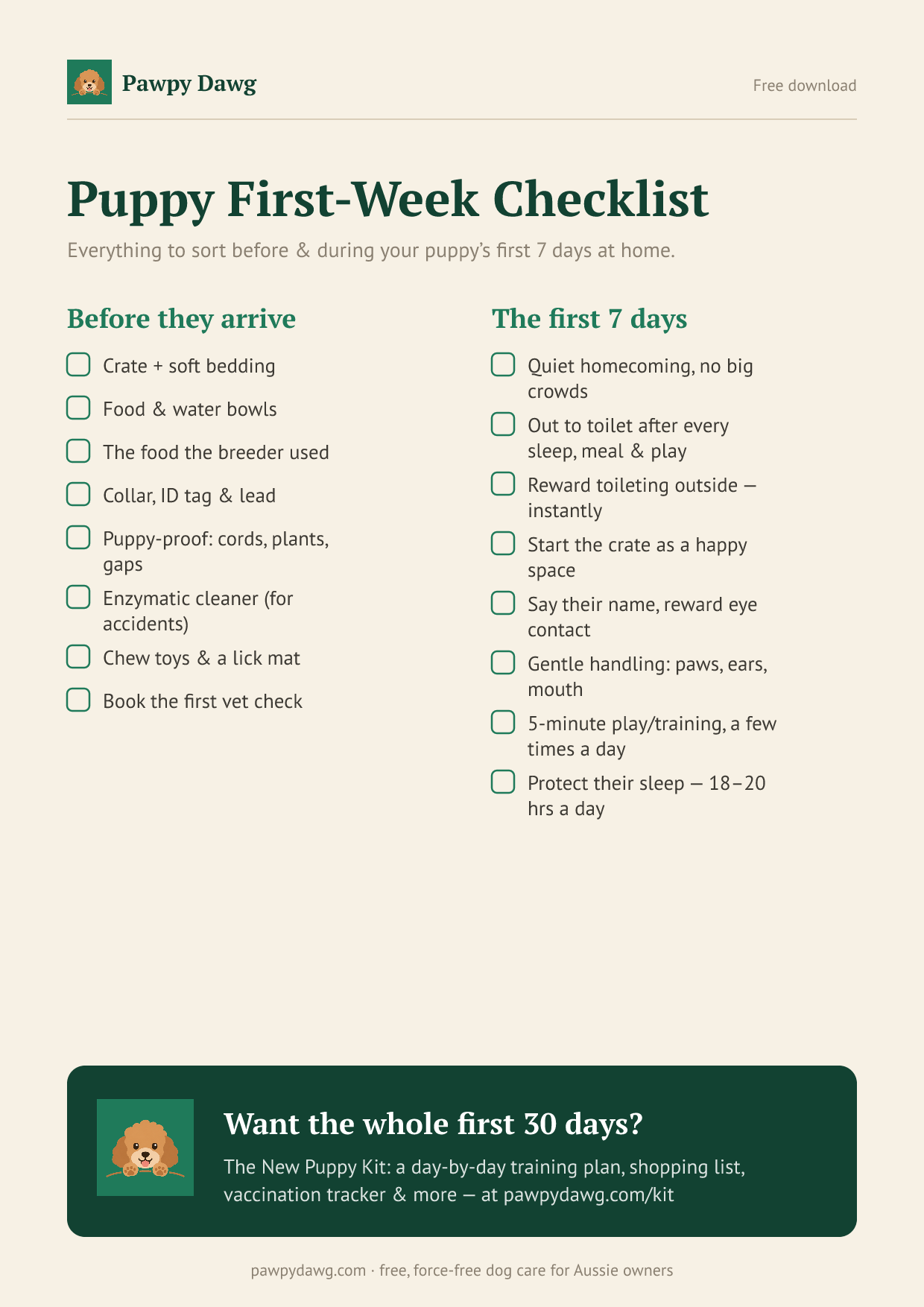
Free printable
Free: the Puppy First-Week Checklist
Everything to sort before and during your puppy's first 7 days home — a printable one-pager. Plus the occasional genuinely useful dog tip. No spam, unsubscribe anytime.
Related guides

Is Pet Insurance Worth It in Australia? The Honest Maths
Is pet insurance worth it in Australia? We crunch real premiums vs real vet bills — cruciate surgery, snake bite & more — so you can decide with confidence.
Read the guide →
How Much a Dog Really Costs Per Year in Australia (2026 Breakdown)
How much does a dog cost per year in Australia? 2026 line-item breakdown covering food, vet, insurance, grooming & the costs first-timers always miss.
Read the guide →
Dog Vaccination Schedule in Australia: What, When and What It Costs
Confused by C3, C5 and kennel cough? Here's your complete dog vaccination schedule Australia cost guide — puppy timelines, adult boosters & typical AUD prices.
Read the guide →