
Are Bones Safe for Dogs? Raw vs Cooked and What Vets Say
Are bones safe for dogs? Vets weigh in on raw vs cooked bones, the real risks involved, safer chew alternatives, and warning signs you shouldn't ignore.

Written by Bradley Brown
Founder & editor · Reviewed 2026-11-12
A quick note: this guide is general information, not veterinary advice. For anything urgent or specific to your dog, your vet is always the right call.
Most dogs go absolutely feral for a bone. That enthusiasm is real, it's ancient, and it makes owners feel good — like they're giving their dog something genuinely satisfying. So it's deeply uncomfortable to discover that bones sit in a grey zone in veterinary advice, one where the answer is "it depends" rather than a clean yes or no.
Here's what that grey zone actually looks like, and how to navigate it without either paranoia or recklessness.
Why Cooked Bones Are a Straightforward No
The chemistry here is simple and the risk is real. When bone is cooked — roasted, boiled, smoked, or pressure-cooked — the collagen and moisture that give raw bone its flexibility are driven out. What remains is brittle and crystalline. Instead of bending under pressure the way raw bone does, cooked bone shatters into sharp, irregular shards.
Those shards are the problem. They can lacerate the mouth, puncture the oesophagus, perforate the stomach lining, or lodge anywhere along the gastrointestinal tract. Veterinary emergency clinics across Australia see this regularly — especially after barbecues, when well-meaning families toss a leftover lamb shank or chicken drumstick to the dog waiting patiently nearby.
The size or type of bone doesn't offer meaningful protection once it's been cooked. A large beef femur cooked at high heat is just as likely to splinter dangerously as a small chicken wing. Smoking and slow-cooking don't make bones safer — they often make them more brittle, not less.
Commercially sold "smoked bones" and "basted bones" in pet shops fall into this same category. The packaging may look reassuring, but these products have been associated with gastrointestinal injuries and recalls. The Australian Veterinary Association and international bodies like the American Veterinary Medical Association both advise against cooked bones of any kind.
The rule with cooked bones is not "be careful." It's "don't."
The Raw Bone Debate — What the Evidence Actually Says
Raw bones are where things get more complicated, and where vets themselves land in slightly different places.
The case for raw bones is grounded in biology. Dogs evolved as scavengers and predators. Their jaw structure, stomach acid (which is significantly more acidic than a human's, sitting around pH 1–2 and built to handle raw meat and bone), and digestive tract are all adapted to processing raw animal material. Raw bone has elasticity — it flexes and crumbles rather than shattering, which dramatically reduces the splintering risk. It also provides genuine mental enrichment, satisfies a deep chewing drive, and may contribute to dental hygiene by mechanically scraping plaque from teeth.
The case against — or at least for caution — centres on a few real risks that don't disappear just because a bone is raw.
Bacteria. Raw bones carry Salmonella, Campylobacter, and other pathogens. A healthy adult dog is unlikely to become seriously ill, but they can shed those bacteria in their faeces, creating a risk for humans in the household — particularly children, the elderly, and immunocompromised people. This is not a trivial concern, and it's why some vets recommend against raw bones in households with vulnerable members.
Tooth fractures. This is the injury vets see most often with raw bones, and it's genuinely common. The standard rule of thumb used by veterinary dentists is the "thumbnail test": if you can't make a dent in the bone with your thumbnail, it's too hard for your dog's teeth. Weight-bearing leg bones from large animals — beef femurs, marrow bones, knuckle bones — regularly fail this test. They're dense enough to fracture the carnassial teeth (the large shearing premolars), which are expensive and painful to treat.
Obstruction. A dog who gulps rather than chews — common in greedy eaters, food-anxious dogs, and certain breeds — can swallow large bone fragments that then lodge in the oesophagus or intestine.
Constipation. Too much bone in the diet causes chalky, pale, rock-hard stools that are painful to pass. If your dog's poo looks like chalk, reduce the bone content.
So what do mainstream guidelines actually recommend? The raw feeding (BARF) community and many integrative vets support raw meaty bones with appropriate supervision and size-matching. More conservative mainstream vets — and official bodies — recommend caution or avoidance, primarily because the risk-benefit calculation shifts depending on the individual dog, household, and bone type. This is an area where you'll get different answers from different credentialled professionals, and that's not confusion — it reflects genuine uncertainty in the evidence.
Matching the Bone to the Dog (If You Choose to Feed Raw)
If you decide raw bones are right for your dog and your household, the variables that matter most are:
Bone size relative to dog size. The bone should be large enough that your dog cannot fit it entirely in their mouth or swallow it whole. A bone your dog can get their whole mouth around is a choking risk. As a rough guide: large breed dogs get large raw meaty bones (lamb necks, beef brisket bones); medium breeds get lamb flaps or chicken carcasses; small breeds can manage chicken wings or necks.
Raw meaty bones vs. recreational bones. Raw meaty bones — bones with a substantial amount of raw meat and cartilage attached — are generally considered safer than bare marrow bones or knuckle bones. The meat slows consumption and the softer connective tissue gives teeth something to work through progressively. Bare weight-bearing bones (femurs, knuckle bones) are where most tooth fractures happen.
Always supervise. This is non-negotiable. A dog left alone with a bone that wedges in their mouth, splinters unexpectedly, or gets swallowed in a panic is a dog at risk.
Take it away when it gets small. Once a raw bone has been chewed down to a size that could be swallowed whole, remove it. Yes, the dog will protest. Remove it anyway.
Frequency. Raw meaty bones are not an every-day item for most dogs. Two to three times a week is a reasonable ceiling; daily bone feeding often causes constipation and throws off calcium-phosphorus balance in the broader diet.
Never freeze then give straight from frozen. Partially thawed is fine. Rock-solid frozen bones are significantly harder and increase the tooth fracture risk.
Safer Alternatives That Still Satisfy the Chewing Drive
If you'd rather avoid bones entirely — or you have a gulper, a dog with a history of GI issues, or a household with young children — these alternatives provide real chew satisfaction without the same risk profile:
Bully sticks (pizzle sticks). Fully digestible, long-lasting, and genuinely enjoyed by most dogs. They're not calorie-free (factor them into daily intake), but they don't splinter and they pass through without issue if swallowed. Expect to pay $3–$10 each from reputable Australian suppliers.
Raw chicken wings or necks (for appropriate sized dogs). These sit at the softer end of the raw bone spectrum. Many vets who are cautious about harder bones are comfortable with these for medium to large dogs, primarily because the bones are soft enough to be crushed rather than splintered. Not appropriate for small breeds or gulpers.
Deer or elk antler (with caveats). Antler fails the thumbnail test — it is very hard — and is not recommended by veterinary dentists as a regular chew. Mention it only because it's widely sold in Australian pet shops, often marketed as a "safe natural chew." It's not as safe as advertised.
Rubber chew toys (Kong-style). Stuffed with wet food, peanut butter (xylitol-free), or canned sardines and frozen, a rubber Kong provides genuine mental enrichment and chew satisfaction with essentially no physical risk. Not the same sensory experience as a bone, but for many dogs it scratches enough of the itch.
Himalayan yak chews. Compressed, dried cheese — hard but not as brittle as bone, and digestible when they soften down. Moderate calorie load. Remove and soften in the microwave once they've been chewed down to a stub to prevent choking.
Dental chews (VOHC-approved). The Veterinary Oral Health Council accredits products that have demonstrated efficacy in reducing plaque or tartar. These are the dental chews worth buying — look for the VOHC seal on the packaging.
Warning Signs That Need a Vet, Not a Wait-and-See
Whether you give bones or not, knowing what a bone-related emergency looks like is worth having in your head.
Gastrointestinal obstruction signs develop within hours of ingestion and may include: repeated retching or unproductive vomiting, excessive drooling, pawing at the mouth, bloated or tight abdomen, lethargy, and refusal to eat or drink. A complete obstruction is a surgical emergency — it will not resolve on its own. If your dog ate a bone and is showing these signs, call your vet immediately. Do not try to induce vomiting.
Oesophageal obstruction is especially urgent. A dog with something lodged in their throat will retch repeatedly, appear distressed, may extend their neck in an unusual way, and cannot keep water down. This requires emergency treatment within hours.
Tooth fractures are often not immediately obvious — dogs are good at hiding oral pain. Signs to watch for over the following days include: reluctance to eat hard food, chewing on one side, pawing at the face, blood on toys or the water bowl, or visible cracking or discolouration on a tooth. Slab fractures of the carnassial tooth are painful and prone to infection; they need veterinary dental treatment.
Bone constipation is unpleasant but not usually an emergency unless it lasts more than 48 hours or the dog is clearly straining and distressed. Pale, crumbly, chalky stools after a bone meal are the sign. Increase water intake, skip the next bone, and monitor. If straining continues past 48 hours or you see blood, see your vet.
If your dog ate a cooked bone — especially chicken or pork — and seems completely fine, monitor closely for 24–48 hours for any of the obstruction signs above. Many dogs do get away with it. But the window between "fine" and "surgical emergency" can close quickly, so err toward calling your vet for advice if you're uncertain.
The Practical Bottom Line
Cooked bones: not worth the risk, ever. Raw meaty bones: a reasonable choice for many dogs when matched to size, supervised, and given with realistic frequency — but not mandatory, and not right for every dog or household. If you're not sure whether your dog is a good candidate, that's exactly the kind of question your vet is well-placed to answer with your specific dog in mind.
The dogs who get into serious trouble with bones are almost always unsupervised, given the wrong size or type, or given cooked bones by an owner who didn't know better. Now you do.
As an Amazon Associate we earn from qualifying purchases.
Frequently asked questions
Can I give my dog a cooked lamb bone from last night's roast?
No — cooked bones of any kind, including lamb, splinter into sharp shards that can lacerate your dog's mouth, throat, stomach, or intestine. The cooking process makes bone brittle regardless of its size or type. Dispose of it and offer a raw meaty bone or a bully stick instead.
Are chicken bones safe for dogs?
Raw chicken bones — particularly wings and necks — are generally considered safe for medium to large dogs when given under supervision, as they're soft enough to be crushed rather than splintered. Cooked chicken bones are a different matter entirely and should never be given; they splinter dangerously. Small dogs and gulpers should avoid them altogether.
My dog ate a bone and is now vomiting — what should I do?
Call your vet straight away, especially if the vomiting is repeated, unproductive, or accompanied by drooling, a bloated abdomen, or lethargy — these can be signs of an obstruction or perforation, which are surgical emergencies. Do not try to make your dog vomit at home, as this can cause additional injury if sharp fragments are present.
What bones do vets recommend for dogs?
Vets who do recommend bones generally favour raw meaty bones sized appropriately for the dog — lamb necks or beef brisket bones for large breeds, chicken wings or necks for medium dogs. Weight-bearing bones like beef femurs are associated with tooth fractures and are best avoided. Some vets advise against all bones and recommend dental chews or rubber chew toys as safer alternatives.
How do I know if a bone is too hard for my dog's teeth?
Use the thumbnail test: press your thumbnail firmly into the bone's surface. If you can't make a dent, the bone is too hard and poses a real tooth fracture risk. Beef femurs, knuckle bones, and antler typically fail this test. Raw meaty bones with cartilage and meat attached tend to pass it.
Are smoked or store-bought bones from the pet shop safe?
Generally no. Commercially smoked and basted bones have been heat-processed, which makes them brittle in the same way home-cooked bones are. Several products in this category have been linked to gastrointestinal injuries and product recalls. The attractive packaging doesn't change the underlying risk — treat them the same as any cooked bone.
Free printable
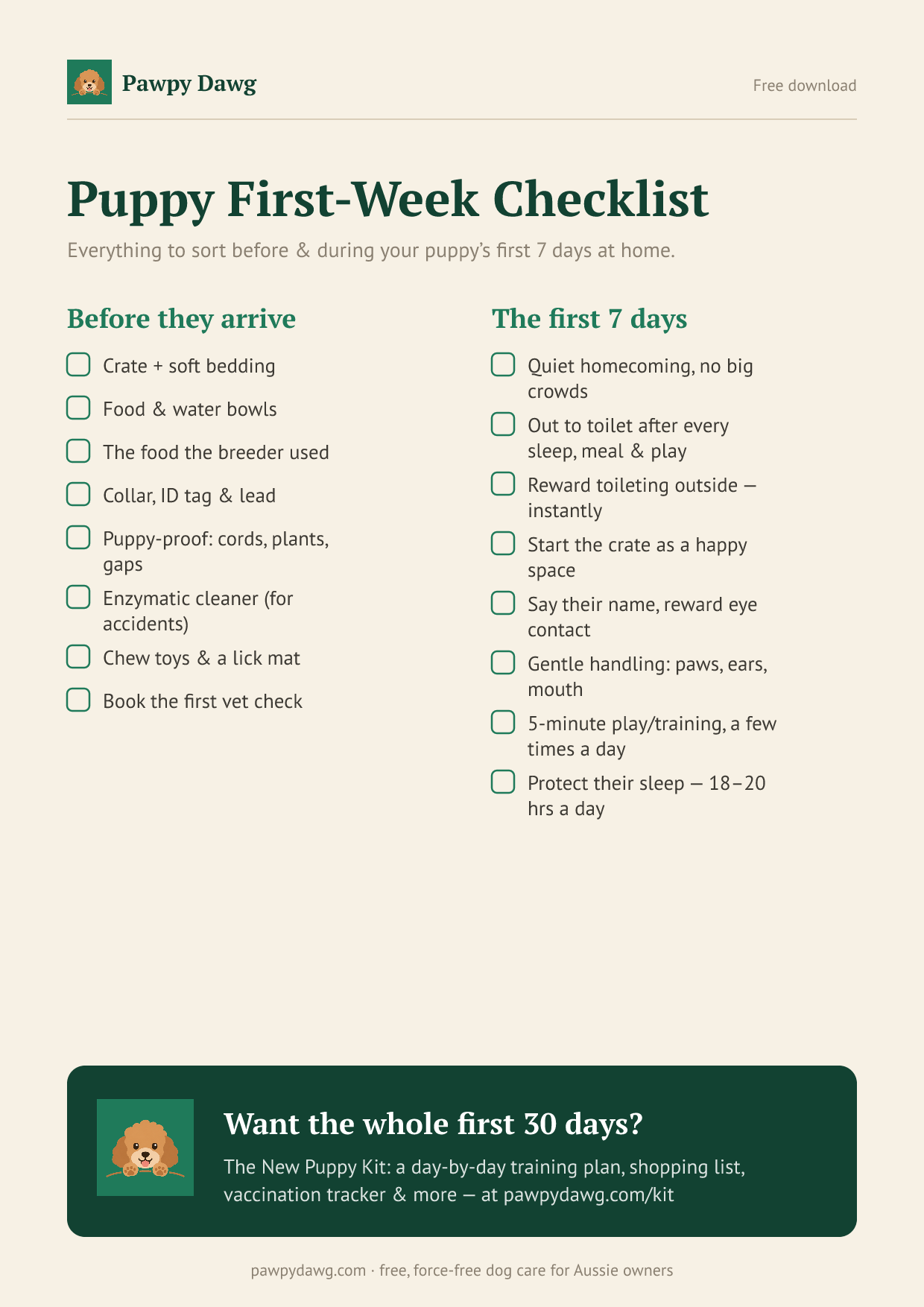
Free: the Puppy First-Week Checklist
Everything to sort before and during your puppy's first 7 days home — a printable one-pager. Plus the occasional genuinely useful dog tip. No spam, unsubscribe anytime.
Related guides
Is Pet Insurance Worth It in Australia? The Honest Maths
Is pet insurance worth it in Australia? We crunch real premiums vs real vet bills — cruciate surgery, snake bite & more — so you can decide with confidence.
Read the guide →
How Much a Dog Really Costs Per Year in Australia (2026 Breakdown)
How much does a dog cost per year in Australia? 2026 line-item breakdown covering food, vet, insurance, grooming & the costs first-timers always miss.
Read the guide →
Dog Vaccination Schedule in Australia: What, When and What It Costs
Confused by C3, C5 and kennel cough? Here's your complete dog vaccination schedule Australia cost guide — puppy timelines, adult boosters & typical AUD prices.
Read the guide →