
Maltese Training Guide: A Realistic 8-Week Plan
A realistic 8-week Maltese training plan built around their temperament. Short daily sessions, clear milestones, and no guilt trips.

Written by Bradley Brown
Founder & editor · Reviewed 2026-07-17

Maltese are clever, people-focused dogs who can absolutely be well-trained — but they respond very differently to pressure than, say, a Labrador. This 8-week plan is built around how they actually learn: in short bursts, with plenty of positive reinforcement and zero intimidation.
Is the Maltese actually easy to train?
Yes and no. Maltese are highly motivated by attention and food, which makes them quick to pick up new behaviours. What trips owners up is their sensitivity. Harsh corrections, raised voices, or repetitive drills that go on too long will cause a Maltese to shut down, sulk, or simply disengage. They're not being stubborn — they're telling you the session has stopped being safe or fun.
The other complication is small-dog syndrome, which isn't a personality flaw in the dog — it's a pattern that develops when owners unconsciously apply different rules to little dogs. A Maltese who jumps up gets cuddled instead of redirected. A Maltese who barks gets picked up. Over time, the dog learns that unwanted behaviour works. The good news: that pattern is completely reversible. Consistency over a few weeks is all it takes.
Keep every session to 5 minutes maximum for a puppy, 10 minutes for an adult. End on a success, always.
What should I teach first, and in what order?
Weeks 1–2 are about foundation, not tricks. Focus on:
- Name recognition — say the name once, mark with "yes!" the instant they look at you, and reward with a small treat. Do this 10–15 times a day in different rooms. Within a few days, that name should snap their head around reliably.
- Sit — lure the nose up and back with a treat until the bottom drops, say "sit" as it happens, then reward. Don't repeat the cue; one ask, then lure if needed.
- Marker word or clicker — whichever you choose, stick with it. A consistent marker (the word "yes" or a click) tells the dog the exact moment they've earned the reward. This speeds up everything that follows.
Weeks 3–4, once sit is solid, introduce drop (down), stay (just 2–3 seconds to start), and come when called from a short distance inside the house. Keep the recall game joyful — crouch down, use a happy voice, make arriving at you the best thing that's happened all day.
Weeks 5–6 are about adding duration and mild distraction: a slightly longer stay, a sit-stay while you take two steps back, a recall across the backyard. This is also when you can start working on loose-lead walking. Maltese don't need huge exercise distances, but pulling on a harness is still unpleasant for everyone. Stop the moment the lead goes tight, wait for slack, then move forward again. Boring, but it works within a week or two.
Weeks 7–8 are consolidation and real-world proofing. Can your dog sit calmly while you open the front door? Recall past a distraction? Settle on their mat while you eat dinner? These are the behaviours that make day-to-day life genuinely easier.
Why does my Maltese ignore me the second we go outside?
Because the outside world is overwhelming and full of scent information, and you haven't yet built the habit of checking in with you outdoors. This is normal — not a sign your training has failed.
The fix is to make yourself worth paying attention to outside, before you ask for anything. Carry high-value treats (small pieces of cooked chicken or cheese work well — much better than dry kibble in a distracting environment). When your dog glances at you spontaneously, reward it. You're building the reflex of "looking at my owner pays off." Once that reflex is consistent inside, you transfer it outside by starting in a quiet spot — your backyard or a low-traffic footpath — before attempting a busy park.
Never call your dog's name repeatedly when they're not responding. Each ignored call weakens the cue. Instead, make a novel sound (a kiss noise, a quick "pup pup pup"), wait for eye contact, reward generously, then ask for the recall.
How do I stop my Maltese barking at everything?
Barking in Maltese is often attention-seeking or alert behaviour, and the worst response — which almost everyone does instinctively — is to say "shhh," "no," or "quiet" in a frustrated tone. To your dog, that's just you barking back at them. It rewards the behaviour by giving it attention.
A more effective approach:
- Don't react at all for minor barking at nothing. Turn away, leave the room briefly if needed. The moment quiet happens, reward it.
- Teach a "quiet" cue deliberately — wait for a natural pause in the barking, say "quiet," then immediately reward the silence. With repetition, the word starts to predict the reward for being silent.
- Address the trigger where possible. Alert barking at the window? Manage the environment — block the view, or give your dog something to do before the postie arrives.
Expect this to take 3–4 weeks of consistency before you see a reliable change. It won't happen in a day, but it will happen.
Can I train a Maltese to use a toilet patch instead of going outside?
Yes, and many Australian Maltese owners use an indoor grass patch or puppy pad for overnight or apartment living alongside outdoor toileting. The key is treating indoor and outdoor toileting as two separate trained behaviours, not one contradicting the other.
Pick a specific patch location and take your dog there consistently after meals, after naps, and after play. The moment they go, mark and reward with genuine enthusiasm — toileting is one of the most under-rewarded behaviours in small dogs. If you catch them going somewhere else, simply interrupt calmly, move them to the patch, and reward if they finish there. No punishment. Punishment during toilet training teaches dogs to hide where they toilet, not to stop doing it.
Most Maltese are reliably toilet trained within 4–6 weeks if the schedule is consistent. Accidents after that point are usually a signal that the schedule slipped, not that the dog "forgot."
What if my Maltese has already picked up bad habits — is 8 weeks still realistic?
Absolutely. Behaviour that has been reinforced for months takes slightly longer to shift than a clean slate, but the same principles apply. The key insight is that you're not "untraining" anything — you're building a new, better-reinforced behaviour to replace the old one.
If jumping up is the issue, for example, every person in the household must stop rewarding it — which means no eye contact, no touch, no speech until four paws are on the floor. Then reward the floor behaviour immediately and consistently. It often gets worse for a day or two (an extinction burst — the dog tries harder before giving up) before it improves. That spike is a sign it's working.
Be honest about where you're inconsistent. An 8-week plan only works if the rules are the same whether you're tired, whether guests are over, and whether your dog is being especially cute. Inconsistency is the single biggest reason Maltese training stalls — not the dog's temperament, and not anything you've permanently broken.
As an Amazon Associate we earn from qualifying purchases.
Frequently asked questions
How long does it take to train a Maltese?
Basic obedience — sit, drop, stay, recall, loose-lead walking — can be reliably taught within 8 weeks using short daily sessions of 5–10 minutes. More complex behaviours or correcting long-standing habits may take a few additional weeks, but the process is the same. Consistency matters far more than session length.
Are Maltese hard to toilet train?
Maltese can take a little longer to toilet train than larger breeds because their small bladders need more frequent trips outside, and owners sometimes miss early signals. With a consistent schedule — after meals, naps, and play — most Maltese are reliably trained within 4–6 weeks. Punishment for accidents is counterproductive and should be avoided entirely.
What treats work best for training a Maltese?
Small, soft, high-value treats get the best results — tiny pieces of cooked chicken, cheese, or commercial training treats no bigger than a pea. Dry kibble works in low-distraction environments at home but is often not motivating enough outdoors. Always account for training treats in your dog's daily food intake to avoid overfeeding.
Why does my Maltese only listen when I have treats?
This usually means the treat has become the reason to comply rather than a reward for complying — often because the cue was repeated multiple times before the dog responded, or treats were shown before the behaviour happened. Practise asking once, waiting, and rewarding after the behaviour. Gradually vary when treats appear so your dog learns the behaviour always pays, just not always with food.
Should I use a harness or collar for a Maltese?
A well-fitted harness is strongly recommended for Maltese. Their tracheas are delicate, and repeated pulling or lead corrections on a collar can cause injury over time. A front-clip harness also helps reduce pulling during loose-lead training without any aversive pressure.
At what age should I start training my Maltese puppy?
As early as 8 weeks — the moment you bring them home. Puppies are absorbing information constantly at this age, and starting early builds good habits before unwanted ones form. Keep sessions to 3–5 minutes for very young puppies and focus on name recognition, sit, and toilet training first.
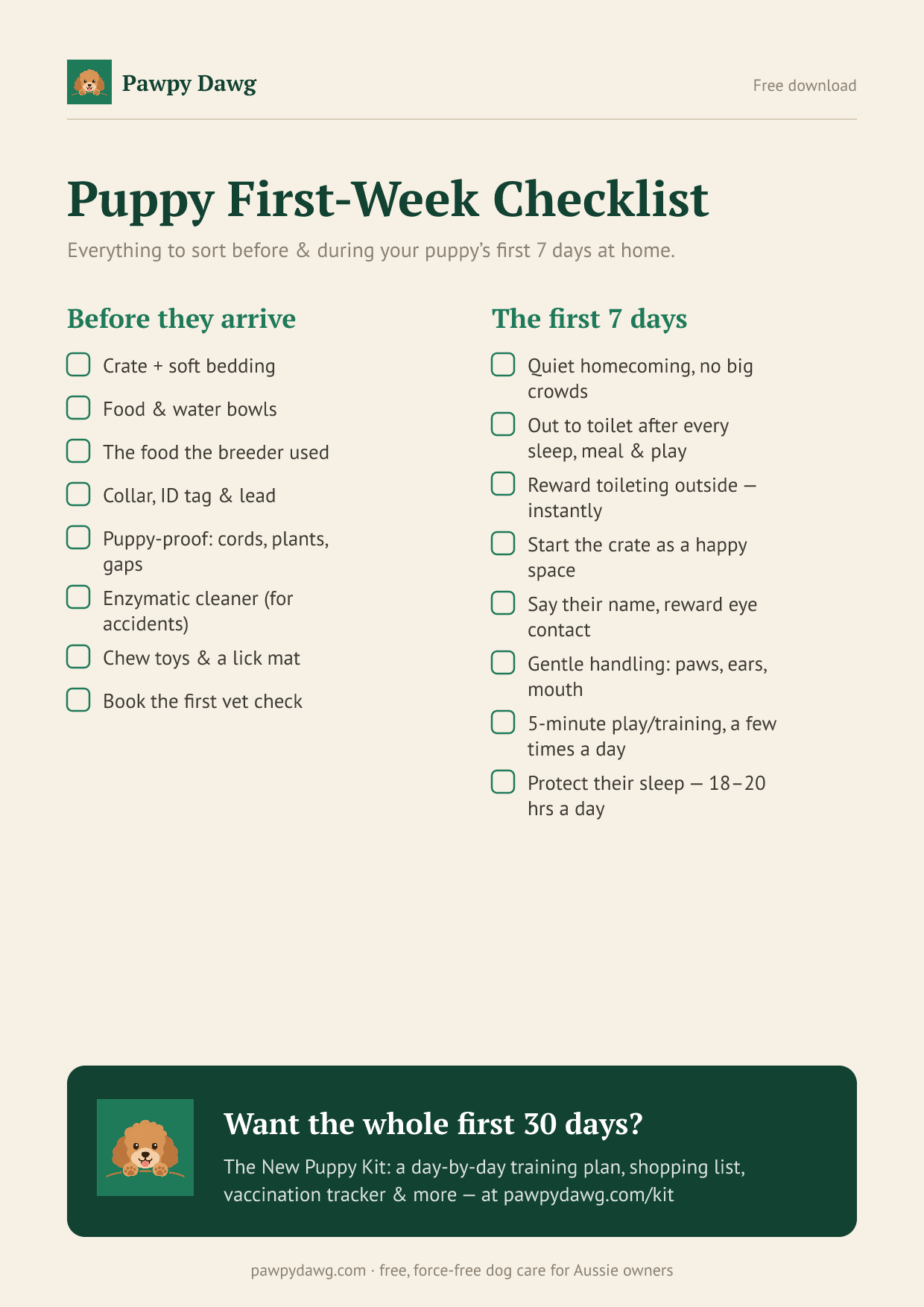
Free printable
Free: the Puppy First-Week Checklist
Everything to sort before and during your puppy's first 7 days home — a printable one-pager. Plus the occasional genuinely useful dog tip. No spam, unsubscribe anytime.