
Dachshund Training Guide: A Realistic 8-Week Plan
A realistic 8-week dachshund training plan built around their stubborn-but-smart temperament. Short daily sessions, clear expectations, and week-by-week progress.

Written by Bradley Brown
Founder & editor · Reviewed 2026-07-18

If You Only Do Five Things, Do These
Before unpacking the full eight weeks, here's the short version. If life gets chaotic and you can only manage the basics, these five habits will carry you surprisingly far:
- Keep every session to five minutes. Dachshunds disengage fast. Short and successful beats long and frustrating every time.
- Use tiny, smelly treats. Think pea-sized pieces of cooked chicken, cheese, or a commercial treat with a strong odour. Dachshunds work for their nose, not your praise alone.
- Train before meals, never after. A full dachshund is a disinterested dachshund.
- Reward the exact moment the right behaviour happens. Timing is everything — a half-second delay means you're rewarding the wrong thing.
- Be boringly consistent. Every person in the house uses the same cues, the same rules, the same rewards. Inconsistency is the single biggest reason dachshund training stalls.
That's it. The rest of this guide explains the why behind each point and gives you a week-by-week structure to follow.
Why Dachshunds Are a Specific Training Challenge (and Not Your Fault)
Dachshunds were purpose-bred in Germany to hunt badgers — underground, alone, without waiting for human instruction. That heritage is still very much alive in your dog. Independent decision-making, selective hearing, and a willingness to ignore you when something more interesting is happening aren't personality flaws. They're deeply wired traits.
This is also why the "stubborn" label gets thrown around so much. A dachshund isn't refusing to sit because they don't respect you. They're running a quick cost-benefit analysis: Is this worth doing right now? Your job isn't to dominate that calculation — it's to make compliance consistently more rewarding than the alternative.
The good news is that dachshunds are genuinely intelligent, food-motivated, and capable of learning a solid range of behaviours. They just need shorter sessions, better treats, and a trainer who doesn't take the eye-roll personally.
The Five Principles, Unpacked
1. Five Minutes Is Actually Enough
Most owners underestimate how quickly a dachshund's focus window closes. Research into canine learning consistently shows that short, frequent sessions produce better retention than long ones. For a dachshund specifically, aim for two to three five-minute sessions per day rather than one fifteen-minute block.
The common mistake: pushing through when the dog starts sniffing the ground, looking away, or offering random behaviours hoping one sticks. That's not a bad dog — that's a dog telling you the session is over. End on a success (ask for something they already know, reward it, finish) and pick it up later.
2. Treat Quality Changes Everything
A dry kibble piece in the kitchen will get you nowhere in the backyard, and nowhere near a distraction. Dachshunds have an extraordinary sense of smell — it's their primary sense — and strong-smelling, high-value treats cut through competing stimuli in a way that bland rewards simply don't.
Rotate between two or three high-value options so they don't habituate to one. Cooked chicken, small cubes of tasty cheese, liver treats, or commercial training treats with a strong odour all work well. Keep pieces tiny — about the size of a blueberry — so you can reward frequently without filling them up inside five minutes.
The common mistake: using the same treat for everything regardless of difficulty. Save your best treats for the hardest moments: recall in the park, ignoring another dog, staying put when the postie arrives.
3. Hunger Is Your Training Partner
A dachshund who has just eaten has very little reason to work for food. Schedule training sessions before breakfast and before dinner whenever possible. This doesn't mean starving your dog — it just means using their natural appetite as leverage.
The common mistake: free-feeding (leaving food out all day). This kills food motivation completely. If your dachshund grazes, switch to structured meal times before starting a training programme.
4. Reward Timing Is a Skill
The window between a correct behaviour and the reward needs to be one second or less for your dog to make the right association. If your dachshund sits, you say "good," reach for a treat, fumble with the bag, and deliver it three seconds later — you've likely rewarded them for standing back up.
A clicker or a consistent marker word ("yes!") bridges this gap. The moment you hear the click or say "yes," the dog knows the reward is coming, even if it takes you another couple of seconds to deliver it. Clickers are cheap (around $5–$10 at most Australian pet stores) and make a genuine difference for precise, fast behaviours.
The common mistake: being inconsistent with the marker. Pick one word or use a clicker — don't alternate between "yes," "good boy," "good girl," and "well done" in the same session.
5. Consistency Across the Household
A dachshund who is allowed on the couch by one person but scolded by another isn't confused — they're learning that rules are optional and worth testing. Every person who interacts with the dog needs to use the same verbal cues (pick one: "sit" not "sit down" and "sit" interchangeably), the same boundaries, and the same approach to rewards.
The common mistake: one household member undermining the training by "just this once." Dachshunds are excellent at identifying and exploiting the soft touch in the house.
The Eight-Week Plan
This plan assumes you're starting with a dachshund who knows nothing formally, or who has picked up a few bad habits. Each week builds on the last. If your dog flies through a week early, move on. If they're struggling, repeat the week without guilt — some dogs need ten days where the plan says seven.
Weeks 1–2: Foundation skills Focus exclusively on sit, drop, and name recognition. These are the building blocks everything else rests on. Use luring (guide the dog into position with a treat) rather than pushing or forcing. Once the dog is reliably following the lure, introduce the verbal cue. By the end of week two, most dachshunds will respond to "sit" and "drop" in a quiet, low-distraction environment about eight times out of ten.
Weeks 3–4: Stay and loose-lead walking "Stay" is taught in tiny increments — one second, then two, then five — before adding distance. Dachshunds find impulse control genuinely difficult, so don't rush this. Loose-lead walking is introduced in the backyard or a quiet street before going anywhere interesting. The goal is not a perfect heel — it's a dog who isn't pulling your shoulder out of its socket.
Weeks 5–6: Recall and the "leave it" cue Recall ("come") is the most important cue your dachshund will ever learn, and it should always be followed by something wonderful — never by something the dog finds unpleasant (like nail clipping or a bath). "Leave it" is invaluable for a breed that will eat anything at ground level. Practise both in the backyard before introducing mild distractions.
Weeks 7–8: Proofing in the real world Take your dachshund's known skills into new environments: a quiet park, a friend's backyard, the footpath outside your local café. Expect a 20–30% drop in reliability when you change locations — this is normal and not regression. Reward more generously in new environments, lower your criteria slightly, and build back up. By the end of week eight, you should have a dog who responds reliably in most everyday situations.
What to Expect, Week by Week
- Week 1: Your dog may seem uninterested or easily distracted. This is normal. Focus on making sessions feel like a game.
- Week 2: You'll notice the first consistent responses. The dog starts anticipating what you want. This is exciting — don't get greedy and add too much too soon.
- Week 3–4: The "teenage" phase can hit even adult dogs in a new training programme. They may test boundaries or seem to forget what they knew. Hold steady.
- Week 5–6: Recall starts to feel real. You'll use "leave it" and mean it. Confidence builds on both sides of the lead.
- Week 7–8: The work pays off in public. Your dachshund isn't perfect, but they're listening. That's the goal — a dog who's engaged, not a robot.
You haven't ruined your dog. You're just getting started.
As an Amazon Associate we earn from qualifying purchases.
Frequently asked questions
How long does it take to train a dachshund?
Most dachshunds can learn basic obedience skills — sit, drop, stay, come, and loose-lead walking — within six to eight weeks of consistent daily practice. That said, dachshunds are an independent breed, so ongoing reinforcement matters more than hitting a finish line. Think of training as a habit, not a project.
Are dachshunds easy to train?
Dachshunds are intelligent but independently minded, which makes them moderate to train rather than easy. They respond very well to positive reinforcement and high-value treats, but they disengage quickly if sessions run long or rewards aren't worth their while. Short, rewarding sessions consistently outperform longer, more demanding ones.
Why does my dachshund ignore me when I call them?
Recall is genuinely difficult for dachshunds because they were bred to follow their nose and make decisions without human guidance. If your dachshund ignores your recall, the most common causes are: the reward isn't high-value enough, recall has accidentally been paired with something unpleasant (like being put on lead to leave the park), or the cue has been repeated so many times without response that the dog has learned to ignore it. Start rebuilding recall in a low-distraction environment with your very best treats.
At what age should I start training a dachshund puppy?
As soon as your puppy comes home — typically around eight weeks of age. Young puppies have a short but critical socialisation window (roughly eight to sixteen weeks) during which positive exposure to people, sounds, surfaces, and other animals has a lasting impact. Basic luring and name recognition can begin from day one. Keep sessions to two or three minutes at this age.
Is crate training recommended for dachshunds?
Yes — when introduced gradually and positively, a crate gives a dachshund a secure den-like space that suits their burrowing instincts. Never use a crate as punishment. Build positive associations slowly by feeding meals near it, then inside it, before closing the door for short periods. Most dachshunds come to genuinely enjoy their crate once it's properly introduced.
How do I stop my dachshund from barking excessively?
Dachshunds were bred to alert their handler, so some barking is normal and expected. Excessive barking is usually driven by boredom, anxiety, or a lack of an alternative behaviour to offer. The most effective approach is to avoid inadvertently rewarding barking with attention (even negative attention counts), ensure the dog gets adequate mental and physical stimulation, and teach a reliable 'quiet' cue using positive reinforcement. If barking is severe or anxiety-based, a consultation with a vet or accredited behaviourist is worthwhile.
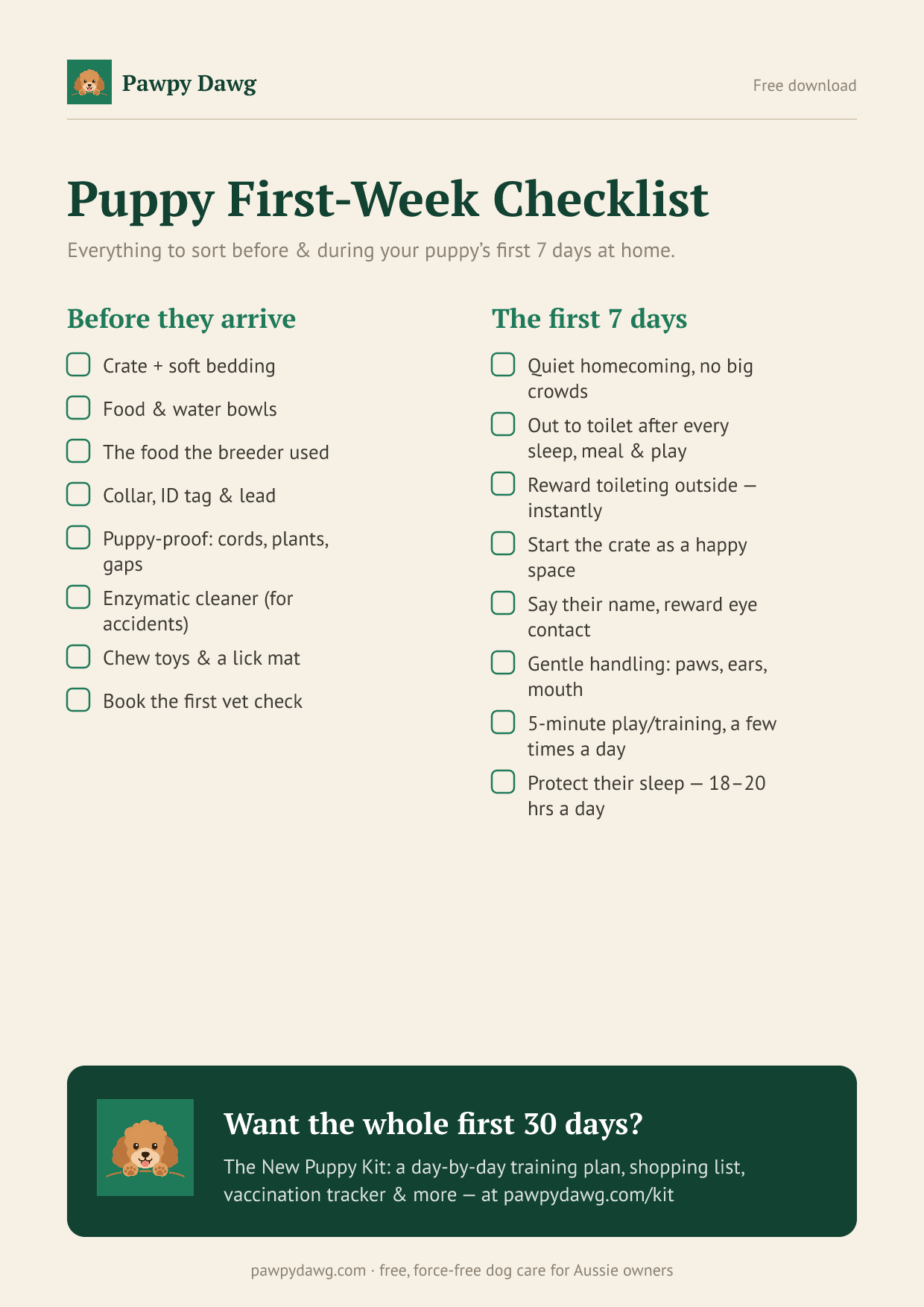
Free printable
Free: the Puppy First-Week Checklist
Everything to sort before and during your puppy's first 7 days home — a printable one-pager. Plus the occasional genuinely useful dog tip. No spam, unsubscribe anytime.