
Cocker Spaniel Training Guide: A Realistic 8-Week Plan
A realistic 8-week cocker spaniel training plan built around their sensitive, eager temperament — short daily sessions, no dominance myths, real results.

Written by Bradley Brown
Founder & editor · Reviewed 2026-11-05

The single worst piece of advice handed to Cocker Spaniel owners is this: "Be the alpha. Show him who's boss." People are still told to roll their dog, use a firm "dominant" voice, or ignore pleading eyes as a power move. With most breeds this is unhelpful. With Cockers, it actively backfires. These dogs are emotionally sensitive and people-oriented to their core — harsh handling shuts them down, creates anxiety, and can trigger the nervous nipping or submissive urination that owners then mistake for a "bad temperament." There is nothing wrong with your Cocker. The method was wrong.
Cocker Spaniel training works best when it leans into what the breed already is: smart, food-motivated, eager to be near you, and built for cooperative work. The 8-week plan below is structured around 5–10 minute sessions once or twice a day — short enough to keep a Cocker's focus sharp and your schedule intact.
"Cockers Are Stubborn — You Have to Force Compliance"
This one has ruined a lot of relationships between owners and their dogs. Cockers can look stubborn when they disengage — they go soft, turn away, lose interest. What's actually happening is stress or boredom, not defiance. A dog who has checked out is telling you the session has gone on too long, the reward isn't worth the effort, or the pressure is too high.
Reality: Cockers are ranked among the more trainable sporting breeds. They were bred to work closely with hunters, reading human cues and adjusting in real time. That instinct is still there. The trick is keeping sessions under 10 minutes, ending before the dog's energy dips, and paying well (small, smelly treats — think cheese, cooked chicken, or quality commercial training treats in the $15–$25/100g range).
Weeks 1–2 focus: Name recognition, sit, eye contact ("watch me"), and coming when called from two metres away. Keep it in a low-distraction space. Reward every correct response. At this stage you're building a habit of paying attention to you, which is the foundation everything else sits on.
"Let Him 'Work It Out' with Other Dogs — Don't Interfere"
Cocker Spaniels can be sociable, but they're also prone to anxiety if early social experiences go badly. Throwing a puppy into a dog park and hoping he figures it out is a gamble that frequently produces a fearful or reactive adult dog. A bad experience at 10–14 weeks (the critical socialisation window) can take months of careful counter-conditioning to undo.
Reality: Socialisation means controlled, positive exposure — not free-for-alls. It means calm, vaccinated adult dogs, not boisterous puppies who bowl your Cocker over. It means watching your dog's body language (ears back, low tail, lip-licking = stressed) and stepping in before he's overwhelmed.
Weeks 3–4 focus: Loose-lead walking basics and structured socialisation. For the lead, start indoors or in the backyard — the moment your Cocker pulls, stop and wait. The second the lead goes slack, move forward. Five minutes of this every day produces results faster than 30 minutes of frustrated pulling. For socialisation, arrange one-on-one meetings with known calm dogs, and expose your dog to different surfaces, sounds, and people — but let him set the pace.
"Once He's Got a Command, He's Got It — Move On"
Owners often teach "sit" in the kitchen, get a reliable response, and assume the job is done. Then the dog won't sit at the vet, in the park, or when visitors arrive. This isn't disobedience — it's a failure to generalise. Dogs learn behaviours in contexts, not as abstract rules. A Cocker who sits beautifully at home has learned "sit in this room, with you standing in front of me, with the treat bag on the bench."
Reality: Generalisation has to be trained deliberately. That means practising every known behaviour in new locations, at new distances, with new distractions — gradually. This is called "proofing," and it's where most home training programmes stall.
Weeks 5–6 focus: Proofing sit, drop, stay, and recall in progressively harder environments. Start in the front yard, then the footpath, then a quiet park. Add mild distractions before heavy ones. Keep rewarding — a dog working in a novel environment is working harder than a dog performing in the lounge room, and that extra effort deserves extra pay.
"He Doesn't Need Mental Stimulation — He Just Needs a Walk"
Cocker Spaniels are scent hounds at heart. Their noses are extraordinary, and when that instinct goes unused, excess energy tends to redirect into barking, destructive chewing, or general chaos. A tired body from a walk is great. A tired mind from sniffing and problem-solving is what actually settles a Cocker for the afternoon.
Reality: Mental enrichment is not optional for this breed — it's basic welfare. And it doesn't need to be complicated.
Weeks 7–8 focus: Layer in scent work and enrichment alongside your existing commands. Scatter kibble in the grass and let your dog hunt it. Hide treats around the lounge room for a sniff-and-seek game. Introduce "find it" — toss a treat, say "find it," let the dog locate it. These are five-minute games, not elaborate protocols. Also begin practising a solid "leave it" and "wait" at doorways — practical skills that pay dividends daily.
What a Realistic Week Actually Looks Like
By week 8, a typical day might look like this:
- Morning (5–7 min): Recall practice in the backyard + one proofing rep of "drop" and "stay"
- Walk: Loose-lead practice for the first block, then free sniffing time
- Evening (5 min): Scatter feeding or a "find it" game, plus one new challenge from that week's focus
That's it. Cocker Spaniel training doesn't require hours or specialist equipment. It requires consistency, short sessions, and a reward that your dog actually wants. Most owners who stick to this framework see a genuinely well-mannered dog by the end of two months — not perfect, but polite, responsive, and much easier to live with.
If you're starting with an older Cocker rather than a puppy, the same plan applies — just expect weeks 1–2 to take a little longer as your dog adjusts to a new way of interacting with you. Adult dogs are absolutely trainable. The timeline shifts; the method doesn't.
As an Amazon Associate we earn from qualifying purchases.
Frequently asked questions
How long should cocker spaniel training sessions be?
Five to ten minutes per session is ideal for Cocker Spaniels. Their focus is sharp but not prolonged — once a Cocker starts disengaging, the session has already gone too long. Two short sessions a day will outperform one long, draggy one every time.
At what age should I start training my Cocker Spaniel puppy?
As soon as your puppy comes home, typically around 8 weeks of age. At this stage, focus on name recognition, simple luring (sit, eye contact), and positive socialisation experiences. Formal obedience can wait; building trust and a positive association with learning cannot.
Why does my Cocker Spaniel ignore me when we're outside?
Outdoors is a high-distraction environment your dog hasn't been trained to work in yet — not a sign of stubbornness. Generalisation (practising known skills in new places) needs to be deliberately trained. Start by practising recall and sit in your front yard before moving to busier locations, and reward heavily for any correct response outside.
Are Cocker Spaniels hard to train compared to other breeds?
No — Cockers are generally considered highly trainable. They're people-focused, food-motivated, and bred for cooperative work. They can appear difficult when training relies on harsh corrections or sessions that are too long, both of which cause them to shut down. Positive, short, reward-based training suits the breed very well.
My Cocker Spaniel is 2 years old and has had no training. Is it too late?
Absolutely not. Adult Cockers can learn just as effectively as puppies, and they often have better focus. The 8-week plan above works for adult dogs — you may spend slightly longer on the foundational weeks as your dog gets used to the new dynamic, but the method is exactly the same.
How do I stop my Cocker Spaniel from pulling on the lead?
The most reliable technique is stop-and-wait: the moment the lead goes taut, you stop moving entirely. The second it goes slack, you move forward again. It feels slow at first but rewires the association quickly — your dog learns that pulling makes the walk stop, and a loose lead makes it continue. Practise in low-distraction areas first and keep initial sessions to five minutes.
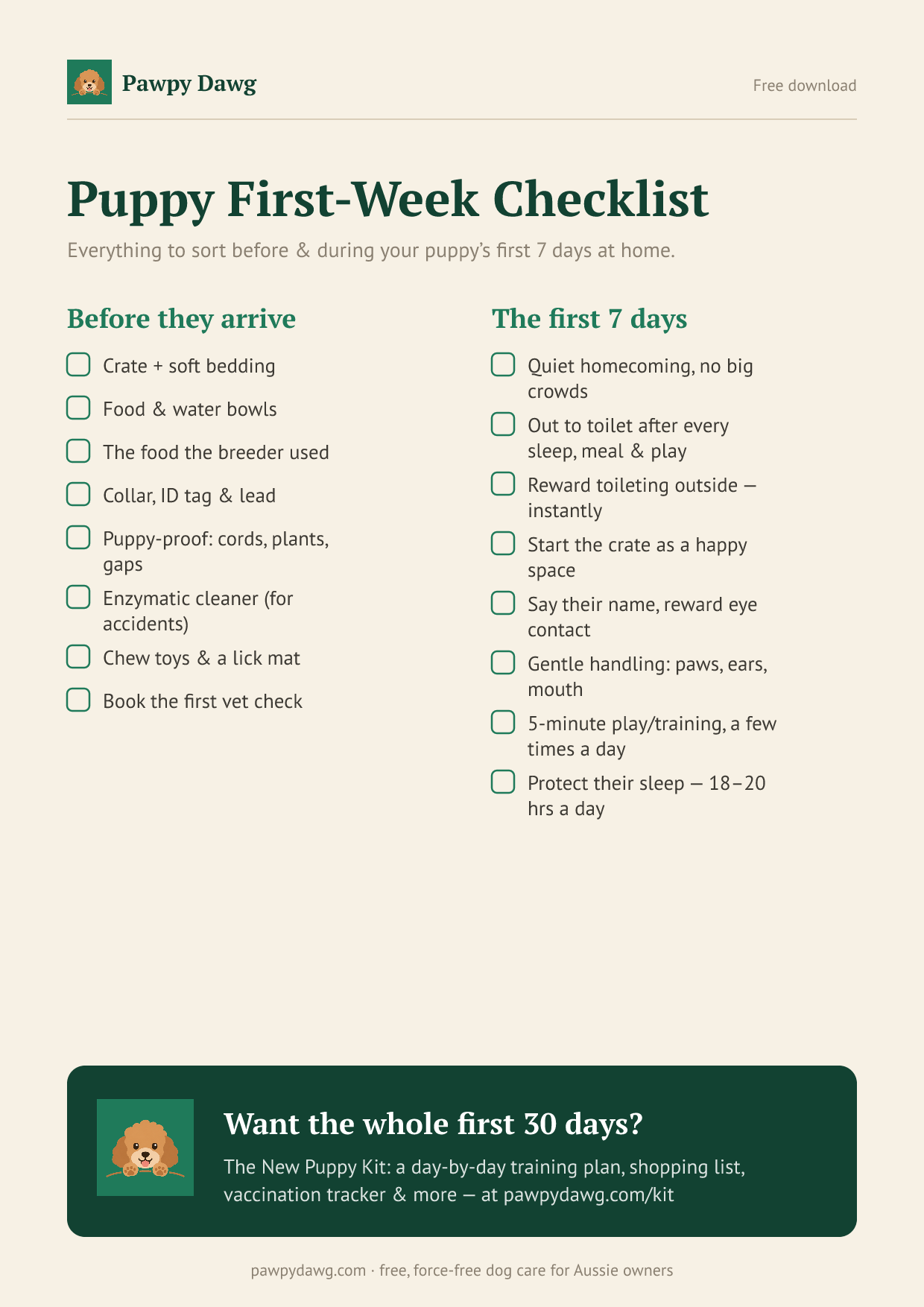
Free printable
Free: the Puppy First-Week Checklist
Everything to sort before and during your puppy's first 7 days home — a printable one-pager. Plus the occasional genuinely useful dog tip. No spam, unsubscribe anytime.
Related guides

Stop Your Cocker Spaniel Pulling on the Lead — the Calm, Force-Free Way
Tired of being dragged around the block? Fix cocker spaniel pulling on the lead with this calm, force-free plan — realistic timelines, common mistakes & pro tips.
Read the guide →
Why Your Cocker Spaniel Barks at Strangers (and How to Turn It Around)
Cocker spaniel barking at strangers? Discover why it happens and get a realistic, positive-reinforcement plan to fix it — in just 5–10 minutes a day.
Read the guide →
Cocker Spaniel Separation Anxiety: Why It Happens and What Actually Works
Cocker spaniel separation anxiety is common and fixable. Get a vet-aligned, positive-reinforcement plan with realistic timelines, mistakes to avoid, and pro help signs.
Read the guide →