
Border Terrier Training Guide: A Realistic 8-Week Plan
A realistic 8-week border terrier training plan built around their bold, brainy temperament — short daily sessions, no fluff, real results.

Written by Bradley Brown
Founder & editor · Reviewed 2026-07-17
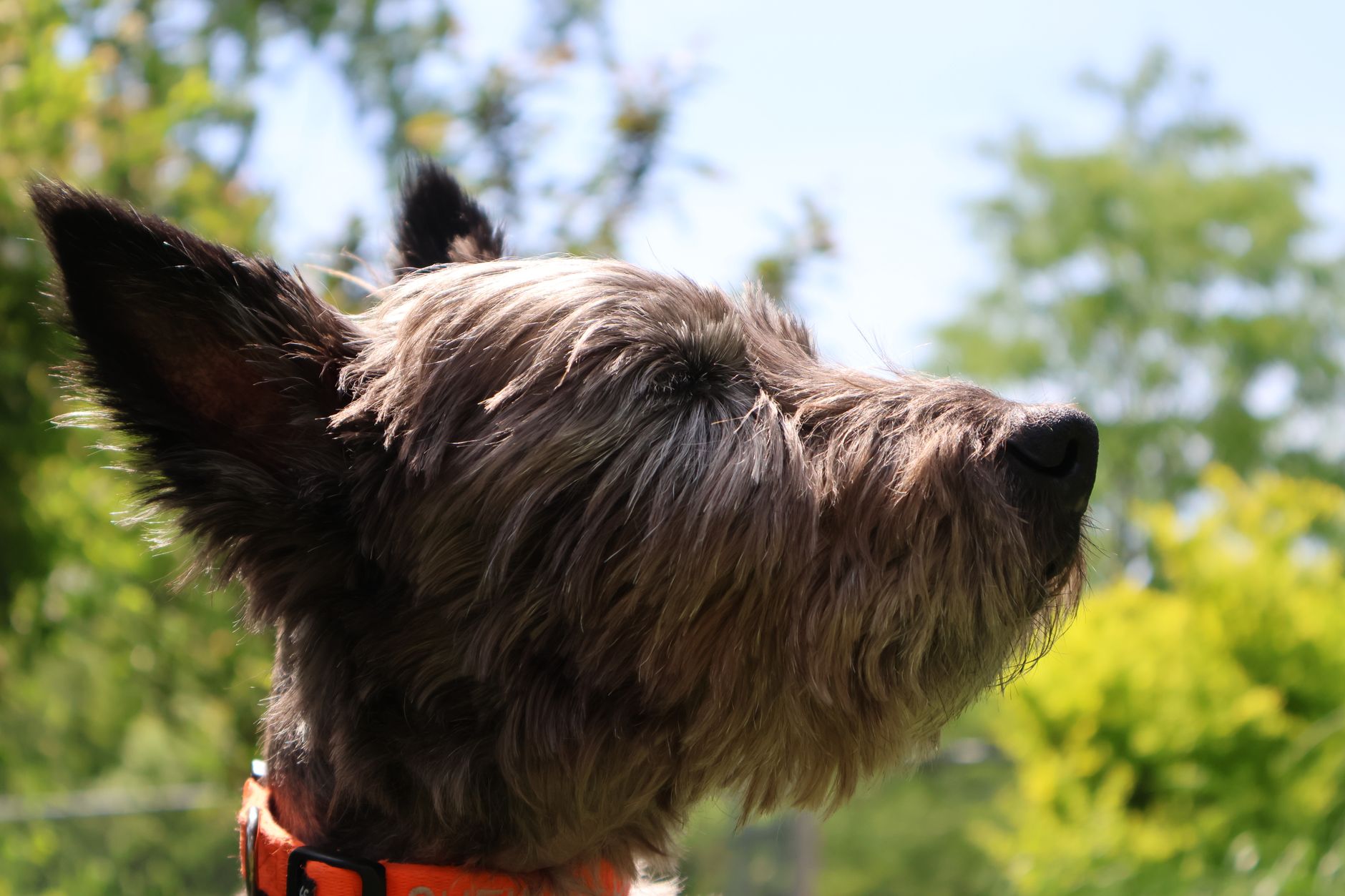
Sarah adopted Pip, a two-year-old Border Terrier, from a rescue in regional Victoria six weeks ago. He's sweet as anything on the couch, but the moment he spots a bird through the back fence, he's gone — deaf to every recall, dragging her across the footpath, utterly somewhere else. She's tried treats, tried a firm voice, tried YouTube. Nothing sticks longer than a day. She's starting to wonder if she's the problem.
She's not. Pip is just being a Border Terrier.
What's Actually Going On Inside That Wiry Head
Border Terriers were bred in the Cheviot Hills of northern England to work independently alongside foxhound packs — hunting, making their own decisions, covering rough ground all day. That heritage isn't a training obstacle; it's the operating system. It means Pip isn't ignoring Sarah out of stubbornness. He's running a program that says high-value distraction = pursue now, ask questions never.
The good news is that Border Terriers are genuinely biddable dogs. Unlike some terrier breeds that seem to regard training as optional, Borders actively enjoy working with people — they just need a handler who understands that their attention is earned, not assumed, and that short, sharp sessions beat long, repetitive ones every time. Research into dog cognition consistently shows that training sessions of five to ten minutes produce better retention than marathon drilling, and for a breed with this much mental horsepower, that guideline is non-negotiable.
The other thing to know: Border Terriers are big-picture thinkers. They respond brilliantly to reward-based training — high-value food treats, a favourite tug toy, enthusiastic praise — but they disengage fast if a session becomes predictable or boring. Keep them guessing. Keep them winning.
The 8-Week Plan
Each week asks for one to two sessions per day, five to ten minutes each. That's it. You're not signing up for hours of drilling.
Weeks 1–2: Building the Currency
Before you can ask Pip — or any Border Terrier — for anything in a distracting environment, you need to become more interesting than the environment. That starts in the least distracting place possible: indoors.
Spend these two weeks on three foundation behaviours: sit, drop, and name recognition (the dog looks at you when you say their name). Use tiny, soft treats — chicken, cheese, fritz — at a rate of roughly one treat per correct response. The goal isn't perfection; it's creating a habit of engagement. End every session before the dog loses interest. If Pip offers a behaviour spontaneously, reward it immediately. You're building a dog who thinks, "Good things happen when I pay attention to this person."
By the end of week two, Pip should be offering eye contact unprompted and responding to sit and drop in a quiet room around nine times out of ten.
Weeks 3–4: Adding a Recall Foundation
Recall is the behaviour most Border Terrier owners struggle with most, so start building it now — in the hallway, in the backyard, nowhere near a fence line or a bird.
Use a distinct recall cue — "here", "come", or a whistle — and pair it with your highest-value reward every single time. Call once, run backwards to make yourself exciting, reward with food and a brief play when the dog arrives. Never call your dog to do something they find unpleasant (baths, nail trims, ending the park visit). If you need to do something the dog dislikes, go and get them instead.
Also introduce leave it this fortnight. Hold a treat in your closed fist, wait for the dog to back off, then mark and reward with a different treat from your other hand. This is the early scaffolding for the impulse control that will eventually help Pip ignore that bird.
Weeks 5–6: Proofing in the Real World
This is where most training plans fall over, because owners try to jump from the hallway to the off-leash park. Don't. Work in gradually increasing levels of distraction:
- Quiet backyard → front yard → quiet footpath → busier street → park perimeter on lead
At each level, ask for the behaviours your dog already knows well before adding new challenges. If Pip fails more than two or three times in a row, you've moved up a level too quickly — drop back and make it easier. This isn't failure; it's calibration.
Introduce loose-lead walking properly now. The method that works best for most Border Terriers is stopping dead the moment the lead tightens, then resuming when the dog returns to your side. It feels slow. It is slow. But within a week of consistency it produces genuine change, because the dog figures out that pulling simply doesn't work.
Weeks 7–8: Reliability Under Pressure
By now, Pip has a solid foundation. These final two weeks are about stress-testing it — introducing the specific triggers that cause him to switch off.
If the back fence is his weakness, start fifty metres from it. Ask for a sit. Reward. Ask for focus. Reward. Move five metres closer. Repeat. This is systematic desensitisation in its simplest form, and it works precisely because you're keeping the dog under their threshold — working, thinking, succeeding — rather than flooding them with the thing that derails them.
Practice the recall in the backyard with mild distractions: a ball rolling past, another family member walking through. Reward arrivals with a jackpot — five or six treats delivered one at a time, or thirty seconds of tug. Border Terriers respond well to that kind of enthusiastic payoff.
By week eight, your goal isn't a perfectly obedient dog in every situation. It's a dog who, when called, pauses and returns to you most of the time, even when something interesting is happening. That is a genuinely safe, genuinely connected dog.
A Few Things Worth Knowing for the Long Haul
Border Terriers need adequate physical exercise — at least forty-five minutes of off-lead running or vigorous play daily — or their training will plateau. A tired-but-not-exhausted dog learns. A cooped-up, under-stimulated one doesn't.
Mental enrichment matters just as much. Scatter feeding, sniff walks, food puzzles and basic nose-work games (hiding treats under cups, introducing a scent to search for) tap directly into the hunting drive and leave Borders genuinely satisfied in a way that a lap around the block never quite does.
If you hit a wall — Pip's reactivity is escalating rather than improving, or the recall is going backwards after weeks of progress — a single session with a certified dog trainer (look for a member of the Pet Professional Guild Australia or Delta Society) can identify what's actually happening. Expect to pay $A100–$A180 for a private consult. It's almost always worth it.
Sarah and Pip are at week five now. He still glances at the fence. But he glances back at her too — and that's the whole game.
Frequently asked questions
Are Border Terriers easy to train?
Border Terriers are among the more trainable terrier breeds — they're eager to engage with people and pick up new skills quickly. The main challenge is their independent streak and high prey drive, which means they can switch off in distracting environments. Short, rewarding sessions kept well below ten minutes get the best results.
How do I stop my Border Terrier from pulling on the lead?
The most effective approach is stopping completely the moment the lead goes tight, then resuming only when your dog returns to a loose lead. It feels painfully slow at first, but most Border Terriers work it out within one to two weeks of consistent practice. Front-clip harnesses can also reduce pulling mechanics while you build the habit.
Why won't my Border Terrier come when called?
Recall breaks down most often when the dog has learned that coming means the fun ends, or when they've been called repeatedly without a worthwhile reward. Rebuild it from scratch in a low-distraction space using your highest-value treats, call once only, and make arriving back to you a genuinely exciting event. Never punish a dog that does eventually return, no matter how long it took.
How much exercise does a Border Terrier need each day?
Most adult Border Terriers need at least forty-five minutes of genuine exercise daily — off-lead running, fetch, or vigorous play rather than just a slow walk. Mental stimulation through nose-work, food puzzles or training sessions is equally important and helps settle the breed's natural restlessness.
At what age should I start training a Border Terrier puppy?
You can start basic reward-based training from the day your puppy comes home, usually around eight weeks of age. Short sessions of two to three minutes are plenty at this age. Early socialisation — gentle exposure to different people, surfaces, sounds and environments before sixteen weeks — is just as important as formal obedience work.
Do Border Terriers get bored with repetitive training?
Yes — they disengage quickly from drills that become predictable. Mix up the order of cues you ask for, train in different locations, and vary your rewards between food, play and praise. Ending a session while the dog is still keen and succeeding is far more effective than pushing through until they switch off.
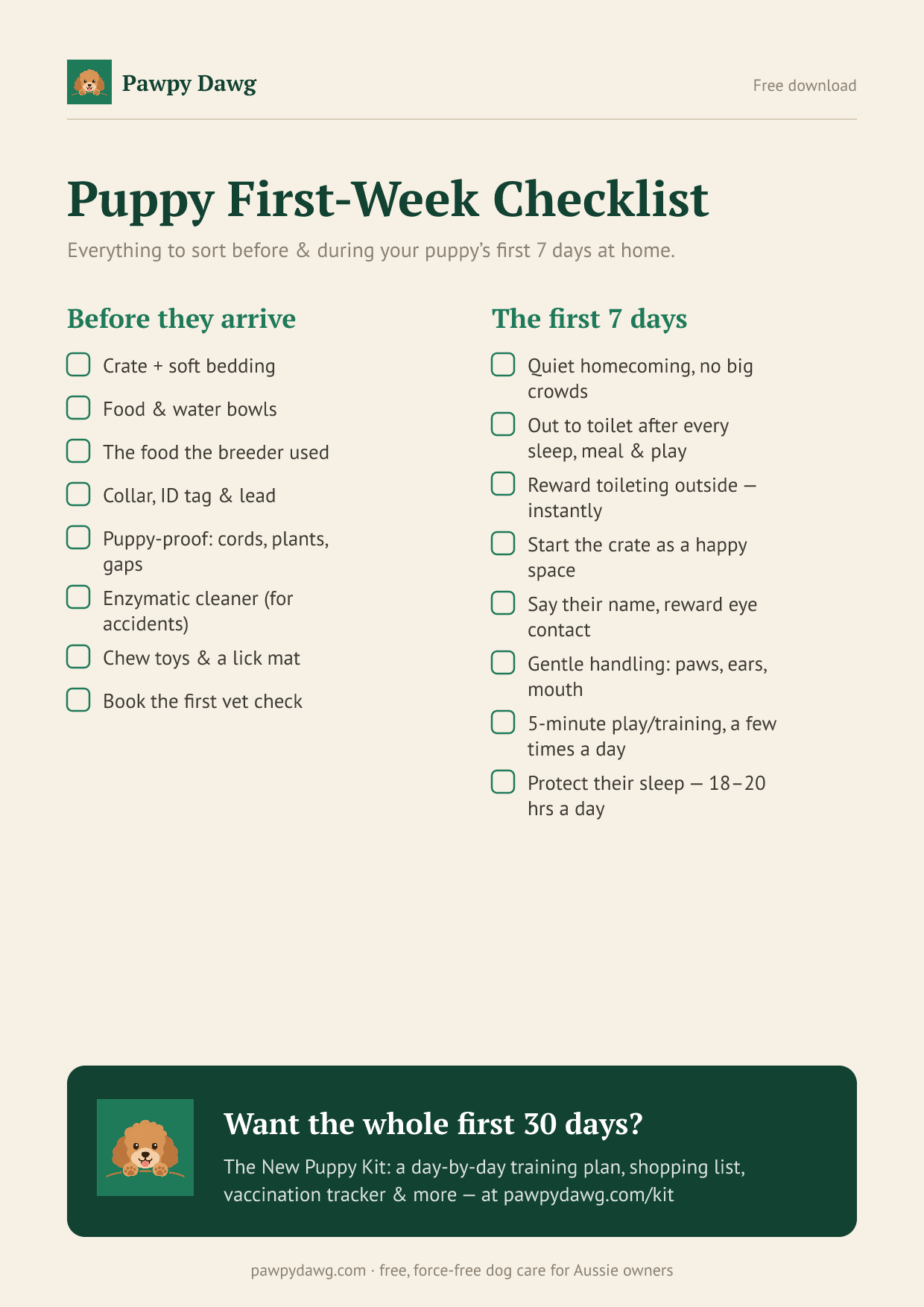
Free printable
Free: the Puppy First-Week Checklist
Everything to sort before and during your puppy's first 7 days home — a printable one-pager. Plus the occasional genuinely useful dog tip. No spam, unsubscribe anytime.