
Taking Your Dog on Holiday in Australia: Stays, Parks and Rules
Planning dog friendly holidays in Australia? Find genuine pet-welcoming stays, national park rules, beach access tips, a packing list, and how to settle your dog away from home.

Written by Bradley Brown
Founder & editor · Reviewed 2026-11-10
Australia is one of the best countries in the world to travel with a dog — if you know where to look and what to expect. Here's a practical clinic covering the questions owners actually search before they leave the driveway.
How do I find accommodation that's genuinely dog-friendly, not just "pet-tolerant"?
There's a real difference between a property that allows dogs and one that's actually set up for them. A truly dog-friendly stay will have secure fencing (ask the specific height — 1.2 m is a minimum for most medium breeds), no "dogs must be crated at all times" clause buried in the fine print, and outdoor areas where your dog can actually move around.
Dedicated search platforms like BringFido, Stayz (filter by "pets allowed"), and Hipcamp are the most reliable starting points. Hipcamp in particular lists farm stays and rural properties where dogs can often roam off-lead on private land — a genuinely different experience from a motel car park. Dog-friendly cabin parks run by operators such as G'Day Parks and Big4 have standardised pet policies, so you know what you're getting.
Always ring ahead rather than relying solely on the listing. Ask: Is the entire property fenced? Are dogs allowed inside the room or cabin, or only in outdoor areas? Is there an extra cleaning fee (commonly $30–$80 AUD per stay)? Are there weight or breed restrictions? Getting this in writing saves arguments on arrival.
Which national parks in Australia allow dogs, and where are they banned?
This is where many people get caught out. The majority of Australian national parks do not allow dogs, including almost all parks managed by NSW National Parks, Parks Victoria, Queensland Parks and Wildlife, and their equivalents in other states. The reasoning is genuine: domestic dogs disturb ground-nesting birds, small mammals, and reptiles even when on-lead and well-behaved.
There are exceptions, and they vary by state. In NSW, dogs on-lead are permitted in some Crown reserves and state forests but not national parks proper. Victoria's Alpine National Park allows dogs on certain fire trails. South Australia's Belair National Park permits dogs on-lead on specific tracks. Western Australia's parks largely prohibit dogs, but some coastal reserves alongside parks are accessible.
The practical approach: search "[park name] dog policy" on the relevant state parks authority website before you go — policies change, and information on third-party sites goes stale quickly. As a fallback, state forests managed by Forestry Corporation are generally more dog-permissive than national parks, and many make a good hiking alternative.
Which beaches can my dog actually access, and when?
Beach access for dogs is controlled by local councils, not a national standard, which means rules can change suburb by suburb. Most patrolled swimming beaches in capital cities are off-limits to dogs year-round or restricted to early morning and evening windows (typically before 9 am and after 5 pm during daylight saving). Off-lead dog beaches do exist — Sydney alone has around 20 — but they're outnumbered by restricted zones.
Before you drive two hours to a coastal town expecting a beach run, check the local council website. Search "[council name] dog beach rules" or look for a "dogs on beaches" PDF. Regional and rural coastal councils are often more relaxed; small towns on the Sapphire Coast (NSW), Mornington Peninsula (Vic), and Yorke Peninsula (SA) frequently have fully off-lead beach access outside summer peak periods.
A few practical notes: dogs must be under effective control even on off-lead beaches, which means reliably coming when called. If your dog's recall isn't solid in a high-distraction environment, keep the lead on and work up to it. Rinse salt and sand from paws and coat after beach visits — repeated exposure can cause skin irritation and, if your dog licks their paws, mild gastric upset.
What should I actually pack for a dog on a road trip?
Pare the packing list down to what genuinely matters rather than buying a new set of "travel accessories."
Non-negotiables:
- Water from home (or bottled) for the first day — sudden water changes can cause loose stools
- Collapsible bowl
- Your dog's usual food in a sealed container; don't switch brands mid-trip
- Vet records, including vaccination certificate and microchip number, in case of a vet visit away from home
- Any regular medications, plus a note of the dosage
- A recent photo of your dog on your phone in case they go missing
- Poo bags (never assume the destination has dispensers)
- A familiar blanket or bed — scent is a powerful settling tool
- Tick prevention, especially if heading into bush or long-grass areas
Worth bringing:
- A long line (5–10 m) for areas where off-lead isn't permitted but your dog needs to stretch
- A well-fitting harness for car travel — dogs should be restrained in vehicles; an unrestrained dog is a projectile in an accident and is illegal in some states
Leave the novelty travel outfit at home.
How do I keep my dog calm and settled somewhere unfamiliar?
Dogs read a new environment through their nose first. When you arrive at the accommodation, let your dog sniff the outdoor area on-lead before entering, then allow a methodical sniff of the interior before you start unpacking. This isn't indulgence — it's the fastest way to get a dog to relax, because they're confirming the space is safe on their own terms.
Set up their bed or familiar blanket in the spot where you'd like them to sleep before anything else goes down. Dogs sleep better when their rest area smells like home, and placing it early signals that this is your place now rather than leaving them unsettled while you unpack.
Maintain your usual feeding times and your normal morning and evening routine as closely as possible. Dogs regulate their stress partly through predictable daily rhythms, and a holiday that blows up those rhythms entirely can produce anxious or disruptive behaviour that owners sometimes misread as "bad behaviour." It isn't — it's a dog asking for structure.
If your dog is prone to separation anxiety, don't test their limits on night one. Bring them into the room where you are rather than immediately isolating them, and build from there. For dogs with significant travel anxiety, speak to your vet before the trip — there are short-term options, from calming supplements to prescription medication, that make the experience manageable for the dog rather than something to be endured.
Are there rules about dogs in cars and on public transport during a trip?
In every Australian state, dogs must be properly restrained when travelling in a vehicle. In practice this means a harness attached to a seatbelt anchor, a crate secured so it cannot slide, or a cargo barrier that prevents the dog from entering the passenger area. Dogs riding loose in the cabin or unrestrained in a ute tray are illegal and genuinely dangerous.
On public transport, the rules differ sharply. Most metropolitan train, bus, and ferry networks prohibit dogs except assistance animals. Some tourist operators — particularly in regional towns and on scenic rail journeys — are exceptions, but confirm before you book. Rideshare drivers can decline a dog, though some platforms (like DiDi Pet and certain Uber drivers) explicitly welcome them. For road trips, your own vehicle remains the most practical and dog-comfortable option by far.
Rest stops matter on long drives. Stop every two hours minimum to let your dog toilet, drink, and move. Never leave a dog unattended in a parked car in Australian conditions — even with windows cracked, interior temperatures can reach dangerous levels within minutes on a mild day, let alone in summer.
As an Amazon Associate we earn from qualifying purchases.
Frequently asked questions
Can I take my dog to national parks in Australia?
Most Australian national parks prohibit dogs to protect native wildlife. Exceptions vary by state — some fire trails in Victoria's alpine parks and certain tracks in SA's Belair National Park allow dogs on-lead. Always check the relevant state parks authority website before visiting, as policies change and third-party information can be outdated.
What is the best way to find dog-friendly accommodation in Australia?
Platforms like Hipcamp, BringFido, and Stayz (filtered by 'pets allowed') are reliable starting points. Always ring the property directly to confirm fencing security, indoor access rules, and any extra fees — typically $30–$80 AUD per stay. Getting the details in writing before arrival avoids disputes on the day.
Are dogs allowed on Australian beaches?
Beach access is controlled by local councils and varies significantly — sometimes street by street. Most patrolled metro beaches restrict dogs to early morning and evening hours, while many regional and rural beaches are more relaxed. Search your destination council's website for current rules before you go, as they change seasonally.
Do dogs need to be restrained in cars in Australia?
Yes. All Australian states require dogs to be properly restrained in vehicles, using a crash-tested harness clipped to a seatbelt anchor, a secured crate, or a cargo barrier. An unrestrained dog is both a legal risk and a serious safety hazard in the event of sudden braking or a collision.
How do I stop my dog being anxious in a new place on holiday?
Let your dog sniff the outdoor area on-lead before entering, then allow them to explore the interior before you unpack. Place their familiar bedding down first, and stick to your usual feeding and exercise schedule as closely as possible. Dogs settle faster when their routine stays predictable, even in a new environment.
What vaccinations or health checks does my dog need before a holiday in Australia?
Your dog should be up to date on core vaccinations (C5 is recommended if staying near other dogs at parks or caravan parks) and on appropriate tick, flea, and heartworm prevention. Carry a copy of vaccination records in case of a vet visit away from home. If travelling to tick-prone bush areas, speak to your vet about the most effective prevention for that region.
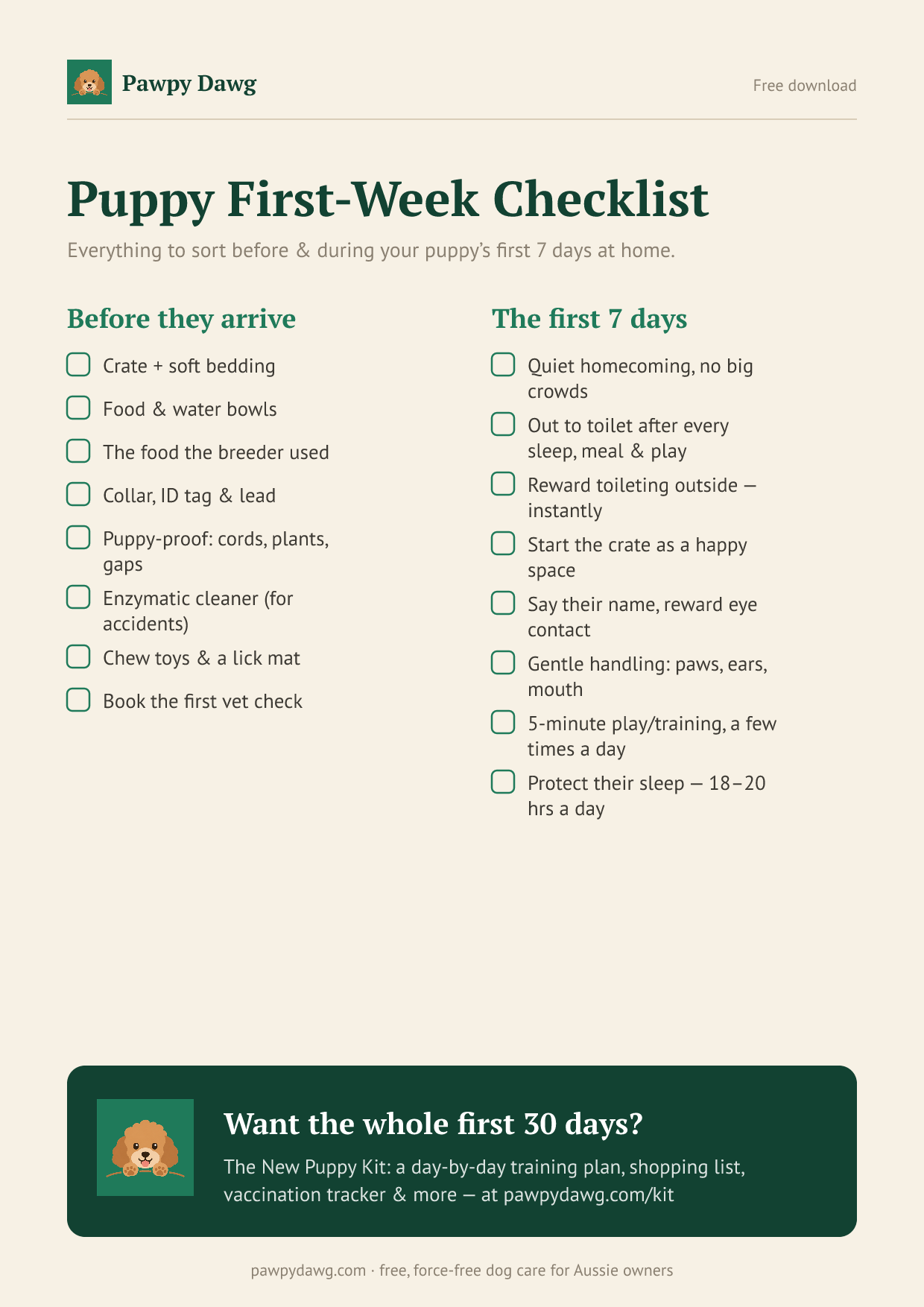
Free printable
Free: the Puppy First-Week Checklist
Everything to sort before and during your puppy's first 7 days home — a printable one-pager. Plus the occasional genuinely useful dog tip. No spam, unsubscribe anytime.
Related guides
Is Pet Insurance Worth It in Australia? The Honest Maths
Is pet insurance worth it in Australia? We crunch real premiums vs real vet bills — cruciate surgery, snake bite & more — so you can decide with confidence.
Read the guide →
How Much a Dog Really Costs Per Year in Australia (2026 Breakdown)
How much does a dog cost per year in Australia? 2026 line-item breakdown covering food, vet, insurance, grooming & the costs first-timers always miss.
Read the guide →
Dog Vaccination Schedule in Australia: What, When and What It Costs
Confused by C3, C5 and kennel cough? Here's your complete dog vaccination schedule Australia cost guide — puppy timelines, adult boosters & typical AUD prices.
Read the guide →