
Preparing Your Dog for a New Baby: A Month-by-Month Plan
Preparing your dog for a new baby doesn't have to be stressful. This month-by-month plan covers routines, boundaries, introductions, and safe habits for year one.

Written by Bradley Brown
Founder & editor · Reviewed 2026-11-10
If You Only Do Five Things, Do These
- Shift your dog's routine now — gradually move walk times, feeding times, and attention windows to match your post-baby schedule, at least six weeks before your due date.
- Teach a solid "go to your place" cue — a dog that can settle on a mat on request is safe around a newborn; a dog that can't, isn't.
- Make the nursery a calm, permissioned space — not forbidden, not a free-for-all. Teach your dog to enter only when invited and to settle quietly inside.
- Introduce baby sounds and smells before the birth — play recordings of crying, bring home a hospital blanket, use the new lotions and powders on yourself.
- Plan the first meeting deliberately — it takes ten minutes of thought beforehand and pays off for years.
Months Seven and Eight: Adjust the Routine Before You're Too Tired to Do It
The single biggest shock to a dog when a baby arrives isn't the baby — it's the collapse of the schedule they've relied on. If your dog currently gets a 7 am run and an hour of backyard play every afternoon, and those things suddenly disappear or shrink, you've got a stressed, confused dog on your hands exactly when you have zero capacity to deal with one.
What to do: Map out what your realistic dog-care routine will look like in the first three months postpartum. Then start living that routine now. If the morning walk is going to be 20 minutes instead of 45, make that change today. If a family member is going to take over afternoon feeding, hand it over now so your dog adjusts to the new person before life gets chaotic.
The common mistake: Owners overcompensate in late pregnancy — extra walks, extra cuddles, extra everything — out of guilt. This creates a peak that the post-birth drop feels even more dramatic against. Steady and predictable beats lavish then absent.
This is also the time to book any vet checks, update vaccinations, and sort out parasite prevention. A dog with an untreated skin condition or intestinal worms is a genuine hygiene concern around an infant.
Month Eight: Teach "Place" in Five Minutes a Day
A reliable settle cue is the most useful thing your dog can know when a baby is in the house. It means you can park your dog safely while you're feeding, while visitors are holding the baby, or while you're doing a nappy change on the floor.
How to build it:
- Pick a mat or bed and name it ("place," "bed," "mat" — whatever you'll remember under sleep deprivation).
- Lure your dog onto the mat, reward with a small treat the moment all four paws are on it.
- Build duration in short increments: five seconds, then ten, then thirty. Reward for staying, not for coming off.
- Practise in every room, including near the nursery.
Ten minutes a day across four to six weeks produces a dog that will genuinely hold a settle for several minutes. That's enough.
The common mistake: People practise "place" only in one spot, then are baffled when it doesn't transfer. Dogs don't generalise automatically — you need to practise in the lounge, the hallway, outside the nursery door.
Month Eight–Nine: The Nursery Is Not Off-Limits — It Has Rules
Banning your dog from the nursery entirely can create an obsession with getting in. A better approach is controlled access with clear rules: your dog may enter when you invite them and must settle when asked.
Spend a few sessions walking your dog calmly into the nursery on lead, letting them sniff, then asking for a settle on a mat you've placed inside. Reward calm behaviour. If they sniff the cot, let them, then redirect. The goal is "this is a boring, calm room" not "this is a forbidden mystery box."
Once the baby arrives, you can let your dog be in the room during feeding or settling — with supervision — which is far safer and calmer than a dog scratching at the door outside.
What to actually gate off: The cot, the bassinet, any surface the baby sleeps on. A pressure-mounted baby gate on the nursery door gives you the ability to let your dog see and smell without full access when you need that option.
Preparing for the Birth: The Sound and Smell Rehearsal
Dogs don't experience a newborn as "a small human." They experience a strange new creature that smells of amniotic fluid and vernix, makes high-pitched sounds at unpredictable intervals, and moves in jerky, unfamiliar ways. The more of this you can pre-load, the calmer the introduction.
Sounds: Search YouTube or Spotify for "newborn baby crying sounds" and play them at low volume during normal household activities — feeding your dog, watching TV. Gradually increase volume over a few weeks. The goal isn't desensitisation to trauma; it's just familiarity.
Smells: When the baby is born and before you bring them home, ask your partner or support person to bring home a muslin or wrap the baby has been swaddled in. Let your dog sniff it calmly — on the floor, no fuss. This registers the scent as "familiar and non-threatening" before the visual overwhelm of the actual baby.
Lotions and powders: Start using the baby's brand of nappy cream, talc-free powder, and wash on yourself during the last month. Your dog will associate those smells with you, which is reassuring when they smell them on the baby.
The First Introduction: Ten Minutes of Planning
| What to do | Why it matters |
|---|---|
| Come home without the baby first | Your dog gets to greet you with full excitement; that energy is discharged before the baby enters |
| Bring the baby in after the initial greeting settles | Calmer baseline for the dog when the baby appears |
| Keep the baby at adult height initially | Eye level introductions can feel confronting — start high |
| Let your dog approach and sniff from the side, not the face | Less threatening body language for both |
| Keep leads on for the first few interactions even indoors | Gives you an easy, calm way to redirect without grabbing |
| Watch body language, not behaviour | A still, stiff dog or whale eye is more concerning than excited sniffing |
Do not force closeness. If your dog wants to sniff and walk away, that is a win. The relationship builds over months, not minutes.
The First Year: Safe Habits That Become Second Nature
Zero unsupervised contact — ever, at any age in year one. This is the single non-negotiable. It doesn't mean your dog is dangerous; it means that even the gentlest dog can be startled, and an infant cannot protect themselves. Supervision means eyes on, in the same room, alert — not "I can hear them from the kitchen."
Floor time ground rules: Once your baby is on the floor (from around three to four months), teach your dog that floor time is a "four paws on the ground, no-jumping zone." Practise this before the baby is mobile, while stakes are low.
As the baby becomes mobile (six to twelve months): This is statistically the riskiest phase. A crawling baby approaches dogs in ways that look threatening — direct eye contact, reaching for the face, cornering. Teach your baby to approach from the side (yes, you teach both species). Give your dog multiple exit routes and never put them in a position where they feel trapped.
Reinforcing calm around the baby all year: Keep treating your dog for calm behaviour near the baby. A small treat when the dog settles near the pram, a quiet "good dog" when they lie calmly during a feed — these stack up. The dog learns that the baby predicts good things.
What to Expect Week by Week
Weeks 1–2: Your dog will likely be hypervigilant — sniffing everything, seeking reassurance, possibly clingy or slightly withdrawn. Both are normal stress responses. Maintain routine strictly.
Weeks 3–4: Most dogs begin to habituate to the sounds and smells. You'll notice them checking in less frantically and returning to normal sleep patterns.
Month 2: A settled dog starts to show curiosity rather than anxiety. They may position themselves near the baby's sleep area — this is typically guardian behaviour, not predatory.
Months 3–6: The relationship starts to form. Many dogs become visibly attentive to the baby's sounds and distress — again, normal and often sweet.
Month 6 onwards: Stay alert as the baby becomes mobile. Re-establish any boundaries that have slipped. This is worth a quick refresher on "place" and recall if either has gone rusty.
You have not ruined your dog by not doing this sooner. Dogs are adaptable, and a consistent few weeks of preparation — even starting late — makes a real difference. The plan above, done in five-to-ten minute sessions, is genuinely achievable when you're 36 weeks pregnant and exhausted. Start with the routine shift and "place," and the rest follows.
Frequently asked questions
How early should I start preparing my dog for a new baby?
Ideally start two to three months before your due date — this gives you time to shift routines gradually and teach key behaviours like a settle cue without rushing. That said, even four to six weeks of consistent preparation makes a meaningful difference, so starting late is still worth doing.
Should I keep my dog out of the nursery completely?
A total ban often backfires by making the nursery feel like a forbidden, fascinating space. A better approach is to allow supervised, calm access with clear rules — your dog enters when invited and settles on request. Gate off the cot and sleep surfaces, but let your dog learn that the nursery is a calm, boring room.
My dog is very excitable and jumpy — is it safe to bring a newborn home?
Yes, but it takes some preparation. The priority is teaching a reliable 'place' or settle cue and practising calm greetings before the birth. For the first introduction, discharge your dog's greeting energy by coming home alone first, then bring the baby in once your dog has settled. Keep a lead on during early indoor interactions for easy, calm redirection.
What dog body language should I watch for around my baby?
Calm sniffing, a loose body, and choosing to walk away are all positive signs. Watch for a stiff or still body, whale eye (whites of the eyes showing), a low tucked tail combined with fixation, or any low growl — these signal discomfort and mean you should calmly increase the distance between dog and baby. Never punish a growl; it's your dog's warning system.
How do I stop my dog from jumping on me while I'm holding the baby?
Practise the scenario before the birth — carry a swaddled doll or a bag at chest height and reward your dog for keeping four paws on the ground. Ask visitors to do the same during pregnancy. Once the baby is home, turn away and withhold all attention the moment jumping begins, and treat generously when your dog stays down.
Is it normal for my dog to be anxious or withdrawn after the baby comes home?
Yes, and it usually resolves within two to four weeks as your dog habituates to the new sounds, smells, and routine. Keep their schedule as consistent as possible, maintain short daily play or training sessions, and avoid inadvertently rewarding anxious behaviour with excessive reassurance. If anxiety persists beyond four weeks or escalates, speak with your vet or a certified dog trainer.
Free printable
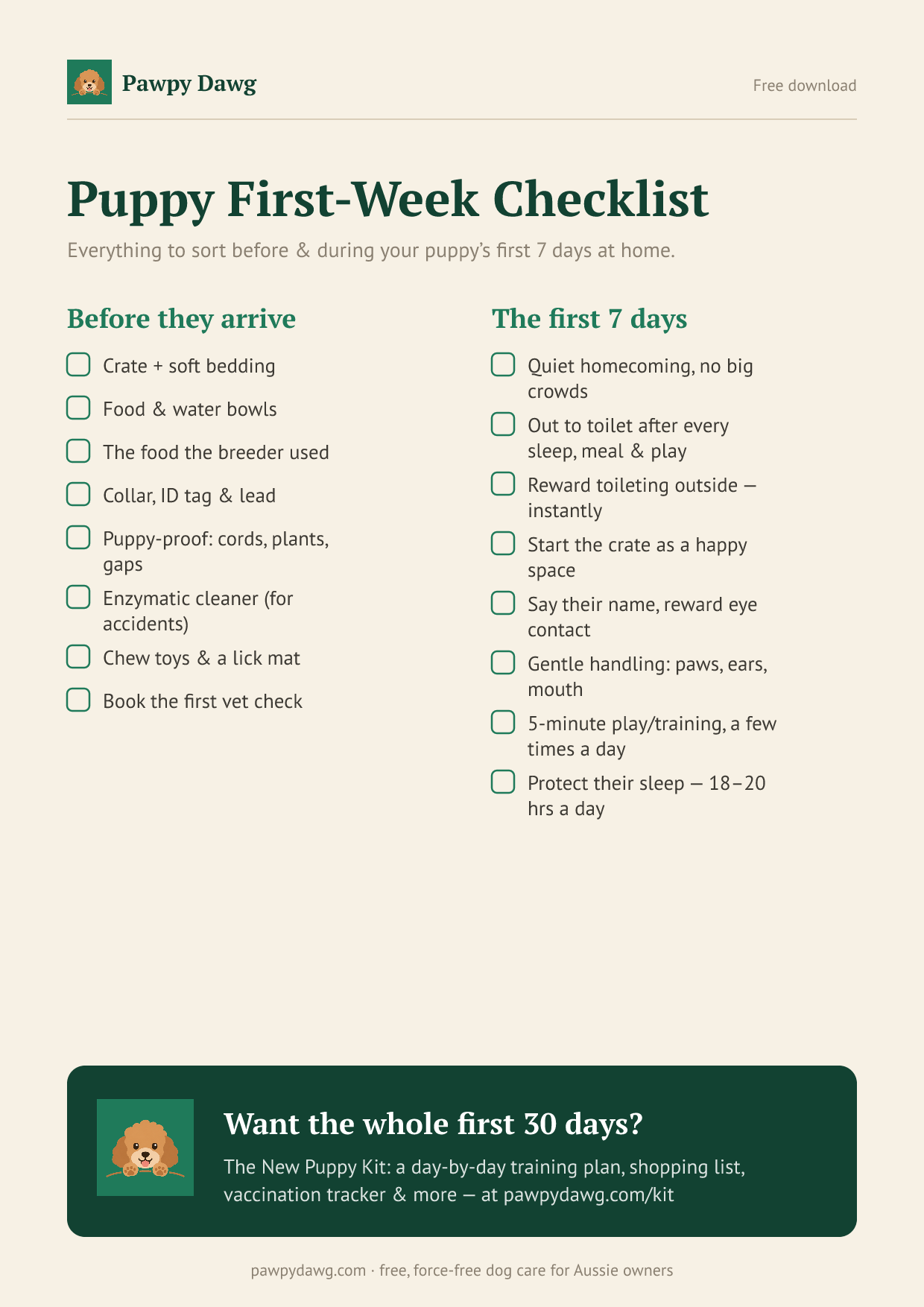
Free: the Puppy First-Week Checklist
Everything to sort before and during your puppy's first 7 days home — a printable one-pager. Plus the occasional genuinely useful dog tip. No spam, unsubscribe anytime.
Related guides
Is Pet Insurance Worth It in Australia? The Honest Maths
Is pet insurance worth it in Australia? We crunch real premiums vs real vet bills — cruciate surgery, snake bite & more — so you can decide with confidence.
Read the guide →
How Much a Dog Really Costs Per Year in Australia (2026 Breakdown)
How much does a dog cost per year in Australia? 2026 line-item breakdown covering food, vet, insurance, grooming & the costs first-timers always miss.
Read the guide →
Dog Vaccination Schedule in Australia: What, When and What It Costs
Confused by C3, C5 and kennel cough? Here's your complete dog vaccination schedule Australia cost guide — puppy timelines, adult boosters & typical AUD prices.
Read the guide →