
Lead Reactivity: Calming a Dog That Lunges at Other Dogs
Is your lead reactive dog lunging at other dogs on walks? Learn why it happens, how threshold works, and a week-by-week plan to fix it — fast.

Written by Bradley Brown
Founder & editor · Reviewed 2026-11-10
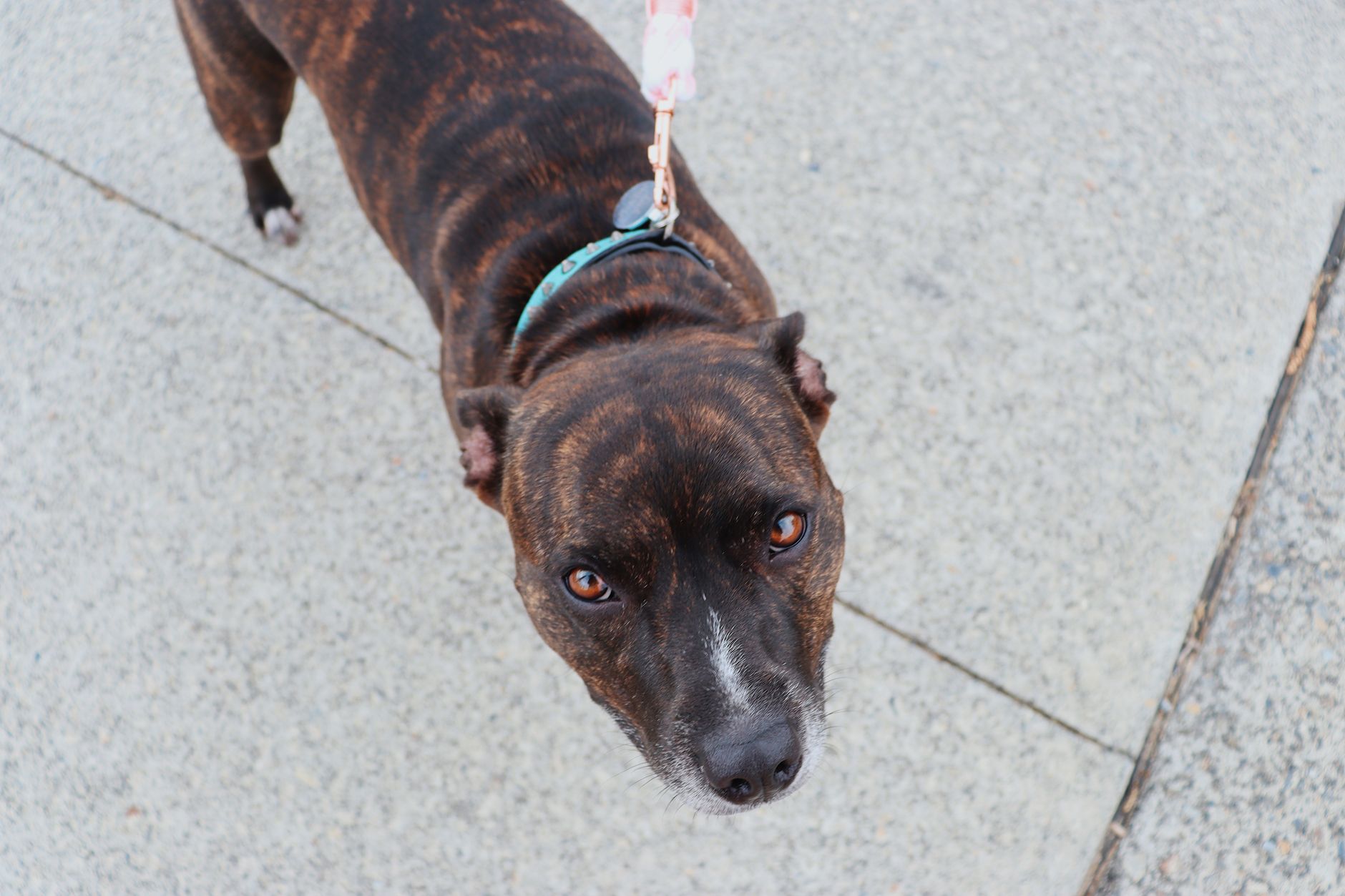
Priya walks her two-year-old Labrador, Mango, every morning before work along the shared path near the Darebin Creek in Melbourne. Most days it's fine — until another dog appears. The moment Mango spots one, he hits the end of the lead, barking and spinning like he's being attacked. Priya has started leaving the house at 5:45 am just to avoid other dogs. She's embarrassed, exhausted, and quietly convinced she's broken him.
She hasn't. Mango is a textbook lead reactive dog, and the behaviour makes complete sense once you understand what's actually happening inside his head.
What's really going on behind the lunging
Reactivity on lead is almost never about aggression. The vast majority of dogs that lunge and bark at other dogs are frustrated, frightened, or some mix of both. The lead itself is a big part of the problem.
Off lead, a dog like Mango has options. He can approach, sniff, do a wide arc, or walk away. On lead, all of those natural choices are removed. The lead creates a bottleneck: arousal rises, the dog can't do what his instincts tell him to do, and the pressure releases as a dramatic outburst. Veterinary behaviourists describe this as "barrier frustration" — the same mechanism that makes dogs bark at the fence.
Fear plays an equally common role. A dog that had limited socialisation as a puppy, had one frightening encounter with another dog, or is simply a more sensitive individual may interpret an approaching dog as a genuine threat. When you feel trapped and scared, you get loud. That's not a character flaw in Mango; it's a survival strategy.
Genetics can predispose certain dogs to higher general arousal or sensitivity, and some breeds are wired to react intensely to movement. That doesn't mean the behaviour is permanent — it means you need a plan that works with the dog in front of you.
Threshold: the concept that changes everything
Before any training makes sense, you need to understand threshold. Think of it as a dial inside your dog's brain. Below threshold, your dog notices a trigger (another dog) but can still think, take treats, and respond to you. Above threshold, the rational brain has gone offline — the dog is in full reactive mode and no learning is happening.
Every training session must happen below threshold. That's it. That's the whole game.
For Mango, threshold might be 30 metres on an open oval. For a more sensitive dog, it might be 50 metres, or only achievable when the other dog is stationary and partially hidden by a parked car. Distance is your most powerful tool. More distance = more thinking brain = more learning.
The mistake most owners make is trying to "work through it" by getting closer before the dog is ready. This floods the nervous system and usually makes reactivity worse over time, not better.
A four-week counter-conditioning plan
The goal is to build a reliable new association: other dog appears → great things happen for my dog. Over repetition, the sight of another dog stops predicting "threat" and starts predicting "rewards." This is called counter-conditioning, and it's the approach backed by mainstream veterinary behaviour guidelines worldwide.
Week 1 — Find the magic distance
Identify a spot where you can reliably see other dogs from far away. An oval with a dog-walking area works well, as does a quiet park bench set back from a path. Bring Mango's highest-value food — cooked chicken, fritz, cheese — not kibble. The moment he notices a dog in the distance but before any tension hits the lead, start feeding steadily: small piece after small piece until the other dog is gone or has moved away. When the dog disappears, the food stops. Dog appears → food rains down. Dog gone → food stops. Keep sessions to five minutes. Go home. That's enough.
Week 2 — Sharpen the marker
Add a consistent marker the instant Mango looks at the distant dog: a cheerful "yes!" or a click if you use a clicker. Then deliver the food. You're teaching him that noticing the other dog is the thing that earns the reward — this is crucial, because you want him to look at the trigger and then look back at you, not stare and escalate. Practice the same five-to-ten-minute sessions, still at a distance where he stays calm.
Week 3 — Very slow distance reduction
If Mango spent week 2 consistently below threshold (loose lead, taking food happily, offering eye contact), you can begin to reduce distance slightly — a few metres at a time, over multiple sessions. If he goes over threshold at any point, you've moved too fast. Add distance back and treat that session as a win for showing you useful information, not a failure.
Week 4 and beyond — Build real-world reps
Start applying the same approach on your regular walk routes, using distance and U-turns as your safety valves. When a dog appears unexpectedly close, do a cheerful "let's go!" and turn away briskly before Mango hits threshold. This isn't avoidance — it's intelligent management while the counter-conditioning catches up with real life.
Refer back to Priya: by week four, Mango was still noticing dogs but glancing back at her rather than erupting. She stopped leaving the house at dawn. Progress isn't linear, but it compounds.
Gear that helps — and what to ditch
A front-attach harness (such as a Halti, Ruffwear Front Range, or any well-fitted Y-harness with a front clip) reduces pulling and gives you more directional control without causing pain or fear. These are widely recommended by veterinary behaviourists as a humane management tool.
A head halter (Gentle Leader, Halti headcollar) can be very effective for strong dogs, but it must be introduced gradually with counter-conditioning of its own — many dogs hate them at first. Never jerk the lead when using a head halter; the neck torque can injure a dog.
What to avoid: prong collars, choke chains, and e-collars (shock collars). These add pain or fear to an already-anxious dog, and peer-reviewed research consistently links aversive tools to increased aggression and anxiety in reactive dogs. They may suppress the outburst temporarily while the underlying emotion gets worse. In several Australian states, e-collars are already restricted or under review.
A standard flat collar is fine for ID tags, but clip the lead to a harness, not the collar, for a reactive dog.
When to bring in a professional
If four to six weeks of consistent work hasn't moved the needle, or if your dog has made contact with another dog (even once), book a session with a certified, force-free behaviourist. Look for the letters CAAB, CPDT-KA, or a veterinary behaviourist (DACVB). A single professional session — typically $150–$250 AUD in metro areas — can recalibrate your approach and rule out underlying anxiety that might benefit from medication alongside training.
Mango isn't broken. Neither is your dog. Reactivity is one of the most common presentations veterinary behaviourists see, and it responds well to patient, structured work. Five minutes a day, the right distance, and the right rewards — that's genuinely all it takes to start turning this around.
As an Amazon Associate we earn from qualifying purchases.
Frequently asked questions
Can a lead reactive dog ever be fully cured?
Many dogs improve dramatically — to the point where owners stop noticing the problem in everyday life. 'Fully cured' is less useful a goal than 'reliably manageable.' Some dogs will always notice other dogs more than others do, but with counter-conditioning they learn to look at the trigger and then look back at you rather than explode. That's a genuinely good outcome.
My dog is fine off lead at the dog park — why does he go crazy on lead?
This is one of the clearest signs of barrier frustration rather than true aggression. Off lead, your dog can greet, sniff, and disengage on his own terms. On lead, those options disappear and the arousal has nowhere to go except outward. Many dogs that seem aggressive on lead are perfectly sociable the moment they're unclipped.
How long does it take to see results with counter-conditioning?
Most owners notice a meaningful change in four to eight weeks of consistent, short daily sessions — typically five to ten minutes. Progress depends on how long the behaviour has been practised, the dog's underlying anxiety level, and how reliably you can control the training environment. Dogs that have been reactive for years may take longer but still improve.
Should I use a no-pull harness or a head halter for my reactive dog?
Either can work well. A front-attach harness is usually easier to introduce and comfortable from day one. A head halter gives more control for very strong dogs but must be introduced slowly — most dogs need a week or two of pairing it with treats before they accept it calmly. Both are safer and more effective for reactive dogs than a collar alone.
Is my reactive dog dangerous? Will he bite another dog?
Most reactive dogs are reacting out of fear or frustration, not predatory intent, and many would retreat if they could. That said, any dog can bite under sufficient stress, so it's worth being cautious and keeping your dog below threshold during training. If your dog has a history of making contact with another dog, see a veterinary behaviourist sooner rather than later.
Can I use treats if my dog is too worked up to eat on walks?
If your dog won't take food, he's already over threshold — which means you're too close to the trigger. Move further away until he's calm enough to eat. The willingness to take food is one of the most reliable indicators that a dog is in a learning state. Use the highest-value food you can (cooked chicken is hard to beat) and always train before meals, not after.
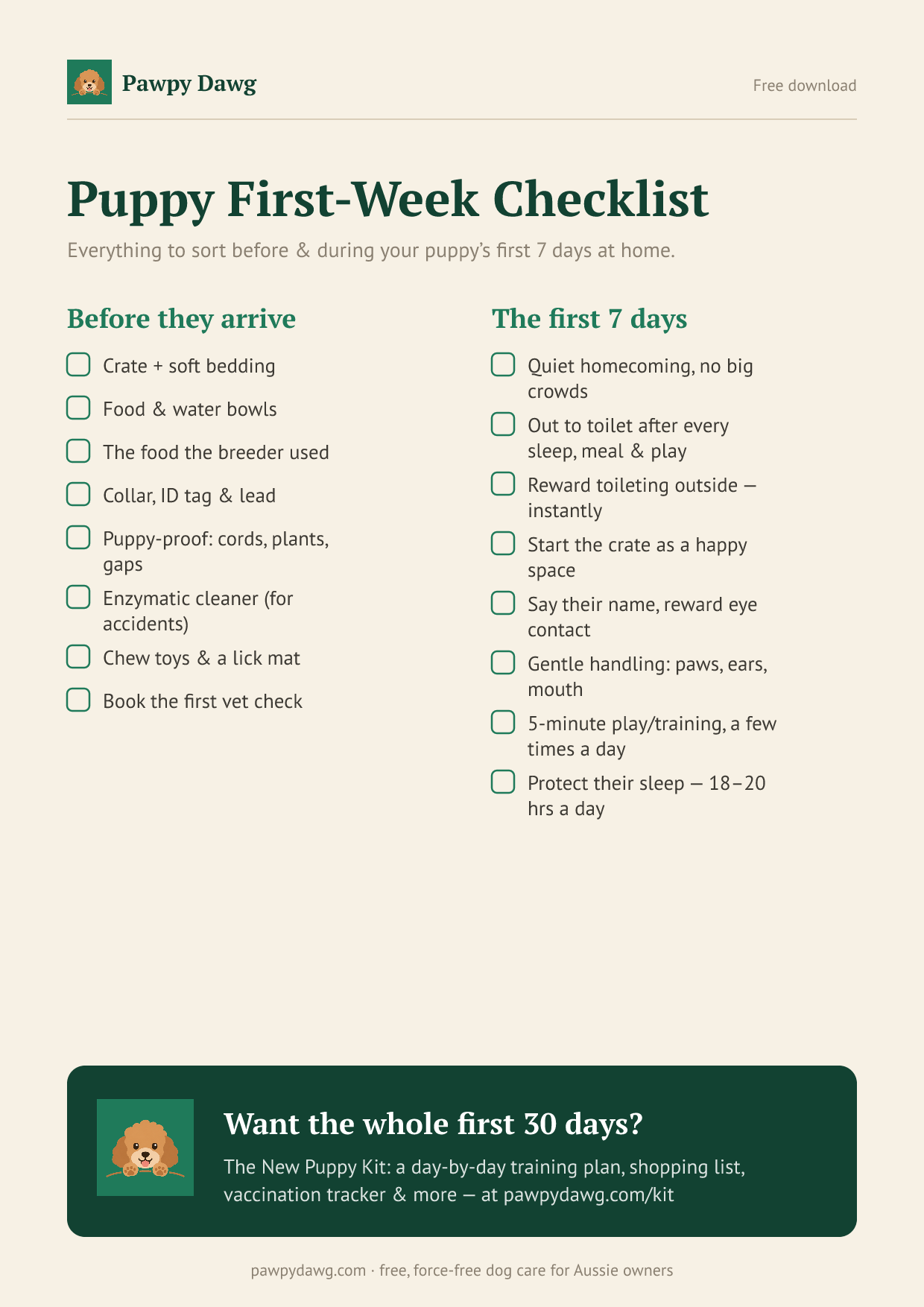
Free printable
Free: the Puppy First-Week Checklist
Everything to sort before and during your puppy's first 7 days home — a printable one-pager. Plus the occasional genuinely useful dog tip. No spam, unsubscribe anytime.
Related guides
Is Pet Insurance Worth It in Australia? The Honest Maths
Is pet insurance worth it in Australia? We crunch real premiums vs real vet bills — cruciate surgery, snake bite & more — so you can decide with confidence.
Read the guide →
How Much a Dog Really Costs Per Year in Australia (2026 Breakdown)
How much does a dog cost per year in Australia? 2026 line-item breakdown covering food, vet, insurance, grooming & the costs first-timers always miss.
Read the guide →
Dog Vaccination Schedule in Australia: What, When and What It Costs
Confused by C3, C5 and kennel cough? Here's your complete dog vaccination schedule Australia cost guide — puppy timelines, adult boosters & typical AUD prices.
Read the guide →