
How to Choose a Dog Bed: Size, Support and Chew-Proof Options
Not sure how to choose a dog bed? Here's how to measure your dog, pick the right style, and what's genuinely worth spending more on in the Australian climate.

Written by Bradley Brown
Founder & editor · Reviewed 2026-11-12
Buying a dog bed sounds straightforward until you're standing in a pet-store aisle surrounded by forty options, none of which are labelled in any way that reflects how your dog actually sleeps. This guide cuts through it.
Before you buy anything: measure the dog, not the packaging
Bed sizing on Australian retail packaging is inconsistent. "Large" at one brand is "medium" at another. The only reliable method is measuring your dog directly.
For dogs that sleep curled up, measure the diameter of the curl — nose to base of tail when they're balled up — then add 20–25 cm. That's your minimum internal diameter.
For dogs that sleep sprawled out (and many do, especially in warm weather), measure from the tip of the nose to the base of the tail when they're stretched flat, then add 30 cm. Width matters too: measure shoulder to shoulder at the widest point and add 15 cm each side.
Write those numbers down before you shop. Most owners skip this and buy something that looks right, then wonder why their dog keeps falling off the edge or hanging a leg over the side.
One more thing worth noting: a dog that currently sleeps in a tight curl may sprawl more as they age, especially if joint pain eases with a better surface. Sizing slightly generous is rarely a mistake.
Orthopedic beds: when the extra cost is justified
The word "orthopedic" is used loosely by manufacturers, but what you're actually looking for is high-density memory foam or a firm, supportive foam base — not the cheap egg-crate foam that collapses under any real weight within six months.
Genuine orthopedic beds are worth the investment (typically $120–$350 AUD) for:
- Dogs over seven years old
- Any dog with diagnosed hip dysplasia, arthritis, or elbow dysplasia
- Large and giant breeds, where joint wear starts earlier
- Dogs that have had orthopaedic surgery
For a healthy two-year-old Labrador in good condition, a mid-range supportive bed at $60–$100 is likely fine. Don't let marketing push you into spending more than the dog needs — but don't let price stop you if support is genuinely warranted.
The foam base should be at least 10 cm thick for medium dogs, 12–15 cm for large and giant breeds. Press it firmly with your palm: it should resist and slowly return, not compress flat.
Bolster, raised and flat: matching the style to the sleeper
Bolster beds (the ones with raised sides) suit dogs that like to press their back or head against something — many Greyhounds, Whippets, Beagles and anxious dogs sleep this way naturally. The bolster provides a sense of containment and warmth. The downside: they trap heat, which matters in an Australian summer.
Raised or elevated beds — a stretched fabric platform on a low frame — are excellent for warm climates and for dogs that run hot. Air circulates underneath, the surface stays cooler, and they're easy to hose down. They offer less pressure-point support than foam, so they're better suited to younger dogs or breeds without joint concerns. Good quality raised beds start around $60–$90 AUD and last well.
Flat or pillow-style beds are the most versatile. Combined with a quality foam insert, they work for most dogs in most situations. They're also the easiest to wash, which matters more than most people anticipate before they own one.
For dogs that sleep outside or in a laundry, a raised bed is often the smarter choice year-round — keeping them off cold concrete in winter and off baking surfaces in summer.
Australian heat: what this actually changes about your choice
Most dog-bed advice online is written for northern-hemisphere winters. In Australia, overheating is a far more common problem than cold, particularly for flat-faced breeds (Bulldogs, Pugs, French Bulldogs) and double-coated dogs (Huskies, Malamutes, Golden Retrievers).
Memory foam retains heat. If you're in Queensland, northern WA, or anywhere that sees extended periods above 30°C, a solid memory foam bed without a cooling cover will make a warm dog warmer. Options:
- Raised beds as the primary sleeping surface in summer, with a foam bed available in a cooler spot
- Gel-infused memory foam — legitimately cooler than standard foam, though the difference diminishes over time as the gel equilibrates
- Cooling covers or inserts — some work via water retention (keep them damp), others via phase-change materials. Quality varies. Wet-evaporative ones work better in drier climates; they're less effective in coastal humidity.
- Cotton or canvas covers rather than polyester — breathe better and feel cooler to lie on
If your dog actively seeks out tiles or floorboards over their bed in summer, the bed surface is probably too warm. That's feedback worth acting on.
Covers, washing and the smell problem
A dog bed that can't be fully washed is a problem you'll notice around week three. Sweat, dander, drool and mud accumulate fast.
Look for:
- A removable, zip-off cover that fits a standard washing machine
- Fabric rated for at least 60°C washing (kills dust mites)
- A foam insert with its own waterproof inner liner, or one that can be spot-cleaned and aired thoroughly
Avoid beds where the cover is sewn on, or where the foam insert has no protection and will soak through. This is the detail most people regret skipping.
Canvas and ripstop nylon covers hold up better over time than plush fabrics, which mat, pill and trap hair. Plush looks appealing in-store but is harder to keep clean.
Chew-proof options: realistic expectations
No bed is truly indestructible with a determined chewer, but some are significantly more resistant than others.
Elevated beds with a ballistic nylon or ripstop fabric platform are the most chew-resistant widely available option — the material is difficult to get purchase on, and the frame removes the satisfying "grab and pull" a dog gets from a loose fabric bed edge.
Chew-proof foam beds with reinforced covers (often PVC-coated or Cordura fabric) are worth considering for dogs that chew from anxiety rather than boredom — they still access the comfort of foam, just can't easily shred the cover.
If your dog is destroying beds, it's usually either separation anxiety, insufficient exercise, or an adolescent phase that resolves with time and training. A tougher bed buys time; it doesn't fix the cause.
Beds marketed as "chew-proof" with thin fleece or plush outer layers aren't. Check the material specifications, not the marketing language.
The last purchase: beds for older dogs
Senior dogs often need new beds because their old ones have compressed into uselessness — foam has a lifespan of roughly two to four years under daily use, and what once felt supportive is now just fabric over a vaguely foam-shaped object.
Signs a senior dog's bed needs replacing: they take a long time to settle, they get up stiffly, they're choosing hard floors over the bed, or they're reluctant to lie down at all. These can also be signs of pain warranting a vet visit, but a collapsed bed is an easy first check.
For a senior dog, invest in the orthopedic option. The price difference over a two-to-three year lifespan is negligible compared to the comfort it provides — and there's reasonable veterinary consensus that appropriate support reduces pressure on arthritic joints overnight, when dogs are stationary for eight or more hours at a stretch.
As an Amazon Associate we earn from qualifying purchases.
Free printable
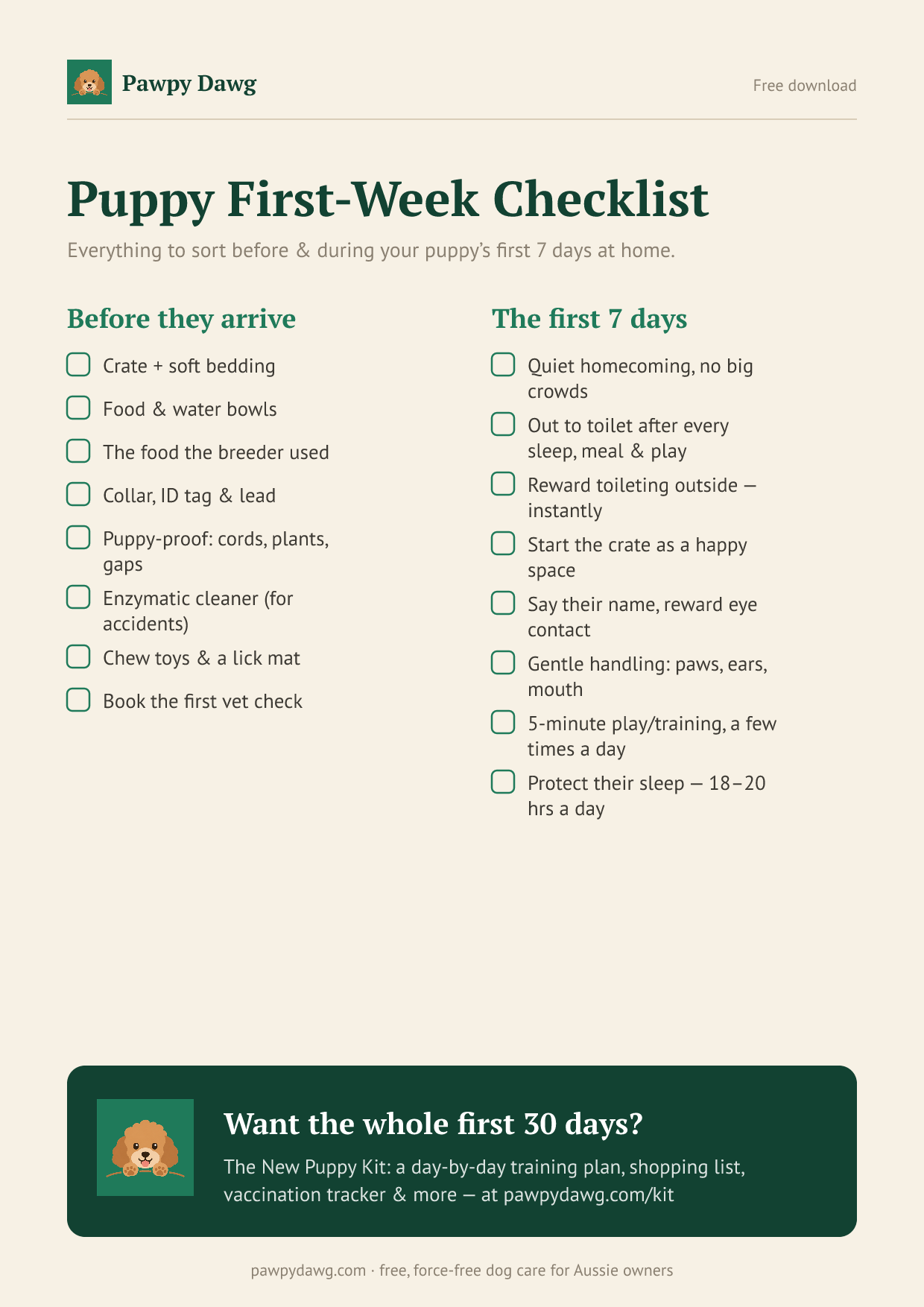
Free: the Puppy First-Week Checklist
Everything to sort before and during your puppy's first 7 days home — a printable one-pager. Plus the occasional genuinely useful dog tip. No spam, unsubscribe anytime.
Related guides
Is Pet Insurance Worth It in Australia? The Honest Maths
Is pet insurance worth it in Australia? We crunch real premiums vs real vet bills — cruciate surgery, snake bite & more — so you can decide with confidence.
Read the guide →
How Much a Dog Really Costs Per Year in Australia (2026 Breakdown)
How much does a dog cost per year in Australia? 2026 line-item breakdown covering food, vet, insurance, grooming & the costs first-timers always miss.
Read the guide →
Dog Vaccination Schedule in Australia: What, When and What It Costs
Confused by C3, C5 and kennel cough? Here's your complete dog vaccination schedule Australia cost guide — puppy timelines, adult boosters & typical AUD prices.
Read the guide →