
Flea and Tick Treatments for Dogs in Australia: Chews, Spot-Ons and Collars Compared
Chews, spot-ons or collars? Compare every flea and tick treatment for dogs in Australia — coverage, duration, monthly cost and how to avoid doubling up.

Written by Bradley Brown
Founder & editor · Reviewed 2026-11-07
The advice you'll see repeated endlessly in Facebook dog groups goes something like this: "Just grab a cheap supermarket spot-on — they all do the same thing." They don't. Some of the most widely sold products in Australian supermarkets and discount stores contain older actives like permethrin or pyrethrins that offer patchy flea control and virtually no protection against paralysis ticks (Ixodes holocyclus) — the tick that kills dogs on Australia's east coast every year. Picking the wrong product isn't a character flaw; the packaging looks similar and the marketing is deliberately vague. Here's what actually separates your options.
"Natural" or herbal treatments are safer and work just as well
Lavender sprays, tea-tree rinses, garlic supplements, diatomaceous earth — these get recommended constantly, especially in communities wary of chemicals. The reality is blunt: none has reliable, peer-reviewed evidence for flea or tick control in dogs, and some are actively dangerous. Tea-tree oil is toxic to dogs even at low concentrations. Garlic causes haemolytic anaemia. Diatomaceous earth can irritate airways and does nothing against ticks.
Meanwhile, modern registered parasiticides — the isoxazolines (fluralaner, afoxolaner, sarolaner, lotilaner) used in chews, and the synthetic spot-ons — have extensive safety data and are registered with the APVMA. "Safer" in this context means proven safe, not sounds natural. If your dog has had a reaction to a registered product, talk to your vet about alternatives in the same class rather than stepping down to something unproven.
One treatment covers everything — ticks, fleas, mites, worms, the lot
No single product does all of that, and chasing one that does often leads to unnecessary doubling up — or dangerous gaps. Here's how the main formats actually break down:
Oral chews (isoxazolines) Products like Bravecto (fluralaner), NexGard (afoxolaner), Simparica (sarolaner) and Credelio (lotilaner) are the gold standard for paralysis tick prevention in Australia. They work systemically — the active circulates in your dog's bloodstream, so any tick that bites is exposed to it. They kill fleas fast and control paralysis ticks, brown dog ticks and bush ticks.
What they don't cover: intestinal worms, heartworm, mange (some do, some don't — read the label), and ear mites. You'll still need a separate intestinal wormer and, in heartworm areas, a heartworm preventative.
Spot-ons Quality varies enormously here. Veterinary-grade spot-ons such as Advantix (imidacloprid + permethrin) repel and kill fleas and ticks, including paralysis ticks — but permethrin-based products are fatally toxic to cats, so they're not suitable in cat-owning households. Advocate (imidacloprid + moxidectin) covers fleas, heartworm, some mites and lungworm but offers no tick control — a critical point for anyone on the coast. Generic supermarket spot-ons with older actives often don't list paralysis tick on the label at all.
Flea collars The Seresto collar (imidacloprid + flumethrin) is the standout in this category — it has genuine evidence for flea and tick control, including paralysis tick, for up to eight months. Cheap generic collars with older pyrethroids have poor efficacy and are essentially decorative. The Seresto's main limitation is that it can be pulled off, chewed, or lost in water activities, so it needs regular checking.
Monthly chews are more expensive than spot-ons, so spot-ons make more sense financially
This one's worth unpacking with actual numbers, because "monthly" vs "quarterly" or "eight-monthly" changes the equation completely.
Rough monthly cost estimates across common Australian retail prices (vet clinics and online pharmacies vary):
-
Small dog (up to ~10 kg)
- Oral chew (monthly): ~$20–$28/month
- Oral chew (3-monthly, e.g. Bravecto): ~$15–$18/month
- Veterinary spot-on (monthly): ~$12–$18/month
- Seresto collar (8-month): ~$10–$13/month
-
Large dog (25–40 kg)
- Oral chew (monthly): ~$28–$38/month
- Oral chew (3-monthly): ~$20–$28/month
- Veterinary spot-on (monthly): ~$18–$26/month
- Seresto collar (8-month): ~$12–$15/month
The collar looks cheapest, but factor in that you'll still need a separate flea treatment if the dog swims frequently (water reduces efficacy), and you need to verify it covers paralysis tick in your region. Buying a spot-on plus a collar because you're unsure whether one is enough is a classic doubling-up trap — and it's money wasted at best, and a potential overexposure risk at worst.
If your dog is on a "complete" product, you don't need to check for ticks manually
This is the myth that costs lives. Even the best-registered paralysis tick products — chews, spot-ons, collars — are not 100% effective 100% of the time. Australian veterinary guidelines recommend daily tick searches throughout tick season (spring through autumn, though ticks are active year-round in warmer coastal areas) regardless of what preventative your dog is on.
Run your fingers slowly through the coat against the grain, paying particular attention to the head, neck, ears, between the toes and around the collar line. A paralysis tick attached for under 24 hours is far less likely to cause serious toxicosis than one that's been feeding for three or four days.
What to actually do
- Know your region. If you're in a paralysis tick zone (coastal NSW, QLD, Victoria's east coast, parts of SA and WA), tick protection must be explicitly listed on the label — not implied.
- Choose one primary product registered for paralysis tick if you need it, then add separate cover only for what that product misses (e.g., an intestinal wormer, a heartworm preventative).
- Check the APVMA registration label, not just the marketing claim. "Tick control" and "paralysis tick" are not the same thing.
- Stick to the interval. A chew given on day 32 instead of day 28 creates a gap. Set a phone reminder.
- Talk to your vet if your dog has epilepsy or a known neurological condition — the isoxazoline class carries a small risk of neurological side effects in sensitive individuals, and your vet can help weigh that up.
The best flea and tick treatment for dogs in Australia is the one that covers what your dog is actually exposed to, that you give on time, every time — and that you back up with a quick daily hands-on check during tick season.
Frequently asked questions
What is the best paralysis tick prevention for dogs in Australia?
Oral isoxazoline chews (Bravecto, NexGard, Simparica, Credelio) are considered the most reliable paralysis tick prevention available in Australia. They work systemically, so any tick that bites is exposed to the active ingredient. Veterinary-grade spot-ons like Advantix and the Seresto collar are also registered for paralysis tick and are good alternatives, particularly if your dog won't take tablets.
Can I use a flea collar and a spot-on at the same time?
Generally, you should avoid combining two products that contain the same class of active ingredients, as this can lead to overexposure without extra benefit. If you're using a Seresto collar for tick and flea control, adding a permethrin-based spot-on on top is unnecessary doubling up. If you feel your current product has a gap, speak to your vet about a targeted addition rather than layering two full-coverage products.
Are isoxazoline chews (like NexGard or Bravecto) safe for all dogs?
Isoxazolines are safe for the vast majority of dogs and have extensive safety data behind them. However, the product inserts carry a warning for dogs with a history of seizures or neurological conditions, as a small number of sensitive individuals have experienced neurological side effects. If your dog has epilepsy or a known neurological condition, discuss the choice with your vet before starting.
Do I still need to check for ticks if my dog is on a tick prevention product?
Yes — no product offers 100% protection, and Australian veterinary guidelines recommend daily tick searches throughout tick season regardless of what preventative you use. Focus on the head, neck, ears, between the toes and around the collar line. Finding and removing a tick early — before it has fed for 24–48 hours — significantly reduces the risk of paralysis.
Is Advantix safe to use if I also have a cat at home?
No. Advantix contains permethrin, which is fatally toxic to cats. Even indirect contact — such as a cat grooming a recently treated dog — can be lethal. If you have cats in the household, choose a permethrin-free product such as an oral isoxazoline chew or the Seresto collar, and confirm the ingredients with your vet or the product label.
How often do I need to worm my dog if they're already on a flea and tick chew?
Most flea and tick chews (NexGard, Bravecto, Simparica, Credelio) do not cover intestinal worms, so you still need a separate intestinal wormer every three months for adult dogs. Some combination products — like NexGard Spectra or Simparica Trio — add intestinal worm and heartworm cover to the isoxazoline base, which can simplify your routine. Always check the specific product label to know exactly what's covered.
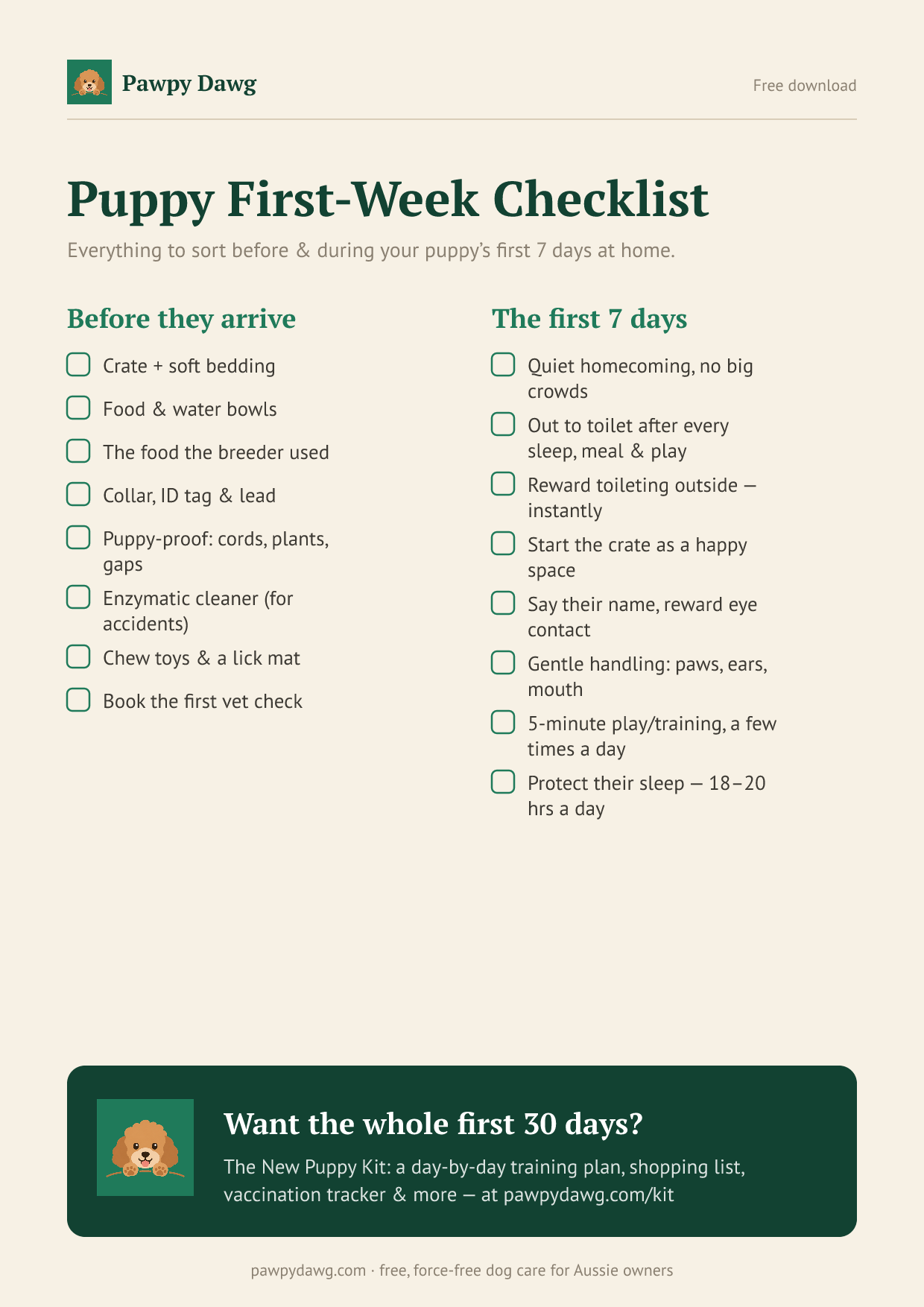
Free printable
Free: the Puppy First-Week Checklist
Everything to sort before and during your puppy's first 7 days home — a printable one-pager. Plus the occasional genuinely useful dog tip. No spam, unsubscribe anytime.
Related guides

Is Pet Insurance Worth It in Australia? The Honest Maths
Is pet insurance worth it in Australia? We crunch real premiums vs real vet bills — cruciate surgery, snake bite & more — so you can decide with confidence.
Read the guide →
How Much a Dog Really Costs Per Year in Australia (2026 Breakdown)
How much does a dog cost per year in Australia? 2026 line-item breakdown covering food, vet, insurance, grooming & the costs first-timers always miss.
Read the guide →
Dog Vaccination Schedule in Australia: What, When and What It Costs
Confused by C3, C5 and kennel cough? Here's your complete dog vaccination schedule Australia cost guide — puppy timelines, adult boosters & typical AUD prices.
Read the guide →